Can I Sue My Own Insurance Company in Missouri?
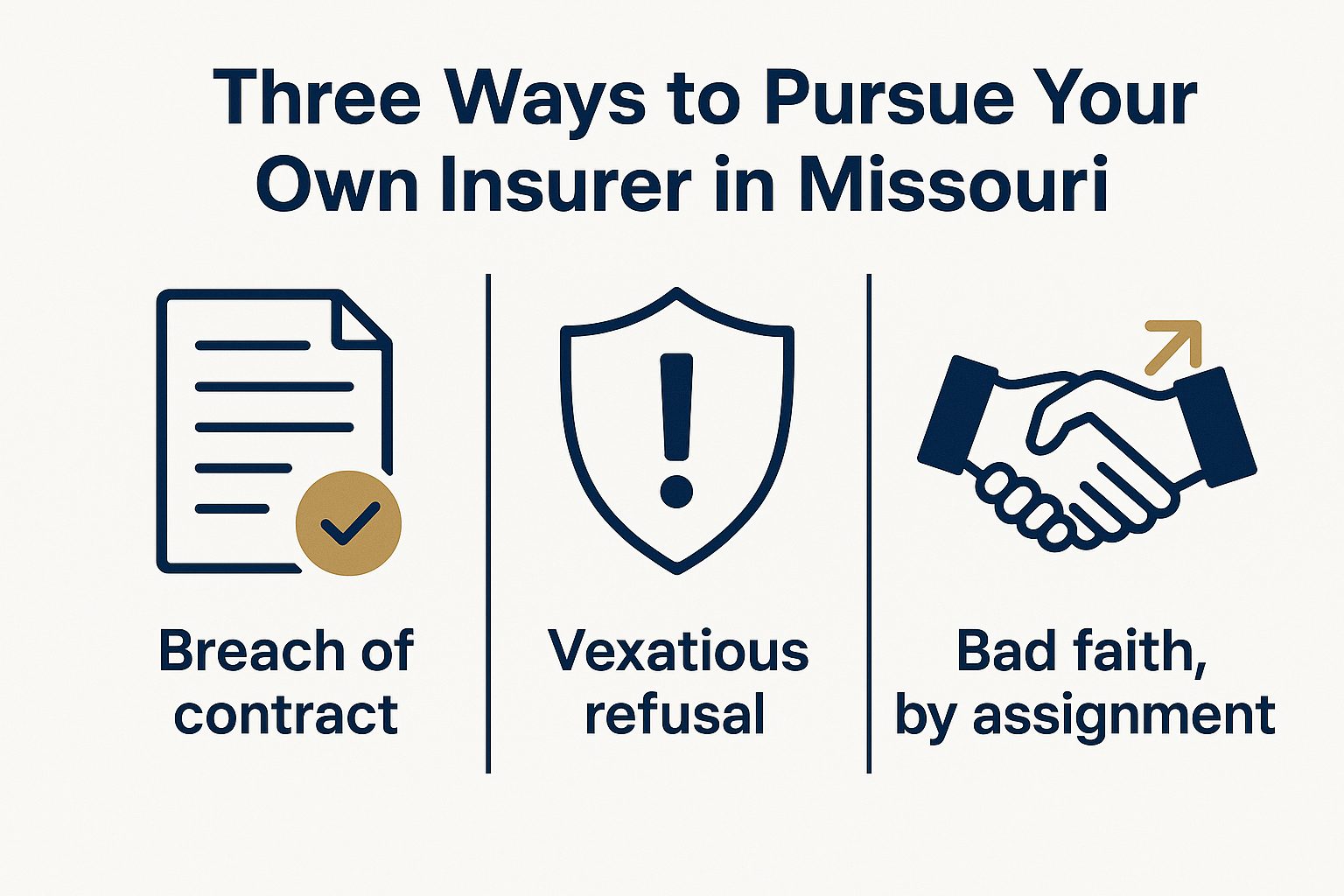
Yes. In Missouri you can bring a claim against your own insurance company, and it happens more often than most people expect. When your insurer owes you money under a policy you paid for and refuses to pay it, delays it, or offers far less than the policy covers, you have the right to pursue that money. The most common example is an uninsured or underinsured motorist (UM/UIM) claim after a crash, where your own coverage is the source of your recovery. If your insurer will not honor that coverage in good faith, Missouri law gives you ways to hold it to the contract.
This page explains when you can sue your own insurer in Missouri, the difference between an ordinary coverage disagreement and a refusal the law treats as improper, and what to realistically expect. If your own carrier is stalling on a claim, our Liberty office serves Clay County and the north Kansas City metro and offers a free case review at 816-367-6937.
When you can pursue your own insurer
A claim against your own insurance company is called a first-party claim. You are the party to the contract, you paid the premiums, and you are asking the company to perform its side of the agreement. That is different from a third-party claim, where you pursue the at-fault driver and that driver's liability insurer.
First-party disputes in a Missouri auto case usually involve one of these coverages.
Uninsured motorist (UM) coverage
UM coverage applies when the driver who hurt you had no insurance, or in a hit-and-run where the at-fault driver is never identified. UM coverage is mandatory in Missouri, so if you carry auto insurance in this state, you carry UM coverage. When you make a UM claim, you are, in effect, standing in the shoes of the person who hit you and asking your own insurer to pay what that uninsured driver should have paid. Your insurer becomes your adversary on the value of the claim, which is why UM disputes so often end up as claims against your own carrier.
Underinsured motorist (UIM) coverage
UIM coverage applies when the at-fault driver had some liability insurance, but not enough to cover your injuries. UIM is optional in Missouri, so whether you have it depends on the policy you bought. If you do, and your damages exceed the at-fault driver's limits, your UIM coverage can make up part of the difference under the terms of your policy.
Med pay and other first-party benefits
Medical payments (med pay) coverage is optional in Missouri and pays certain medical bills regardless of fault. Missouri has no PIP or no-fault system, so there is no mandatory personal injury protection layer the way some states have. If you bought med pay and your insurer refuses to apply it, that too is a first-party matter.
In each of these situations, the money comes from your own policy, and the dispute is between you and your insurer over what the contract requires.
A UM/UIM claim is a contract claim, and the deadline reflects that
Because a UM/UIM claim asks your insurer to perform a written contract, Missouri treats it as a contract action. The statute of limitations for a written-contract claim in Missouri is 10 years under RSMo 516.110. That is a longer window than the 5-year deadline that applies to the underlying negligence claim against the at-fault driver.
Do not read the 10-year figure as a reason to wait. Your policy still requires prompt notice and cooperation, evidence disappears, and delay makes any claim harder to prove. The point is only that a first-party coverage claim and a tort claim against the other driver run on different clocks, and confusing the two can cost you rights. For how UM and UIM coverage works in Missouri from the ground up, see our overview of Missouri uninsured and underinsured motorist claims.
Two ways to pursue a first-party insurer in Missouri
When your own insurer will not pay a covered claim, Missouri gives a policyholder two primary remedies. The first is a breach-of-contract claim on the policy itself: you are suing to recover the benefits the contract says you are owed. The second is a vexatious-refusal claim, which addresses the manner of the refusal and can add a penalty on top of those benefits when the refusal was unreasonable.
One point often confuses people. Missouri does not recognize a separate first-party common-law bad-faith tort against your own insurer. In other words, you cannot sue your own carrier for "bad faith" as a standalone tort the way some states allow. Missouri's answer to an insurer that mishandles a first-party claim is the vexatious-refusal statutes, which function as the state's quasi-bad-faith remedy, working alongside the ordinary contract claim.
Vexatious refusal to pay: Missouri's main tool when an insurer stonewalls
Filing a claim under your policy is one thing. What happens when your insurer refuses to pay a valid claim, or drags it out, without a good reason? Missouri's statutory remedy for that is vexatious refusal to pay, governed by RSMo 375.420 and its companion provision RSMo 375.296.
Vexatious refusal penalizes an insurer that refuses to pay a covered claim without reasonable cause or excuse. If a policyholder proves the refusal met that standard, the statute allows recovery beyond the policy benefits themselves. That recovery takes the form of an additional statutory penalty on top of the benefits owed, plus the policyholder's reasonable attorney fees. The exact way the penalty is calculated is set out in RSMo 375.420. The purpose is to make it costly for an insurer to sit on a valid claim and force the insured to litigate for money that was plainly owed.
An ordinary coverage dispute is not the same as vexatious refusal
This distinction matters, and it is easy to get wrong.
Insurers are allowed to disagree with you. If there is a genuine, arguable question about whether coverage applies, how much your claim is worth, or whether the policy language reaches your situation, the insurer can take a position and litigate it. A reasonable dispute over value or coverage is a coverage dispute, not misconduct. In that scenario you may still recover the benefits you are owed, but the extra penalty for vexatious refusal generally will not be on the table, because the insurer had a reasonable basis to disagree.
Vexatious refusal is different in kind. It targets a refusal made without reasonable cause or excuse, where the insurer is not genuinely disputing the claim so much as declining to pay something it owes. Where the line falls depends on the record: the claim file, the policy, and how the insurer actually handled the claim. That record is the first thing we review.
What "bad faith failure to settle" is, at a high level
You will also hear the phrase bad faith in the insurance context, and it is worth understanding because it is often confused with vexatious refusal.
Bad faith failure to settle is a third-party concept. It arises when a liability insurer, defending its own insured against someone else's claim, fails to settle within policy limits when it reasonably should have, and then exposes its insured to a judgment above those limits. That is a duty the insurer owes to the person it is defending, not to the injured claimant directly.
Here is the wrinkle that brings it back around to the injured person. When an at-fault driver is exposed to an excess judgment because that driver's insurer refused a reasonable settlement, the at-fault driver may assign the resulting bad-faith claim to the injured party as part of resolving the case. Through that assignment, what started as a third-party matter can end up in the hands of the injured person. This is a real mechanism in Missouri practice, but it is nuanced, and how and whether it fits a given case is an attorney judgment.
The practical takeaway is that "suing your own insurance company" can mean several different things: a first-party breach-of-contract claim, a vexatious-refusal claim added on top when the refusal was unreasonable, or, in the assignment scenario, a bad-faith claim that has come to you from the at-fault driver. Which of these fits depends entirely on the facts.
Many disputes with your own insurer come down to a settlement offer that is lower than the claim is worth. This short video walks through how low offers are typically made and how they are usually answered.
Before you sue: the Missouri complaint route
Litigation is not always the first step. Missouri policyholders can file a complaint with the Missouri Department of Commerce and Insurance, the state regulator that oversees insurers, and can reach its Insurance Consumer Hotline at 800-726-7390. A regulatory complaint does not replace a legal claim and it will not, by itself, force payment of your damages, but it creates a record and sometimes prompts an insurer to take a stalled claim seriously. It is one tool among several, and it is worth knowing it exists.
Realistic expectations
A first-party claim against your own insurer is a normal, legitimate part of the auto-injury landscape in Missouri, not a long shot. That said, no attorney can promise a result. The outcome depends on your policy language, the strength of the underlying injury claim, how the insurer actually handled the file, and whether a court would view any refusal as reasonable or not. Some claims resolve once the insurer sees the case is being taken seriously; others require litigation. What we can tell you is what your options are and how the process tends to unfold.
Talk to a Missouri attorney
If your own insurer is delaying, denying, or lowballing a claim, and you are in Clay County or the north Kansas City metro, our Liberty office is available for a free case review. We handle Missouri auto, UM/UIM, and coverage disputes, and we can walk through your policy and the insurer's conduct with you.
Call 816-367-6937 to talk with our Liberty office. If you were injured in a crash and are still sorting out who to pursue, our overviews of what to do after a Liberty car accident and a Kansas City car accident are a good place to start.
This page is general information about Missouri law, not legal advice, and it does not create an attorney-client relationship. Every claim turns on its own facts.
Frequently asked questions
Can I sue my own insurance company in Missouri?
Yes. You can bring a first-party claim against your own insurer when it owes you money under your policy and refuses to pay, delays, or underpays. The most common example is an uninsured or underinsured motorist (UM/UIM) claim after a crash.
Why would I sue my own insurer instead of the other driver?
Because sometimes your own policy is the source of the money. If the at-fault driver had no insurance or too little, your UM or UIM coverage is what pays, and your own insurer decides what to offer. When it will not pay what the policy covers, the claim is against your carrier.
What is vexatious refusal to pay in Missouri?
It is Missouri's statutory remedy, under RSMo 375.420 and 375.296, aimed at an insurer that refuses to pay a covered claim without reasonable cause or excuse. If proven, it allows recovery beyond the policy benefits, in the form of an additional statutory penalty plus the policyholder's reasonable attorney fees.
Can I sue my own insurer for bad faith in Missouri?
Not as a standalone tort. Missouri does not recognize a separate first-party common-law bad-faith claim against your own insurer. Instead, the two primary remedies against a first-party insurer are a breach-of-contract claim on the policy and a vexatious-refusal claim, which serves as Missouri's quasi-bad-faith remedy.
Is a coverage disagreement the same as vexatious refusal?
No. An insurer is allowed to dispute a claim if it has a reasonable, arguable basis. That is a coverage dispute. Vexatious refusal targets a refusal made without reasonable cause or excuse. Which side of the line a refusal falls on depends on how the insurer handled your claim.
How long do I have to bring a UM/UIM claim in Missouri?
A UM/UIM claim is a written-contract claim, and Missouri's statute of limitations for written contracts is 10 years under RSMo 516.110. The separate negligence claim against the at-fault driver runs on a shorter 5-year clock. Do not wait; prompt notice and preserved evidence matter regardless of the deadline.
What does it cost to have a lawyer review my claim?
Our Liberty office offers a free case review. Call 816-367-6937 to discuss a delayed, denied, or underpaid claim.
Author Bio

Kevin A. Jones | Personal Injury Lawyer
Kevin A. Jones, founder and managing attorney of Empower Injury Law, has been practicing law since 2009. With over $25 million in jury verdicts and settlements in his first decade, Kevin has earned a reputation as a fierce advocate for his clients.
Kevin’s approach to law is rooted in his passion for helping people who have been mistreated by corporations, insurance companies, and other powerful entities.
Whether representing individuals wronged by negligent drivers or those injured on someone else’s property, Kevin is dedicated to achieving justice. His extensive experience in the courtroom ensures that clients receive strong, personalized representation that delivers results.
Practice Areas


