If someone (an insurance adjuster, the other driver, a police report) has told you that you were partly at fault for a car accident in Missouri, that does not automatically end your claim. Missouri follows a rule called pure comparative fault. Under it, an injured person can still recover money even when they were partly, or even mostly, responsible for the crash. Your recovery is reduced by your own percentage of fault, but there is no cutoff percentage that bars you completely. It is one of the questions we hear most often at our Liberty office, which serves Clay County and the Northland.
This is general information about Missouri law, not legal advice about your specific case. Every crash turns on its own facts.
The short answer
Missouri is a pure comparative fault state. If you are found partly at fault for a car accident, you can still recover damages, and the amount you recover is reduced in proportion to your share of the fault. If a jury or adjuster assigns you 30 percent of the fault, you recover 70 percent of your damages. If they assign you 80 percent, you still recover 20 percent. There is no threshold at which your own fault wipes out your claim.
That last point is what makes Missouri different from many neighboring states, including Kansas, which cut off recovery once your fault reaches a set percentage. Missouri's answer does not carry across the state line. If your crash happened across the state line, the rule is not the same, and you should not assume Missouri's answer applies.
What pure comparative fault means in Missouri
Comparative fault is the system courts use to divide responsibility for an accident among everyone involved, including the injured person. In a Missouri car accident case, the fact-finder (usually a jury, or an adjuster negotiating a settlement in the shadow of what a jury would likely do) assigns a percentage of fault to each party. Those percentages add up to 100.
The word "pure" describes what happens next. In a pure comparative fault system, your percentage of fault only reduces your recovery. It never eliminates it. A plaintiff who is 90 percent at fault can still collect 10 percent of their damages from a defendant who was 10 percent at fault. That result strikes some people as surprising, but it is the settled rule in Missouri.
Where the rule comes from
Missouri's pure comparative fault rule for ordinary negligence claims, which is what most car accident cases are, comes from a decision of the Missouri Supreme Court, not from a single statute you can look up. In Gustafson v. Benda, 661 S.W.2d 11 (Mo. banc 1983), the court replaced Missouri's old contributory negligence rule (under which any fault by the injured person barred recovery entirely) with pure comparative fault.
If you come across an article that ties Missouri's negligence comparative fault rule to a specific statute number, read it carefully. The general negligence rule traces to case law from Gustafson, and getting that authority right matters. We link the opinion above so you can read the source yourself.
How your fault percentage reduces what you recover
The mechanics are straightforward once you see them in numbers. The outcome rests on:
1. The total dollar value of your damages (medical bills, lost income, future care, pain and suffering, and other losses the law allows). 2. Your percentage of fault for the crash.
Your recovery is your total damages minus your share of the fault. The formula is your damages multiplied by (100 percent minus your fault percentage).
A worked example
Suppose you were hurt in a crash at an intersection in the Northland. After treatment, lost work, and everything else, your total damages come to $100,000.
The other driver ran a stale yellow light, but you were also going a bit over the limit and could have braked sooner. The fact-finder decides you were 25 percent at fault and the other driver was 75 percent at fault.
Under Missouri pure comparative fault, you recover 75 percent of $100,000, which is $75,000. The $25,000 reduction reflects your 25 percent share.
Now change the facts. Say the same $100,000 in damages, but this time the fact-finder decides you were 60 percent at fault. In many states with a modified system, being more than half at fault would end your claim. In Missouri, it does not. You still recover 40 percent of $100,000, which is $40,000. The percentage went up, so your recovery went down, but it did not disappear.
Who decides my percentage of fault?
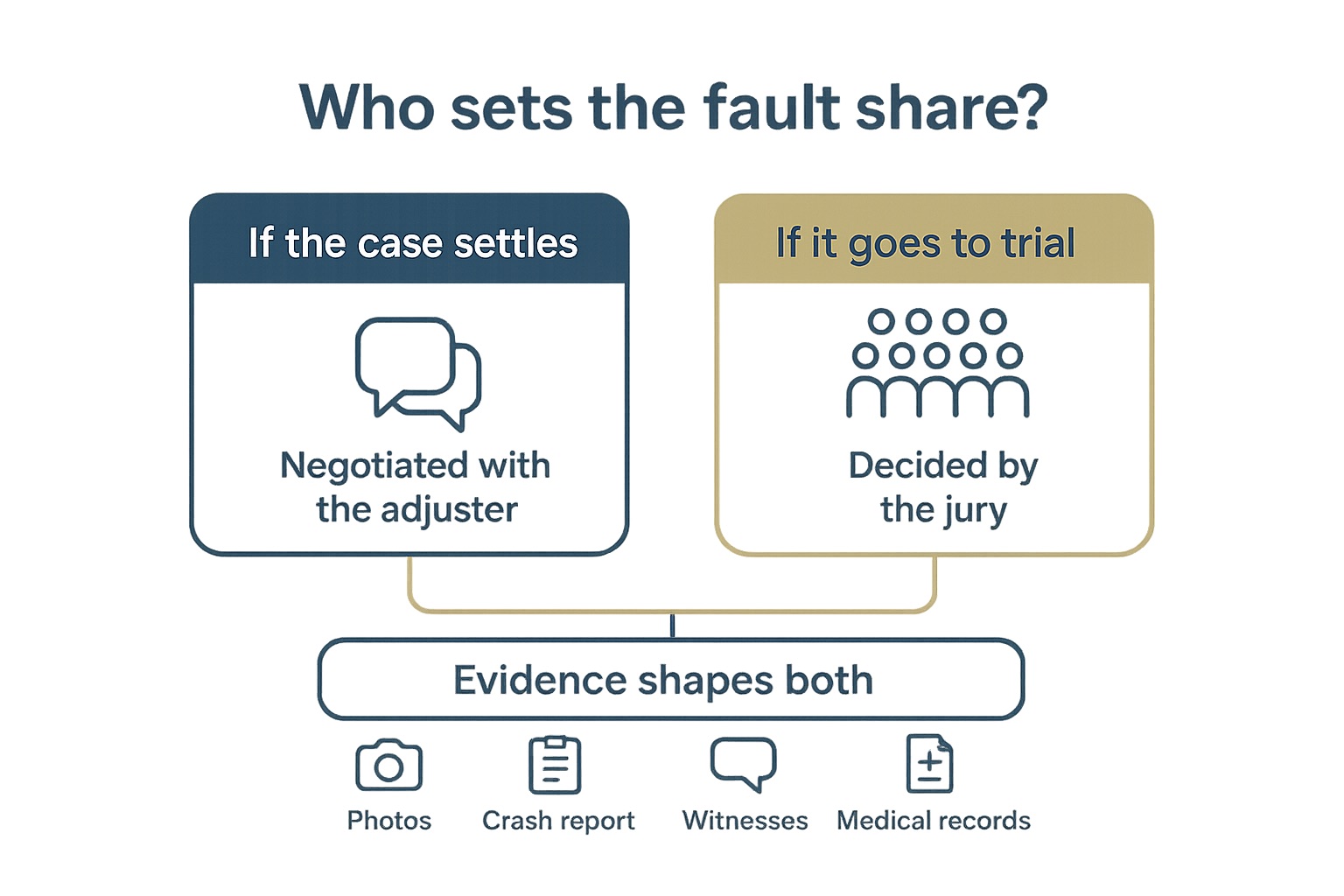
If your case settles, which most car accident cases do, the fault percentages are effectively negotiated. The insurance adjuster forms a view of how a jury would likely divide fault, and that view shapes the offer. A well-documented claim (photos, the crash report, witness statements, medical records) gives you a stronger position in that negotiation.
If your case does not settle and goes to trial, the jury decides the percentages after hearing the evidence, guided by the court's instructions. The jury finds your total damages first, then assigns the fault shares, and the court applies the reduction.
Because so much rides on that percentage, disputes about fault are often the heart of a car accident case. An adjuster who assigns you a high share of fault is reducing what they have to pay. Push back with evidence when the number does not match what happened.
What if more than one other driver was at fault?
Missouri car accidents sometimes involve several vehicles or several potentially responsible parties. Fault can be divided among all of them, and among you. How the shares are allocated and how each defendant's obligation is calculated in a multi-defendant case can get technical, and it turns on the evidence against each party.
Common situations where fault gets disputed
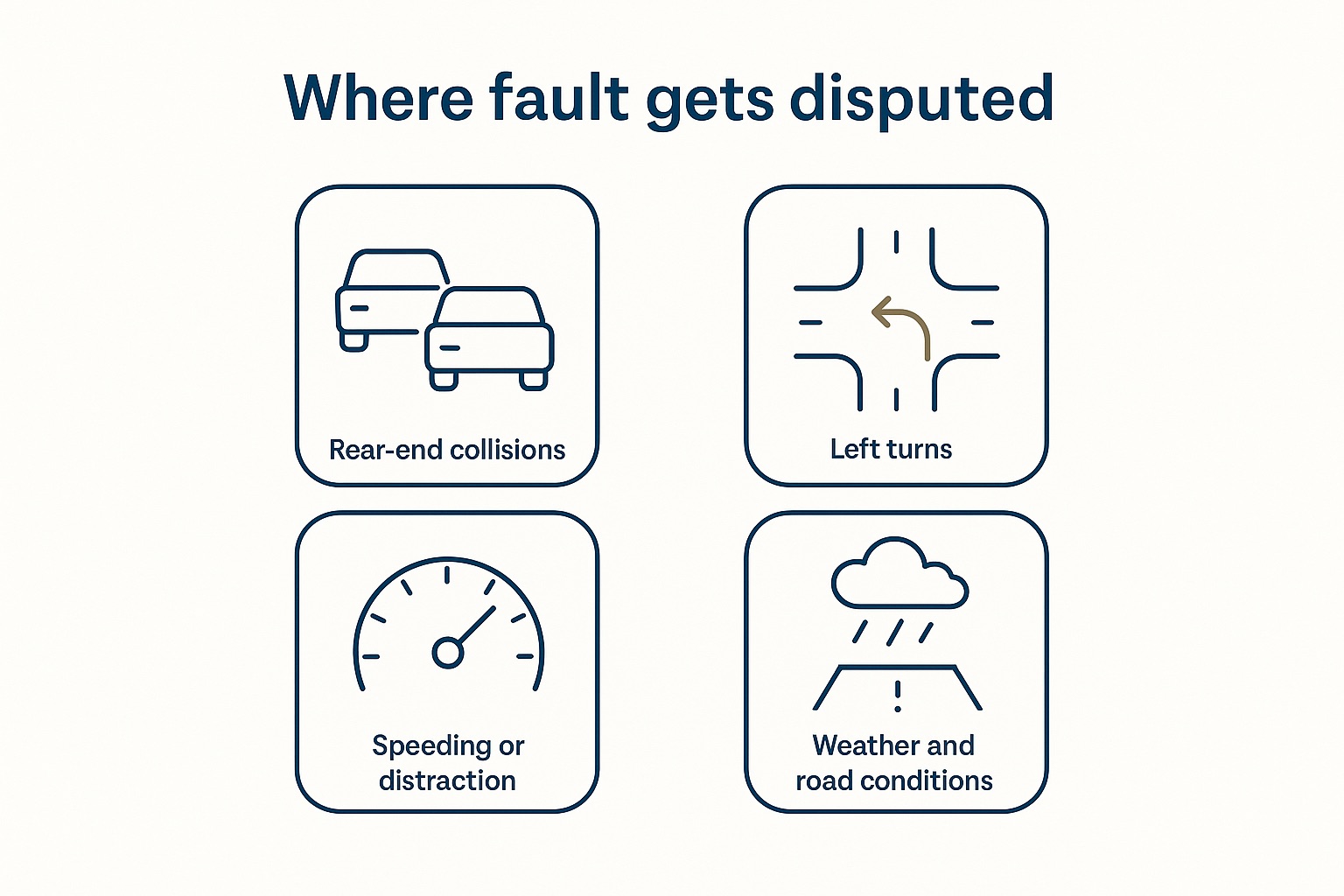
In practice, the argument in a car accident case is rarely about whether comparative fault applies. It is about the percentage. A few situations come up again and again in the Northland, and knowing how they tend to be argued helps you understand where an adjuster's number comes from.
Rear-end collisions
The driver who hits the car in front is usually assigned most or all of the fault, on the theory that they were following too closely or not paying attention. But not always. If the lead driver stopped suddenly for no reason, had a brake light out, or cut into the lane and braked, some share of fault may be argued against them.
Left-turn and intersection crashes
When one driver is turning left across traffic and the other is going straight, fault often turns on who had the right of way, the color of the light, and speed. These are the cases where a fault percentage is most likely to be split, because both drivers frequently had something they could have done differently. That split is exactly what pure comparative fault is built to handle.
Speeding or distraction on your part
Adjusters lean hard on any evidence that you were speeding, texting, or otherwise not fully attentive, because that supports assigning you a larger share. The real question is how much a genuine mistake on your part reduces the claim, and that is negotiable with evidence.
Weather and road conditions
Bad weather does not automatically shift fault, because drivers are expected to adjust to conditions. But it can complicate the picture and become part of the fault argument on both sides. How a specific set of conditions gets weighed is fact-driven.
How comparative fault interacts with your damages and insurance
The fault reduction applies to your damages as a whole, after those damages are valued. It does not change what counts as a recoverable loss in Missouri. Medical expenses, lost wages, future care, and pain and suffering are still on the table; the comparative fault percentage scales the total.
A few related points people ask about:
Missouri does not have a no-fault or personal injury protection system for auto claims. Your recovery comes through a liability or coverage claim, and the comparative fault reduction is applied there, rather than through a separate no-fault benefit.
If the at-fault driver had too little insurance or none at all, your own underinsured or uninsured motorist coverage may come into play, and fault still matters to how those claims are valued. That is a separate topic with its own rules, covered in our guide to uninsured and underinsured motorist claims in Missouri.
If you want a fuller picture of how the pieces add up to a number, including how a fault reduction fits in, our claim-value article walks through it.
Does comparative fault apply to more than car accidents?
Yes. Pure comparative fault is the general Missouri approach to negligence claims, so the same principle can apply well beyond auto collisions. Car accidents are where most people first hear they share the blame. If you have questions about how it applies to a different kind of injury, ask us directly.
What "pure" adds compared with the old Missouri rule
It helps to see what pure comparative fault replaced. For most of Missouri's history, the state used contributory negligence. Under that older rule, if an injured person was even 1 percent at fault, they recovered nothing at all. A small mistake could erase an otherwise strong claim. The Missouri Supreme Court ended that in 1983 and moved to the current pure system, which ties the outcome to a percentage instead of an all-or-nothing bar. So if you have heard from an older relative or an out-of-state source that "any fault means no case," that has not been Missouri law for decades.
Why this matters if an adjuster is already blaming you
It is common, after a crash, for the other driver's insurer to suggest you were mostly or entirely responsible. Sometimes that is a fair read of the facts. Often it is an opening position designed to lower or deny your claim. Because Missouri lets you recover even when you are partly at fault, an early "you were at fault" from an adjuster is not the last word, and it is not a reason to walk away from a legitimate claim.
Be careful about giving a recorded statement or accepting a fault characterization before you understand how it could be used. And do not let time run out. Missouri's statute of limitations for most personal injury claims is 5 years from the date of the injury under RSMo 516.120, but evidence and memories fade long before that, so it is better not to wait.
How we can help in Liberty and the Northland
At our Liberty, Missouri office we handle car accident and injury claims throughout Clay County and the north Kansas City metro. A large part of what we do on these cases is exactly this: documenting the crash, challenging an inflated fault percentage, and making sure a partial-fault argument does not shrink a claim more than the facts justify.
If you want to see how comparative fault could affect your specific situation, you can talk it through with us at no cost. Call our Liberty office at 816-367-6937 for a free consultation. There is no obligation, and you will get a straight answer about where you stand.
You can also learn more about how we handle these cases on our Liberty car accident lawyer page and our Kansas City car accident lawyer page, or read about our broader Liberty personal injury practice. If your crash involved a driver with too little or no insurance, our coverage guide is relevant too. And if you are trying to get a sense of numbers, our article on claim value walks through it.
We also post short client-education videos on our YouTube channel.
Frequently asked questions
Can I recover if I was partly at fault for a car accident in Missouri?
Yes. Missouri uses pure comparative fault, so you can recover even if you were partly at fault. Your recovery is reduced by your percentage of fault, but there is no percentage that bars you completely.
What is pure comparative fault?
Pure comparative fault is a rule that divides responsibility for an accident by percentage. Each party, including the injured person, is assigned a share of fault, and the injured person's recovery is reduced by their own share. Under a pure system, that reduction can be large, but it never eliminates the claim entirely.
What happens if I was more than 50 percent at fault in Missouri?
You can still recover in Missouri even if you were more than 50 percent at fault. If you are found 60 percent at fault, for example, you recover 40 percent of your damages. Missouri does not use a 50 percent cutoff. (Some other states do, so if your crash happened outside Missouri, the answer may be different.)
How is my percentage of fault decided?
If your case settles, the percentage is effectively negotiated based on how a jury would likely see the evidence. If your case goes to trial, the jury assigns the percentages after hearing the evidence and following the court's instructions. Strong documentation of the crash helps support a lower fault share for you.
How much would a 25 percent fault finding reduce my recovery?
It would reduce your recovery by 25 percent. On $100,000 in total damages, a 25 percent fault finding leaves you with $75,000. The formula is your total damages multiplied by (100 percent minus your fault percentage).
Where does Missouri's comparative fault rule come from?
For ordinary negligence claims, including most car accident cases, the rule comes from a Missouri Supreme Court decision, Gustafson v. Benda, 661 S.W.2d 11 (Mo. banc 1983), which adopted pure comparative fault and replaced Missouri's older contributory negligence rule.
How long do I have to file a car accident claim in Missouri?
Missouri's statute of limitations for most personal injury claims is 5 years from the date of injury under RSMo 516.120. Even so, it is better not to wait, because evidence and witness memories fade well before the deadline.