Whiplash and Soft-Tissue Injury Claims in Missouri
If you were hurt in a crash in Missouri and there is no broken bone, no stitches, and nothing dramatic on an X-ray, you can still have a real injury and a real claim. Whiplash and other soft-tissue injuries (strains, sprains, and tears to the muscles, tendons, and ligaments, most often in the neck and back) are among the most common results of a car accident, and Missouri law lets you recover for them the same as any other injury. The catch is that insurance companies systematically treat these claims as minor because they do not show up on imaging the way a fracture does. If you were hurt in Clay County or the north Kansas City area, you cannot control the claim-scoring software carriers use, but you can control the record it scores.
This is general information about Missouri law, not legal advice about your specific claim.
Can you get a settlement for whiplash in Missouri?
Yes. In Missouri, whiplash and other soft-tissue injuries are compensable, and there is no rule that says an injury must appear on an X-ray or MRI to be real. You can recover for your medical bills, your lost wages, and your pain and suffering, whether the injury is a broken bone or a torn ligament that never shows on a scan. What matters legally is that the crash caused the injury and that the injury caused you harm, not whether the damage is visible on a film.
The reason this question comes up so often is that soft-tissue claims are the ones insurers push back on hardest. A fractured bone is hard to argue with. A neck sprain is easier for an adjuster to dismiss, even when it keeps you out of work and wakes you up at night. Understanding how the other side thinks about these claims is the first step to being paid fairly for one.
Soft-tissue injuries are real injuries
Whiplash happens when a sudden force snaps the head and neck back and forth, straining the soft tissue in the neck. It is the classic rear-end collision injury, but any sharp impact can cause it. Common soft-tissue injuries from a crash include neck and back strains and sprains, muscle tears, and injuries to the ligaments and tendons that hold your spine and joints together.
The symptoms are often delayed, which surprises people and gives insurers something to argue about. It is common not to feel the worst of a whiplash injury until a day or two after the crash, once the adrenaline wears off and inflammation sets in. According to the Mayo Clinic, whiplash symptoms most often start within days of the injury, not immediately. That delay is normal medically, but an adjuster will use any gap between the crash and your first complaint of pain to suggest you were not really hurt.
Soft-tissue damage also usually does not show up on standard imaging. X-rays look at bone, so a normal X-ray does not mean you are uninjured; it means nothing is broken. Even an MRI, which is better at seeing soft tissue, does not always capture a strain or a sprain. A "normal" scan is not evidence that you are fine. It is just the limit of what that particular test can see.
Why insurers undervalue soft-tissue claims
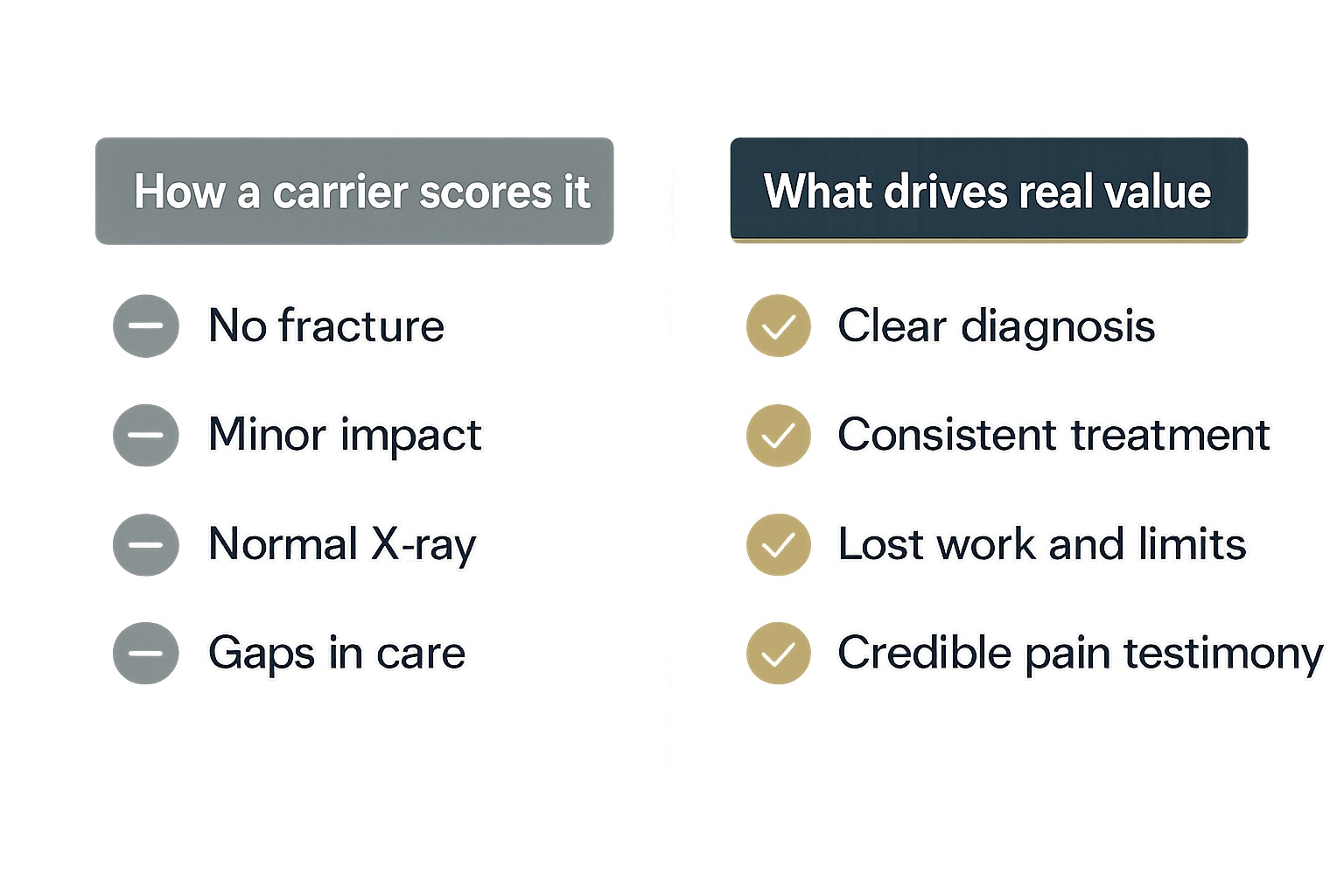
Adjusters do not decide the value of most routine injury claims by hand. Many large auto insurers run claims through valuation software (the best-known example historically is a system called Colossus, and several carriers use similar tools) that scores a claim based on the data entered about it: the diagnosis codes, the type of treatment, how long treatment lasted, whether there were gaps, and whether imaging showed "objective" findings.
These systems are built in a way that tends to reward hard, visible injuries and to discount soft-tissue injuries. A fracture with surgery scores high. A neck sprain treated with physical therapy and no positive scan scores low, sometimes far below what the injury cost the person in pain, missed work, and disrupted life. The software is only as good as what goes into it, and it is designed by and for the insurer, so its defaults lean toward paying less.
This is why two people with similar real-world suffering can be offered very different amounts. The person whose file is thin, with a short treatment history and a gap or two, gets scored as minor. None of this means your injury is not real. It means the process the carrier uses is structured to undervalue exactly the kind of injury you have, and that the way your claim is documented matters enormously to how it comes out.
How do you document a soft-tissue injury?
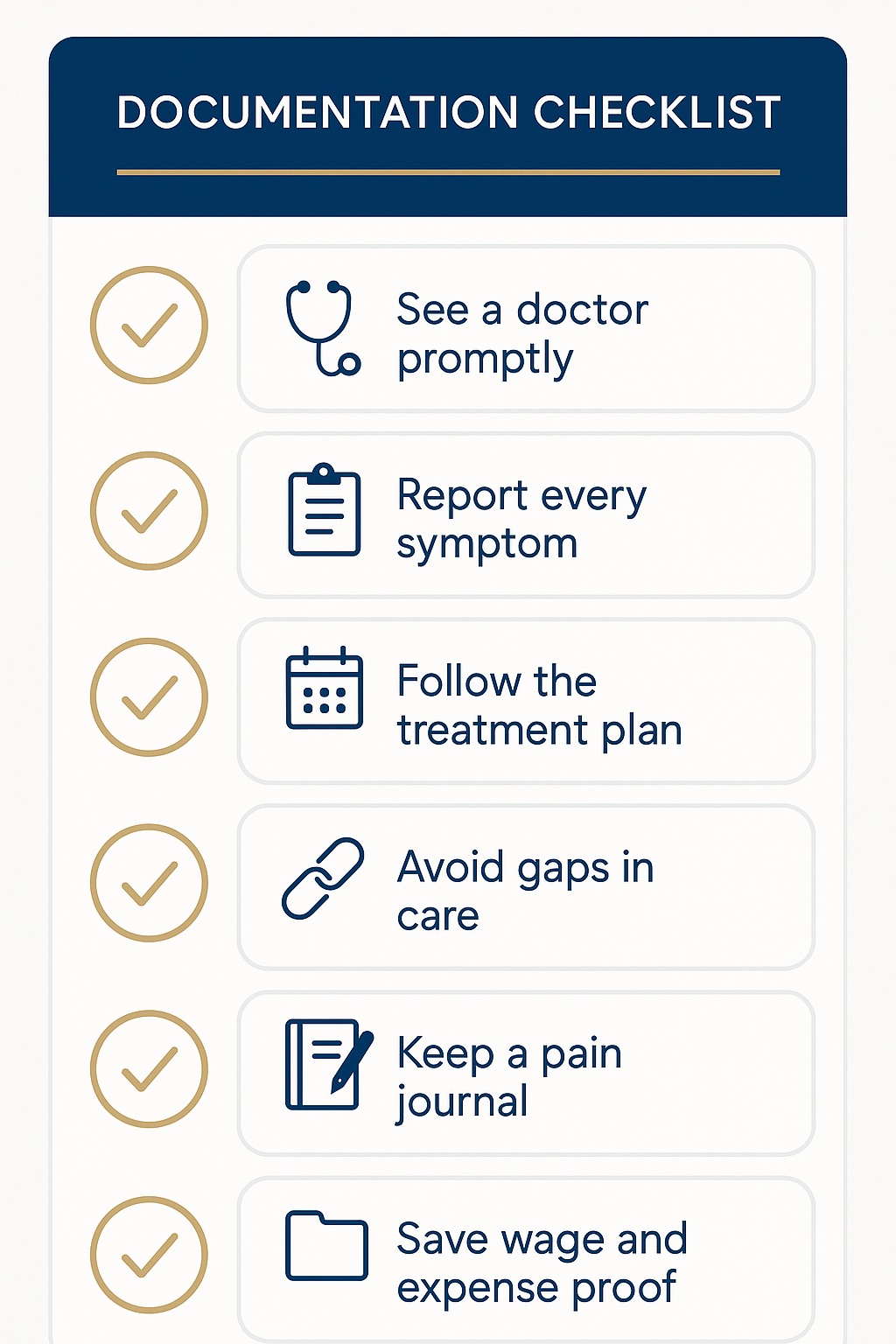
The single most useful thing you can do for a soft-tissue claim is create a consistent, contemporaneous record that connects the crash to your symptoms and your symptoms to your treatment.
- Get evaluated promptly. Being seen soon after the crash, even at urgent care or your primary doctor, creates an early record tying your symptoms to the accident and closes off the "you waited, so you must not have been hurt" argument.
- Describe every symptom, every visit. Tell each provider about all of your symptoms, not just the worst one. If your neck, your lower back, and your headaches all started after the crash, all three belong in the record. Symptoms you do not mention effectively did not happen, as far as the file is concerned.
- Follow the treatment plan. If your provider recommends physical therapy, imaging, or a follow-up, do it, and do it on schedule. Consistent, completed treatment is one of the strongest signals of a genuine injury.
- Avoid unexplained gaps. A stretch with no treatment reads to an adjuster as recovery, even if the real reason was cost, work, childcare, or a wait for a referral. If a gap is unavoidable, having the reason documented helps.
- Keep your own notes. A short daily record of pain levels, missed work, and activities you could not do fills in the human side of the injury that medical codes leave out.
- Save the practical proof. Keep pay stubs or a letter from your employer for lost income, and hold on to records of anything you had to pay out of pocket.
The treatment gap: the most common way a good claim gets undervalued
A treatment gap is a period during your recovery when the records show no care. It is the most common and most damaging problem in soft-tissue claims, because the insurer treats every gap as proof that you got better or were never that hurt.
The frustrating part is that most gaps have nothing to do with how injured you were. People miss appointments because they cannot take more time off work, cannot afford the copays, are waiting weeks for a specialist referral, or started feeling a little better and stopped, only to have the pain return. All of those are understandable. None of them are how the carrier's file will read them.
If you can, keep your care continuous until your provider formally releases you or you reach maximum improvement. If life forces a break, tell your provider why, so the reason lands in the record instead of an unexplained silence. When a gap already exists, it is not fatal to a claim, but it is something that has to be explained and put in context rather than ignored.
Video: does an MRI get you a bigger settlement?
Because imaging comes up constantly in soft-tissue claims, this short video from our channel walks through what an MRI does and does not do for the value of a personal injury claim, and why a "normal" scan is not the end of the conversation.
More client-education videos are on our YouTube channel.
How Missouri law affects the value of a soft-tissue claim
Beyond the documentation, Missouri law shapes what a soft-tissue claim is worth.
Pure comparative fault
Missouri follows pure comparative fault. If you were partly at fault for the crash, your recovery is reduced by your percentage of fault, but it is never barred, even if you were more at fault than the other driver. This rule comes from Missouri case law, Gustafson v. Benda, not from a single statute. In practice it means the carrier has an incentive to pin as much fault on you as it can, because every percentage point of fault it assigns you shrinks what it has to pay. We explain how this works in more detail on our Missouri comparative fault page .
No general damages cap in an ordinary auto case
Whiplash cases are largely about pain and suffering, because the medical bills are often modest compared to the disruption the injury causes. That makes non-economic damages (pain, suffering, and loss of enjoyment of life) a central part of the claim.
Missouri's statutory cap on non-economic damages applies to medical-malpractice actions under RSMo 538.210, which is a different context from an ordinary car-accident claim.
Policy limits are the real ceiling
Whatever a claim is theoretically worth, the practical ceiling is often the amount of insurance available. Missouri's minimum bodily-injury liability limit is $25,000 per person, and many drivers carry only that. If the at-fault driver has a small policy and your damages are larger, your own uninsured or underinsured motorist coverage may be what pays the difference. How the bills incurred along the way get paid and repaid out of a recovery is covered on our Missouri medical bills article .
For a fuller picture of what drives value across an injury claim, see our Missouri car accident claim value article .
How long do you have to file in Missouri?
In Missouri, the deadline to file most personal-injury lawsuits is 5 years from the date of the accident, under RSMo 516.120. That is longer than in many states, but waiting is still a mistake in a soft-tissue case. The value of these claims lives in the medical record, and the record is strongest when it is built early and kept current. Some claims have shorter or different deadlines, so check yours early.
Frequently asked questions
Can I get a settlement for whiplash in Missouri if my X-ray was normal?
Yes. A normal X-ray means nothing is broken, not that you are uninjured. X-rays image bone, and soft-tissue injuries like whiplash often do not appear on standard imaging at all. In Missouri you can recover for a soft-tissue injury based on your diagnosis, your treatment records, and the effect the injury had on your life, whether or not it shows on a scan.
Why is the insurance company saying my soft-tissue injury is minor?
Many insurers score routine injury claims with valuation software that tends to reward visible injuries like fractures and to discount soft-tissue injuries that do not show on imaging. A short treatment history, a gap in care, or a "normal" scan can all cause the software to rate a claim as minor even when the injury genuinely affected your life. It reflects how the carrier's process works, not the reality of your injury.
What is a treatment gap and why does it hurt my claim?
A treatment gap is a stretch of your recovery with no documented medical care. Insurers treat gaps as evidence that you recovered or were never seriously hurt, even when the real reason was cost, work, or a wait for a referral. Keeping treatment continuous, or documenting the reason for any unavoidable break, protects the value of the claim.
Does being partly at fault stop me from recovering in Missouri?
No. Missouri follows pure comparative fault, so being partly at fault reduces your recovery by your percentage of fault but does not bar it, even if you were more at fault than the other driver. The rule comes from Missouri case law, Gustafson v. Benda.
How long do I have to file a whiplash claim in Missouri?
Missouri generally allows 5 years from the date of the accident to file a personal-injury lawsuit, under RSMo 516.120. Waiting is still risky in a soft-tissue case because the claim depends on a medical record that is strongest when it is built early and kept current.
Talk to a Liberty, Missouri injury attorney
If you were injured in a crash in Clay County or the north Kansas City area and an insurer is treating your neck or back injury as if it were nothing, you do not have to accept that framing on your own. Empower Injury Law can help you build the record, put your treatment and lost time in context, and press for a fair value on a claim that carriers are built to underrate. Our Liberty office offers a free consultation. Call 816-367-6937 to talk through your situation. There is no obligation, and no pressure.
To understand the broader claim your injury is part of, see our Liberty car accident page.
*This article provides general information about Missouri law and does not create an attorney-client relationship or constitute legal advice. Outcomes depend on the facts of each case.*
Author Bio

Kevin A. Jones | Personal Injury Lawyer
Kevin A. Jones, founder and managing attorney of Empower Injury Law, has been practicing law since 2009. With over $25 million in jury verdicts and settlements in his first decade, Kevin has earned a reputation as a fierce advocate for his clients.
Kevin’s approach to law is rooted in his passion for helping people who have been mistreated by corporations, insurance companies, and other powerful entities.
Whether representing individuals wronged by negligent drivers or those injured on someone else’s property, Kevin is dedicated to achieving justice. His extensive experience in the courtroom ensures that clients receive strong, personalized representation that delivers results.
Practice Areas


