If your family has lost someone because of another person's negligence in Lawrence or elsewhere in Douglas County, Kansas law gives you a way to hold the responsible party accountable. A wrongful death claim is a civil action, separate from any criminal case, that lets the deceased person's heirs recover for the losses the death has caused them. Empower Injury Law is a personal injury practice with a Lawrence, Kansas office, and this page explains, in plain terms, how Kansas wrongful death claims work, who can bring one, how long you have, and what a family can recover.
We know that reading a page like this is rarely something anyone chooses to do. If you are here because of a recent loss, our intent is not to sell you anything. It is to give you accurate Kansas information so you can decide, without pressure, what makes sense for your family.
What is a wrongful death claim in Kansas?
A wrongful death claim is a lawsuit brought when a person dies because of another party's wrongful act, negligence, or fault. In Kansas the claim is created and governed by statute, K.S.A. 60-1901 and the sections that follow. The statute allows the deceased person's heirs at law to recover the losses they personally suffered because of the death.
It helps to separate two ideas that often get confused. A wrongful death claim compensates the surviving family for their own losses, such as the loss of financial support and the loss of the relationship. That is different from a survival action, which is the claim the deceased person could have brought had they lived, for things like the pain and medical expenses they experienced before death. Both may be available in the same situation, and they are handled together in practice, but they compensate different losses. If you are unsure which applies to your circumstances, that is one of the first things we sort out.
Common situations that lead to Kansas wrongful death claims include fatal auto and truck collisions, crashes caused by impaired or distracted drivers, and hit-and-run or uninsured-driver deaths where the family's own auto coverage may come into play. If the at-fault driver fled or had no insurance, uninsured and underinsured motorist coverage can matter a great deal, and we explain how that coverage works in our guide to Kansas uninsured and underinsured motorist coverage.
Who can file a wrongful death claim in Kansas?
Under K.S.A. 60-1902, a Kansas wrongful death action may be commenced by any one of the heirs at law of the deceased who has sustained a loss because of the death. The claim is brought on behalf of all the heirs who suffered a loss, whether or not each of them joins the lawsuit at the start. Heirs who do not initially join may intervene later.
Kansas does not rank heirs for the purpose of filing. Any one heir at law who suffered a loss may bring the claim, and it is brought for all of them. "Heirs at law" is a defined legal category, not simply anyone who was close to the person: it follows Kansas intestate succession at the time of death. That usually means a surviving spouse and children, with parents or other relatives qualifying when there is no closer heir.
Because only heirs at law can recover, one of the early steps in a Kansas wrongful death case is identifying who those heirs are. That is usually straightforward, but blended families, estranged relatives, or the death of a childless person can make it more involved. Getting this right early avoids problems later, because the amount recovered is ultimately divided among the heirs who proved a loss.
How long do you have to file? The Kansas deadline
In Kansas, a wrongful death action generally must be filed within two years. This comes from K.S.A. 60-513, the Kansas statute of limitations that governs these actions. In most cases the two-year period runs from the date of death, though the precise trigger date can depend on the facts, and certain circumstances can affect when the clock starts or whether it is paused.
Two years can feel like a long time when you are in the middle of grief, but it passes quickly, and there are practical reasons not to wait. Evidence disappears, vehicles get repaired or scrapped, witness memories fade, and insurers begin building their position early. If the deadline passes without a lawsuit on file, the claim is usually lost permanently, no matter how strong it was. If you are anywhere near the two-year mark, or you are simply not sure when your period started, it is worth confirming the date with a lawyer sooner rather than later.
This is general information, not legal advice about your specific deadline. The only reliable way to know your exact filing date is to have a lawyer review the facts of your loss.
What can a family recover in a Kansas wrongful death case?
Kansas separates wrongful death damages into two broad categories, pecuniary (economic) and nonpecuniary (non-economic). K.S.A. 60-1903 sets the framework for the amount of damages and requires a jury to determine pecuniary and nonpecuniary damages separately. K.S.A. 60-1904 lists the specific elements of damage that heirs may recover.
Pecuniary (economic) damages
Pecuniary damages are the measurable financial losses the death caused the heirs. These commonly include:
- Loss of the financial support and benefits the heirs could reasonably have expected from the continued life of the person who died.
- Loss of the value of services the person provided to the family.
- Reasonable funeral and burial expenses.
- Certain expenses of the last illness or care, in defined circumstances.
Nonpecuniary (non-economic) damages
Nonpecuniary damages compensate the human losses that do not come with a receipt. Under K.S.A. 60-1904, these can include mental anguish, suffering, and bereavement, and the loss of society, companionship, comfort, and protection, along with other listed elements. These losses are real, and Kansas law recognizes them, even though they are harder to put a number on.
Kansas caps the nonpecuniary (non-economic) recovery in a wrongful death case at $250,000 in total, under K.S.A. 60-1903. The cap does not apply to pecuniary losses such as lost financial support, or to reasonable funeral expenses and the cost of the person’s care (K.S.A. 60-1904(b)). The jury is not told about the cap; if its award for nonpecuniary loss is higher, the court reduces it to the limit.
No lawyer can tell you what a case is worth from a web page, and no honest one will promise a number. What a claim can recover depends on the facts, the available insurance, and the losses your family can prove.
How are wrongful death damages divided among the heirs?
Because a Kansas wrongful death claim is brought for the benefit of all the heirs who lost something, the recovery is not simply handed to whoever filed the lawsuit. After a recovery, the court apportions the amount among the heirs according to the loss each of them sustained. This is done in a hearing, and the court considers the relationship each heir had with the person who died and the loss each one suffered.
For many families this step is uneventful, because everyone agrees. In others, especially where heirs were not equally close to the person, it can require careful handling. Part of a lawyer's job is to make sure every heir who suffered a loss is accounted for and that the division reflects the actual losses rather than a dispute driven by grief.
Does fault matter in a Kansas wrongful death case?
Yes, and Kansas handles fault differently from some neighboring states, so this is worth stating clearly for Kansas. Kansas follows modified comparative fault under K.S.A. 60-258a. Under this rule, an award can be reduced in proportion to the deceased person's share of fault, and if that share reaches 50 percent or more, recovery is barred. In practical terms, the family can still recover when the person who died was partly at fault, as long as their share of the fault stays below that threshold, with the award reduced by their percentage.
Insurers understand this rule and often try to shift as much fault as possible onto the person who died, because doing so reduces or eliminates what they pay. That is one of the reasons a careful, early investigation matters. Preserving evidence and reconstructing what happened can be the difference between a family recovering and being told the death was mostly the fault of the person who died.
What does a Kansas wrongful death case involve, step by step?
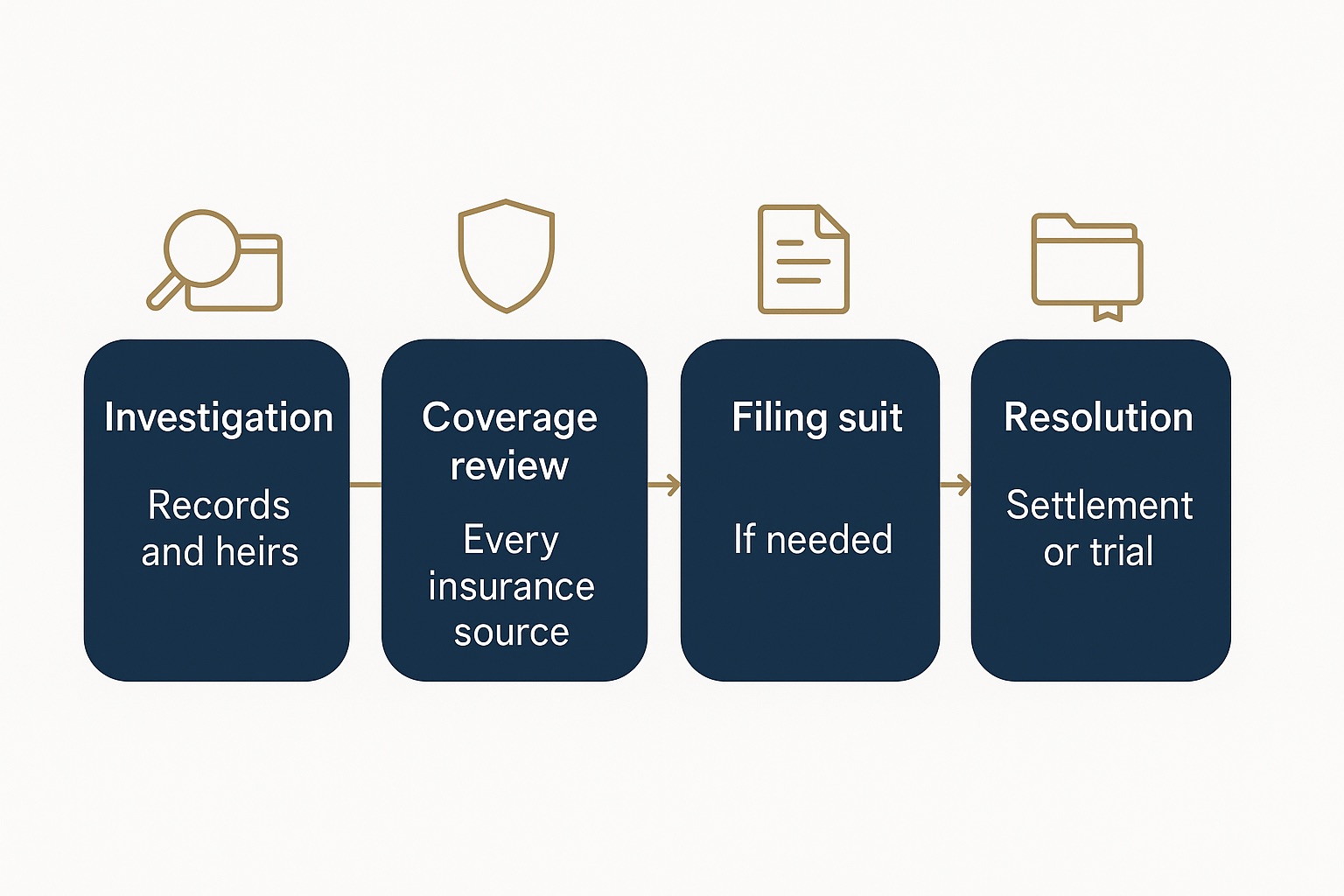
Every case is different, but most Kansas wrongful death matters move through a recognizable sequence.
Investigation and heir identification
We gather the police or crash report, medical records, and available evidence, and we identify the heirs at law who may have a claim. Where a vehicle, roadway, or product may be involved, preserving physical evidence early can be critical.
Insurance and claim evaluation
We identify every source of coverage, which can include the at-fault party's liability insurance and, in hit-and-run or uninsured-driver deaths, the family's own uninsured or underinsured motorist coverage. Finding all available coverage is often where much of the real value of a case is decided.
Filing suit and apportionment
If a fair resolution cannot be reached, we file suit within the Kansas deadline. If the case resolves with a recovery, the court apportions it among the heirs as described above.
Resolution
Most cases resolve by settlement, but preparing a case as if it will be tried is what gives a family a real position. We do not promise a particular outcome, because no one honestly can. What we can do is prepare the claim thoroughly and explain your options at each step.
Where we serve
Empower Injury Law's Lawrence office serves families throughout Douglas County, including Lawrence, Eudora, Baldwin City, and the surrounding area, with some reach toward Tonganoxie and eastward. If your loss happened in the Lawrence area and Kansas law applies, we can help you understand your options. For a general overview of how we handle Kansas injury matters, see our Lawrence personal injury page.
You can also find our client-education videos on the Empower Injury Law YouTube channel. For Kansas-specific procedural and court information, the Kansas Judicial Branch publishes general resources on the state's district and probate courts.
Frequently asked questions
Who can file a wrongful death claim in Kansas?
Under K.S.A. 60-1902, any one of the deceased person's heirs at law who suffered a loss because of the death may file. The claim is brought for the benefit of all the heirs who lost something, and heirs who do not join at the start may intervene later. There is no filing order among heirs. Heirs at law follow Kansas intestate succession, which usually means a surviving spouse and children, with parents or other relatives qualifying when there is no closer heir.
How long do I have to file a wrongful death claim in Kansas?
Generally two years, under K.S.A. 60-513. In most cases the two-year period runs from the date of death, though the exact trigger date depends on the facts. If the deadline passes without a lawsuit on file, the claim is usually lost permanently, so it is worth confirming your specific date with a lawyer early.
What can my family recover in a Kansas wrongful death case?
Kansas allows both pecuniary (economic) damages, such as lost financial support, the value of lost services, and funeral expenses, and nonpecuniary (non-economic) damages, such as mental anguish, bereavement, and loss of companionship, under K.S.A. 60-1903 and 60-1904. Kansas caps the total nonpecuniary recovery at $250,000 under K.S.A. 60-1903; pecuniary losses, funeral expenses, and the cost of the person’s care are not subject to the cap. The actual value of any claim depends on the facts, the available insurance, and the losses the family can prove.
How are the damages divided among the heirs?
After a recovery, the court apportions the amount among the heirs according to the loss each one sustained. The court considers each heir's relationship with the person who died and the loss each suffered. Where heirs agree, this step is usually straightforward.
Does it matter if my loved one was partly at fault?
It can. Kansas uses modified comparative fault under K.S.A. 60-258a. An award can be reduced by the deceased person's share of fault, and if that share is 50 percent or more, recovery is barred. Families can still recover when the person who died was partly at fault, as long as their share stays below that threshold.
Do I need a lawyer for a Kansas wrongful death claim?
You are not required to hire one, but these claims involve strict deadlines, heir identification, insurance coverage that is often larger than it first appears, and fault disputes that insurers press hard. A lawyer's role is to preserve evidence early, account for every heir and every source of coverage, and explain your options without pressure. Most personal injury consultations, including ours, are free.
Talk to a Lawrence wrongful death lawyer
If you would like to understand your options after a loss in Lawrence or Douglas County, you are welcome to reach out for a free, no-pressure consultation. We will listen, answer your Kansas-specific questions, and be honest about whether we think a claim makes sense. There is no obligation, and you decide what happens next.
Empower Injury Law 831 Massachusetts St, Lawrence, KS 66044 Phone: 785-367-6937 Email: [email protected]
This page provides general information about Kansas law and is not legal advice. Reading it does not create an attorney-client relationship, and every case depends on its own facts. For advice about your situation, speak with a lawyer.