Negligent Security Claims in Liberty and the Northland
If you were assaulted, shot, robbed, or otherwise attacked at an apartment complex, bar, parking lot, or other property in Clay County or the north Kansas City metro, you may have a claim against the property owner or manager, not just against the person who attacked you. These are negligent security cases. They rest on a simple idea: a business or landlord that invites people onto its property has to take reasonable steps to keep them safe from foreseeable danger, and that can include the danger of a criminal attack when the circumstances made one predictable.
We handle these claims out of our Liberty office at 28A Westwoods Dr, and we represent people across the Northland, including Kearney, Gladstone, and North Kansas City. Most of the firms advertising for this work are based downtown and frame every case around downtown Kansas City incidents. If your attack happened at a complex off 152, a bar in Liberty, or a store lot in Gladstone, you are better served by someone who knows Clay County and tries cases here. You can reach us at 816-367-6937 for a free, no-pressure conversation about what happened.
What Negligent Security Means
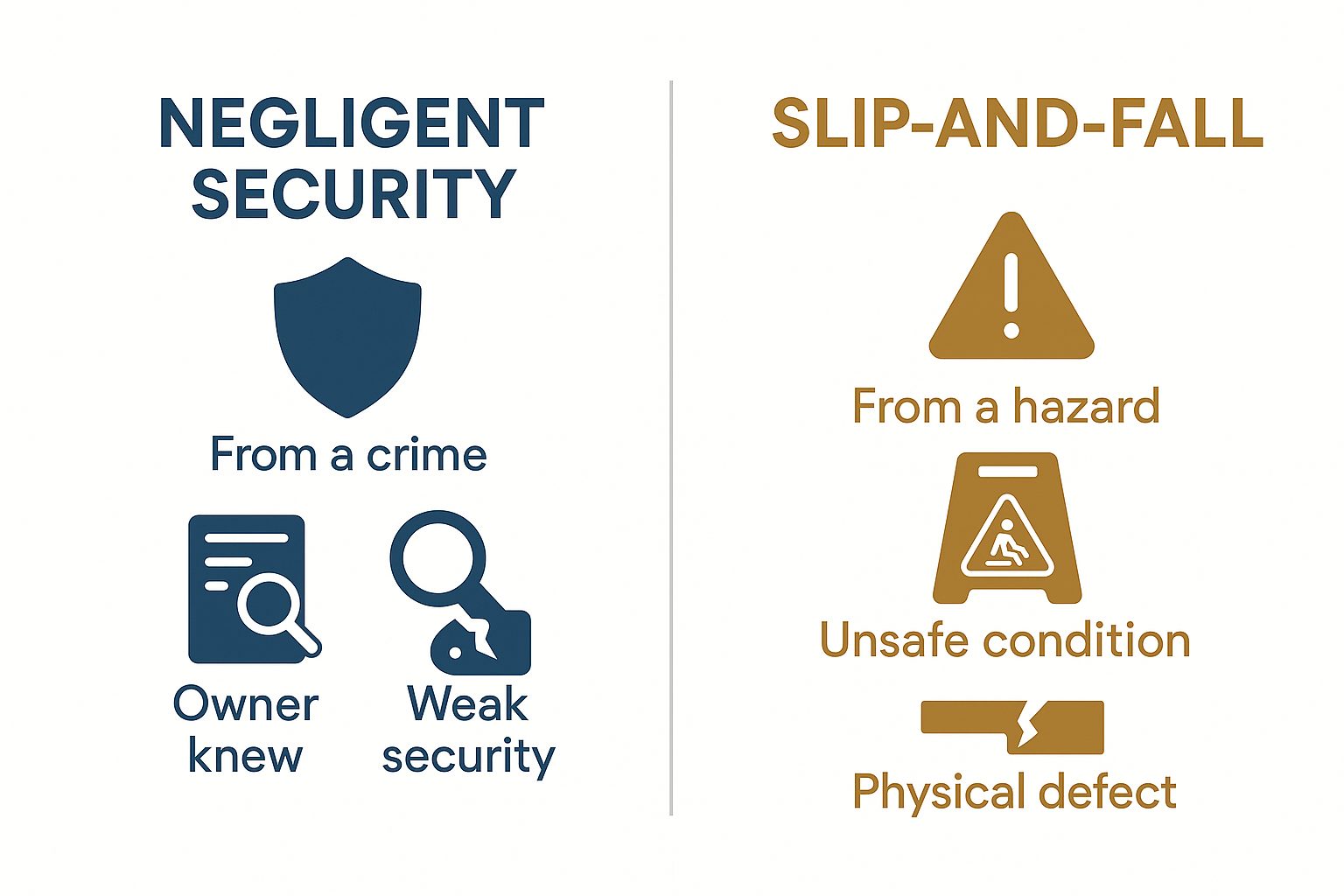
Negligent security is a type of premises liability claim, but it is not the same as a slip-and-fall case. A slip-and-fall is about a physical hazard on the property, a wet floor or a broken stair. A negligent security case is about a property owner failing to provide reasonable security measures, which then allowed a third person to commit a violent crime against you. The injury comes from the criminal act, but the owner's failure to guard against a foreseeable crime is what creates the owner's share of responsibility.
That distinction matters because the two kinds of claims are proven differently. A hazard case turns on the condition of the property. A security case turns on what the owner knew, or should have known, about the risk of crime, and whether the owner's response was reasonable given that risk. For the broader category these claims sit inside, see our overview of premises liability in Missouri and our Liberty premises liability page.
When Is a Property Owner Responsible for a Criminal Attack?
A property owner is generally not an insurer of your safety, and the owner is not automatically liable just because a crime happened on the property. The question is whether the attack was reasonably foreseeable. When a violent crime is foreseeable, the owner can be expected to take reasonable precautions against it, and a failure to do so can make the owner partly responsible for the harm.
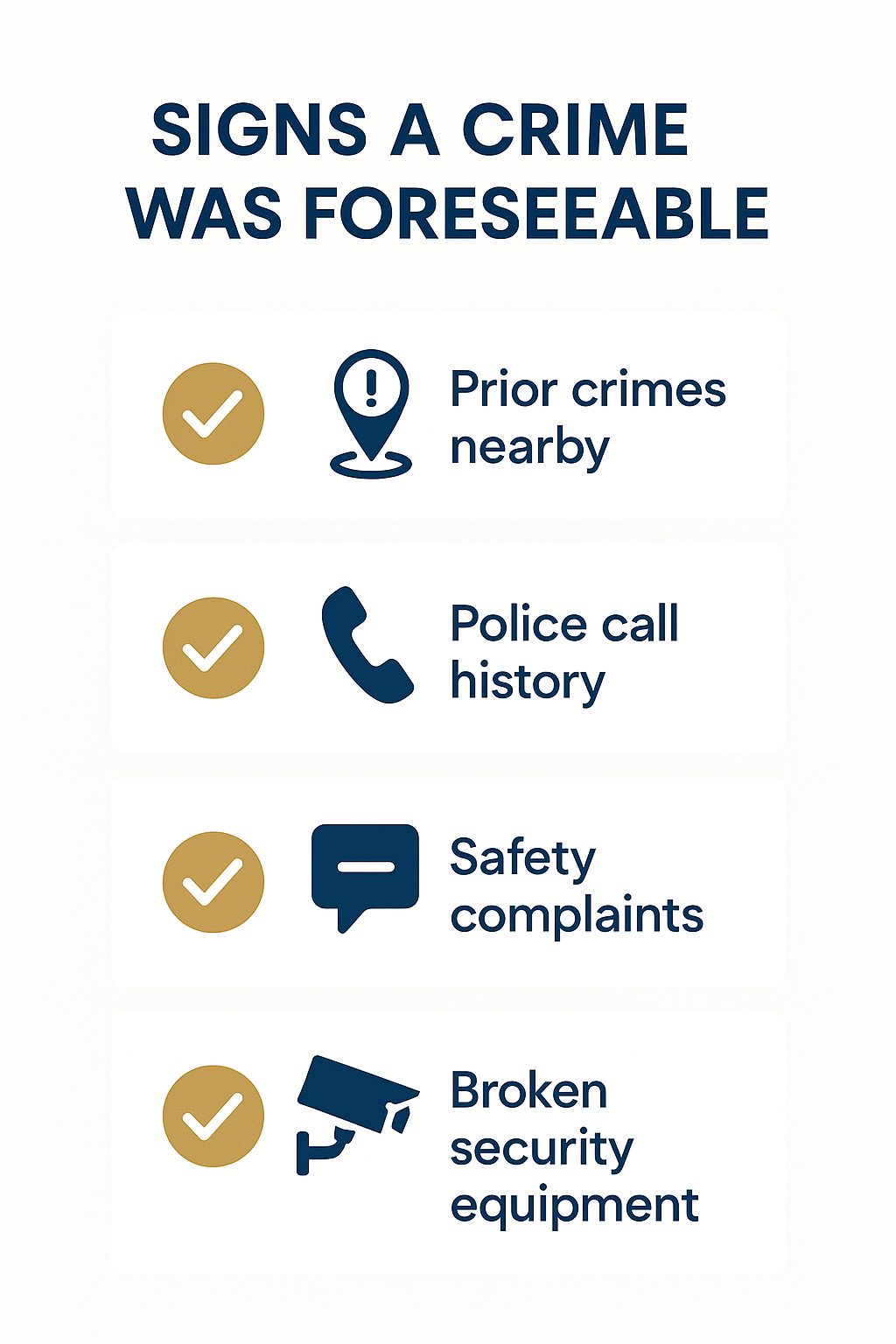
Foreseeability is usually shown through the history of the property and the area around it. Prior similar crimes on or near the location are the most common way to prove it. A complex with a documented pattern of assaults, break-ins, or shootings, and management that knew about them, is in a very different position than a property with no such history.
Evidence that a crime was foreseeable
The kind of proof that tends to matter in these cases includes:
- Police call history and crime reports for the address and the immediate area
- Prior incidents at the same property, and whether management documented or responded to them
- Complaints tenants or patrons made to management about safety
- Broken, missing, or ignored security equipment (gates, lighting, cameras, locks)
- Whether the property advertised security it did not actually provide
Common negligent security failures
- Broken or propped-open gates and exterior doors
- Burned-out or absent lighting in lots, stairwells, and walkways
- Non-working or unmonitored security cameras
- No security personnel where the risk clearly called for it
- Failing to warn tenants or guests about a known, specific threat
Who Can Be Held Responsible
More than one party often shares responsibility in a negligent security case, and sorting out who did what is a large part of the work. The typical defendants are:
- The property owner, who holds ultimate responsibility for the condition and safety of the premises.
- The property management company, which frequently handles day-to-day operations, maintenance, and tenant complaints, and may have known about the risk firsthand.
- A hired security contractor or vendor, if the property brought in guards, patrols, or a monitoring service that did not do the job it was retained to do.
These roles are often split across separate companies, and the arrangement is not always obvious from the outside. The owner of record, the manager on the lease, and the security firm on site can each be a distinct entity with its own insurance. Untangling that ownership and contracting chain is exactly where being based in Clay County helps. We can pull the local records, identify who actually controlled security at that property, and name every party that shares responsibility, rather than guessing at it from downtown.
Where These Cases Happen in the Northland
We see these claims arise at apartment and townhome complexes, bars and nightclubs, convenience stores and gas stations, hotels and motels, shopping-center parking lots, and parking garages. The common thread is a place open to the public or to residents, a known or knowable risk of crime, and a security response that did not match the risk. Whether the property is in Liberty, Kearney, Gladstone, or North Kansas City, the analysis is the same, and local knowledge of the specific location and its history often makes the difference.
Your Share of Fault Does Not End Your Case
People hurt in these situations sometimes worry that their own conduct that night will sink the claim. Missouri follows pure comparative fault, which comes from the Missouri Supreme Court's decision in Gustafson v. Benda. Under that rule, if you are found partly at fault, your recovery is reduced by your percentage of fault, but it is never barred, even if your share is high. A jury that assigns you 30 percent of the fault reduces your award by 30 percent; it does not take the award away. You can read more on our Missouri comparative fault page.
How Long You Have to File
In Missouri, the statute of limitations for most personal injury claims is 5 years from the date of the injury, under RSMo 516.120. If the attack was fatal, the claim becomes a wrongful death action, and the deadline is 3 years from the date of death under RSMo 537.100. Our Liberty wrongful death page covers that path in more detail.
Deadlines are hard cutoffs. Waiting also lets evidence disappear, and in these cases the evidence is perishable in a specific way: surveillance footage is often overwritten within days or weeks, and a property owner who senses a claim may repair the broken gate or lighting before anyone documents it. Reaching a lawyer early lets us send preservation letters and get investigators to the property while the proof still exists.
What a Negligent Security Case Can Recover
A claim against a negligent property owner can seek compensation for medical expenses, future care, lost income and lost earning capacity, pain and suffering, disability, and disfigurement. In a fatal case, the family's wrongful death claim covers different categories of loss. We do not promise any particular result, because the value of a case depends on the facts, the injuries, and the specific evidence of what the owner knew and failed to do. What we can promise is a straight assessment of whether you have a claim worth pursuing.
Working With Our Liberty Office
We take these cases on a contingency basis, which means no fee unless we recover for you, and the initial consultation is free. You can call 816-367-6937, and we will walk through what happened, what evidence may still be available, and whether a claim makes sense. If you prefer to understand the ground first, our Liberty personal injury overview explains how we work, and our YouTube channel has plain-language videos on what to expect from an injury claim. We also handle Kansas City premises liability matters and Liberty car accident claims.
Frequently Asked Questions
Can I sue an apartment complex for an attack that happened there?
Possibly. You are not suing the complex for the crime itself; you are claiming that inadequate security allowed a foreseeable crime to happen. If the complex had a known history of similar incidents, ignored broken gates or lighting, or failed to respond to safety complaints, those facts can support a claim against the owner or management company. The specific history of the property is what we investigate first.
Is negligent security the same as a slip-and-fall case?
No. Both are premises liability claims, but a slip-and-fall is about a physical hazard, and a negligent security case is about a failure to guard against a foreseeable crime. They are proven with different evidence. See our Liberty slip-and-fall page for the hazard side of premises liability.
What if the person who attacked me was never caught?
Your claim against the property owner does not depend on identifying or convicting the attacker. The case against the owner is separate and turns on the owner's own conduct, whether the attack was foreseeable and whether security was reasonable. An unidentified attacker can make the owner's responsibility more central, not less.
How long do I have to file a negligent security claim in Missouri?
For most personal injury claims, 5 years from the date of the injury under RSMo 516.120. If the attack was fatal, the wrongful death deadline is 3 years from the date of death under RSMo 537.100. Even with that window, early investigation matters, because surveillance video and physical conditions at the property often do not last.
Does it cost anything to talk to a lawyer about my case?
No. The consultation is free, and we handle these cases on contingency, so there is no fee unless we recover for you. You can reach our Liberty office at 816-367-6937.
Do you only take cases in Liberty?
No. We work out of Liberty and represent people throughout Clay County and the Northland, including Kearney, Gladstone, and North Kansas City. Being based here, rather than downtown, means we know the specific properties and areas these cases come from.