Distracted Driving Accidents and Missouri’s Hands-Free Law
Texting and holding a phone while driving are illegal in Missouri. The state's hands-free law bars a driver from holding or physically supporting an electronic device behind the wheel, and it covers more than typing a message. If you were hurt in Clay County or anywhere in the Northland by a driver who was looking at a phone instead of the road, that conduct is not just dangerous. It can be useful evidence that the other driver, not you, caused the crash.
Missouri's hands-free law prohibits more than texting, a violation can help establish the other driver's fault, and distraction interacts with the rules that decide what an injured person recovers. The focus here is the general law. For what to do about a specific crash and whether to bring a claim, our Missouri car accident page and our Liberty car accident page go further.
Is it illegal to text and drive in Missouri?
Yes. Missouri's hands-free statute, RSMo 304.822, prohibits operating a motor vehicle while physically holding or supporting an electronic communication device. It is often called the Siddens Bening Hands-Free Law.
The statute reaches a broad set of behaviors, not only text messages. Under the law, a driver may not do any of the following while the vehicle is moving:
- Hold or physically support a phone or similar device
- Write, send, or read a text-based message, including texts, emails, instant messages, and social media
- Make or take a call that is not hands-free
- Record, post, or watch a video (navigation display is treated differently)
- Enter information manually into an app or website
Hands-free and voice-operated use is allowed. A driver can use a mounted phone, a Bluetooth connection, or voice commands, and can touch the device once to start or stop a feature. The point of the law is that the phone stays out of the driver's hand and the driver's eyes stay on the road.
Missouri phased the law in. For a period after it took effect, officers issued warnings rather than tickets, and primary enforcement (an officer can stop and cite a driver for the violation on its own) began later.
Does the other driver's phone use help my injury claim?
It often does. In a Missouri injury claim, you have to show the other driver was negligent, meaning they failed to use the care a reasonable driver would. A driver who was texting or holding a phone when the law told them not to gives you a concrete, documented failure to point to, rather than a vague argument that they "weren't paying attention."
How much legal weight a hands-free violation carries depends on how Missouri treats the violation. In some states, breaking a safety statute is negligence in itself (often called negligence per se), so the violation establishes the breach and the jury decides the rest. In others, the violation is evidence of negligence that the jury weighs along with everything else. Which of those applies to a hands-free violation in Missouri affects how the point is argued and instructed at trial.
Either way, proof that the other driver was on a phone tends to strengthen a claim and to make an insurer less eager to blame you. The practical question is how you prove it.
Proving the other driver was distracted
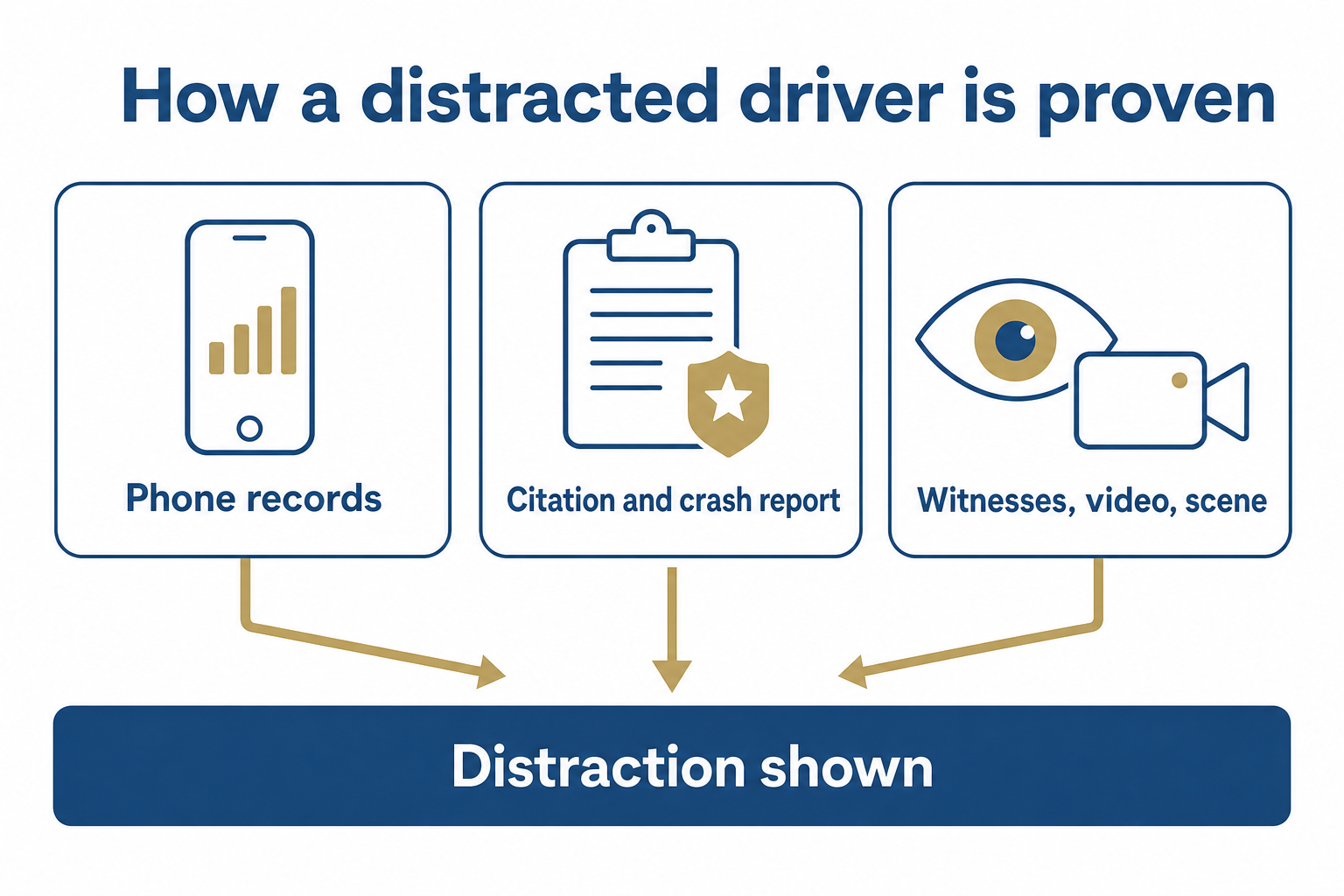
Distraction is rarely something a driver admits. It is shown through records and documents that are gathered after the crash. The most useful sources are these.
Phone records
A phone's call and data logs can show activity at the moment of impact. Timestamps for a sent text, an active call, or data use that lines up with the crash time can place the phone in use when the driver should have been watching the road. These records usually have to be requested formally, and in litigation they can be subpoenaed from the carrier. Because carriers do not keep this data forever, and because the timing matters, this is one reason not to let a claim sit.
The citation and the crash report
If the officer who responded issued a hands-free citation or noted distraction, that appears in the Missouri crash report and in the court record for the ticket. A citation is not the last word on civil fault, and the outcome of the traffic case does not decide the injury claim. It is still a strong starting point and a signal to the insurer about how the facts look.
Witnesses, video, and the scene
Other drivers and passengers sometimes see a phone in the other driver's hand. Nearby businesses, traffic cameras, and dashcams can capture the seconds before impact. Physical evidence at the scene, such as a lack of braking, can also fit a distraction theory. For how fault gets pieced together from these sources, see our guide on how fault is determined in a Missouri car accident claim.
Comparative fault: what if the insurer blames you too?
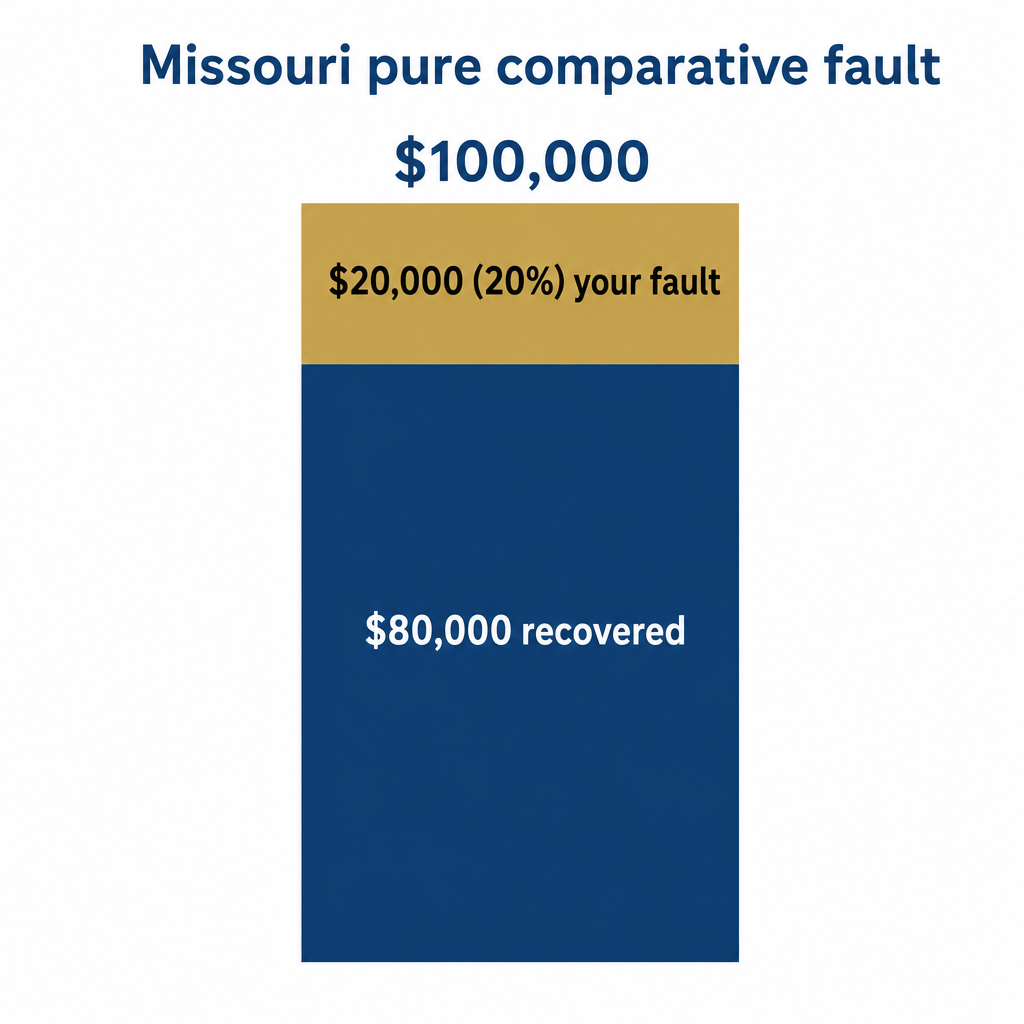
A distracted-driving case does not always put all the fault on one driver. An insurer may argue that you share some blame, for instance that you were speeding or could have avoided the crash. Missouri handles that with pure comparative fault.
Under Missouri's pure comparative fault rule, your recovery is reduced by your percentage of fault, but it is never barred. If your damages are $100,000 and you are found 20 percent at fault, you recover $80,000. Even a plaintiff found mostly at fault can still recover the share attributable to the other driver. That is different from states that cut off recovery once an injured person crosses a fault threshold. You can read more on our Missouri comparative fault page, and the principle is reflected in RSMo 537.765.
This is where a hands-free violation can matter twice. Evidence that the other driver was on a phone both supports their fault and pushes back on any attempt to shift a larger share onto you.
If the distracted driver turns out to be uninsured or flees the scene, your own uninsured motorist coverage may be the source of recovery. Our page on uninsured and underinsured motorist claims in Missouri explains how that coverage works.
How long you have to file in Missouri
Missouri gives you 5 years to file most personal injury lawsuits, measured from the date of the crash, under RSMo 516.120. Our Missouri car accident statute of limitations page covers the deadline and the narrow situations that change it.
Five years is longer than many states allow, but it is not a reason to wait. Phone records can age out, video gets overwritten, and witnesses move and forget. Evidence that the other driver was distracted is strongest when it is secured early.
When it helps to talk to a lawyer
Not every crash needs an attorney. A minor fender-bender with clear fault and no real injury is often something you can handle on your own. Where a distracted-driving case tends to benefit from legal help is when the injury is serious, when the other driver or insurer disputes fault, or when proving the phone use requires records and subpoenas you cannot get on your own.
A lawyer can request and preserve phone records, line them up against the crash timeline, and handle the comparative-fault arguments an insurer raises. If you are weighing whether that is worth it in your situation, our Missouri car accident page walks through how we look at a case and what to expect.
The short video above covers how we think about whether hiring an attorney makes sense after a crash. You can find more client-education videos on our YouTube channel.
If you were hurt by a distracted driver in Liberty, Clay County, or the Northland, you can reach our Liberty office at 816-367-6937 for a free consultation. We can tell you whether the facts support a claim before you commit to anything. Every case turns on its own facts, and nothing here is a promise about yours.
Frequently asked questions
Is holding your phone at a red light illegal in Missouri?
The hands-free law applies to operating a motor vehicle. Whether a car stopped at a light counts as operating depends on the circumstances, and the safer course is to keep the phone out of your hand whenever you are behind the wheel in traffic.
Does a hands-free ticket prove the other driver was at fault for my crash?
No, a citation does not automatically decide civil fault, and the outcome of the traffic case does not control your injury claim. It is strong evidence and a useful starting point, and combined with phone records and witnesses it can make fault clear.
Can I still recover if I was partly at fault?
Yes. Missouri uses pure comparative fault, so your recovery is reduced by your share of fault but not eliminated. Being found partly responsible lowers the amount you collect rather than barring the claim.
How do I get the other driver's phone records?
You usually cannot obtain them directly. They are requested formally and, in a lawsuit, subpoenaed from the carrier. Because carriers do not keep the data indefinitely, acting promptly matters.
How long do I have to sue after a distracted-driving crash in Missouri?
Generally 5 years from the date of the crash under RSMo 516.120. Some situations change that window, so confirm the deadline for your specific facts early.
Author Bio

Kevin A. Jones | Personal Injury Lawyer
Kevin A. Jones, founder and managing attorney of Empower Injury Law, has been practicing law since 2009. With over $25 million in jury verdicts and settlements in his first decade, Kevin has earned a reputation as a fierce advocate for his clients.
Kevin’s approach to law is rooted in his passion for helping people who have been mistreated by corporations, insurance companies, and other powerful entities.
Whether representing individuals wronged by negligent drivers or those injured on someone else’s property, Kevin is dedicated to achieving justice. His extensive experience in the courtroom ensures that clients receive strong, personalized representation that delivers results.
Practice Areas


