If you were hit by a drunk driver in Missouri, you generally have the right to seek compensation for your injuries, your medical bills, your lost income, and other losses the crash caused. A drunk-driving case often involves more than the driver alone. Depending on the facts, the person or business that served the alcohol may also be responsible, and the driver's conduct may support a claim for punitive damages on top of your actual losses. Our office is in Liberty, and we handle drunk-driving injury claims for people across Clay County and the north Kansas City metro.
Drunk driving is a serious and preventable problem. According to the National Highway Traffic Safety Administration, 11,904 people died in alcohol-impaired driving crashes nationwide in 2024. If a drunk driver injured you or killed someone in your family, you can pursue the driver, and sometimes the business that served the alcohol.
What to do after a drunk-driving crash in Missouri
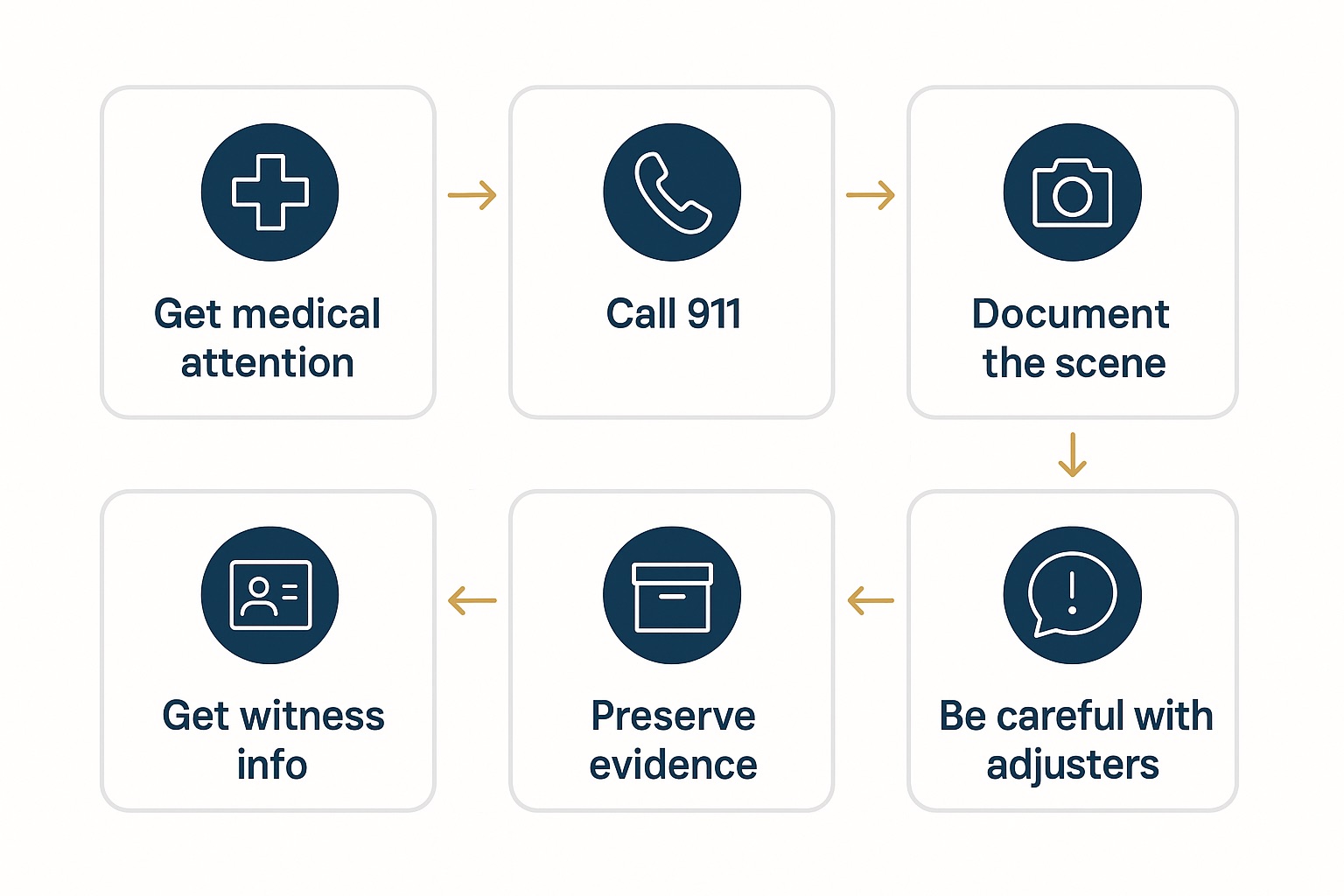
The steps after a drunk-driving crash are much like any serious collision, with a few points that matter specifically when alcohol is involved. If you are able to do so safely, the following can protect both your health and your claim.
- Get medical attention. See a doctor even if you feel only shaken. Some injuries surface hours or days later, and a prompt record ties your injuries to the crash.
- Call 911 and report the crash. Tell the responding officer if you suspect the other driver was impaired. The police report and any field-sobriety or breath-test results can become important evidence.
- Document the scene. Photograph the vehicles, the road, and your injuries. Note where the other driver had been (a bar, a restaurant, an event) if you learn it, since that can matter for a dram-shop claim.
- Get names and contact information for witnesses. Independent witnesses help establish both fault and impairment.
- Preserve evidence. Keep your medical records, bills, and any receipts for out-of-pocket costs. Do not repair or dispose of your vehicle until it has been documented.
- Be careful with insurance adjusters. You are not required to give a recorded statement to the other driver's insurer, and it is reasonable to speak with an attorney first.
If a criminal case (a DWI charge) comes out of the crash, that case runs separately from your civil injury claim. A conviction can help your civil case, but you do not have to wait for the criminal case to conclude before pursuing compensation. For a broader overview of crash claims, see our Liberty car accident lawyer page and our car accident practice overview.
Who can be held liable after a drunk-driving crash
The drunk driver
The impaired driver is almost always the primary responsible party. Driving while intoxicated is negligence, and it is often strong evidence of the kind of conscious disregard for others' safety that supports an injury claim. Fault is decided on the specific facts of the crash, but a driver who chose to drive while impaired is generally accountable for the harm that choice caused.
How impairment and fault are proven
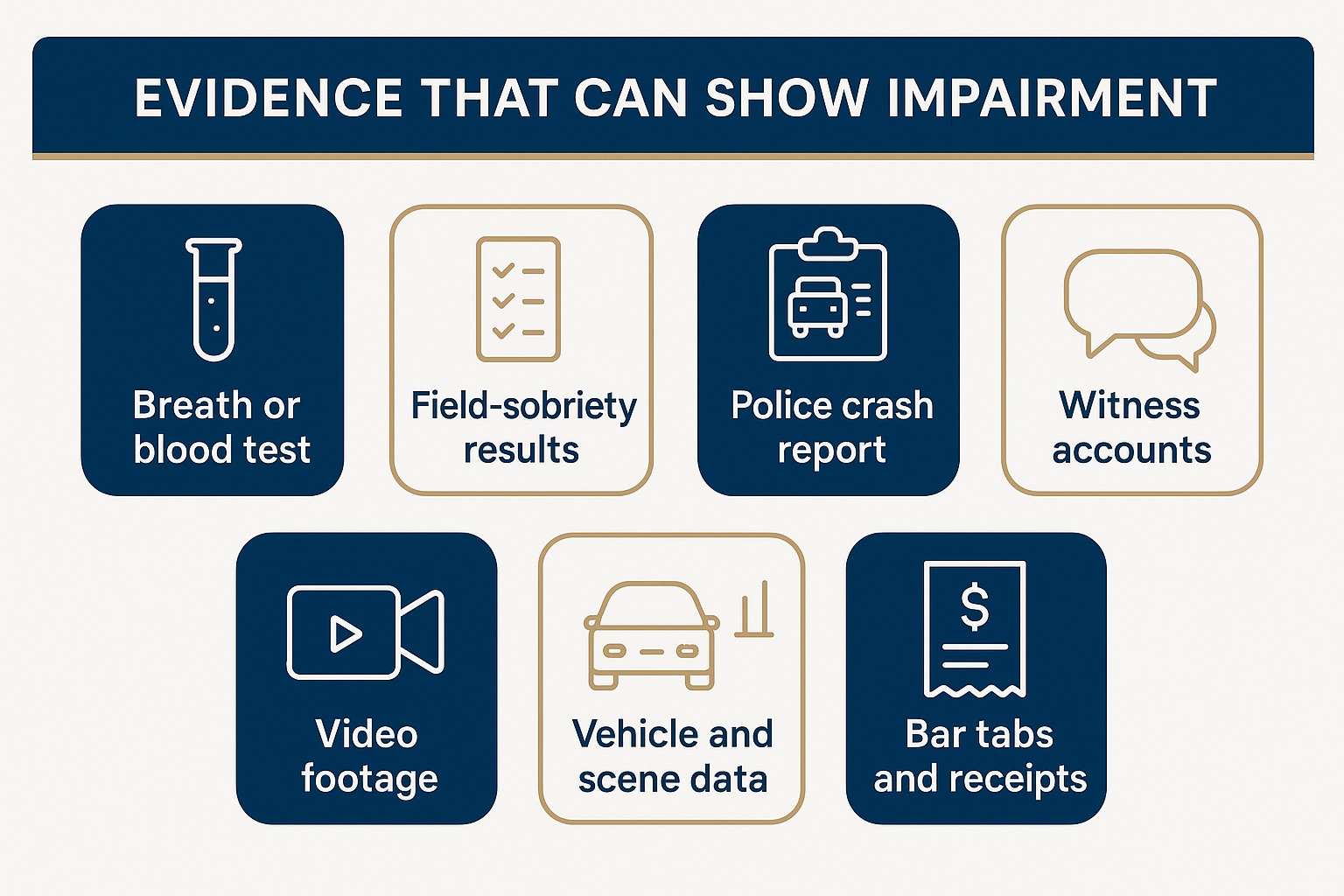
Proving that the other driver was impaired, and that the impairment caused the crash, usually comes down to the evidence gathered in the hours and days afterward. Several kinds of proof tend to matter in a Missouri drunk-driving claim.
- Chemical and field-sobriety results. A breath or blood test showing the driver's blood alcohol concentration, along with any field-sobriety testing the officer conducted at the scene, is often the most direct evidence of impairment. These results are usually recorded in the officer's report and any related records.
- The police and crash report. The responding officer's report documents observations that a jury or an adjuster relies on, such as the smell of alcohol, slurred speech, open containers, the officer's account of how the crash happened, and any citations issued.
- A DWI conviction. If the driver is charged and convicted of driving while intoxicated, that conviction does not automatically decide your civil case, but it can be strong evidence and can support a claim for punitive damages.
- Independent witnesses. People who saw the driving behavior before the crash, or who observed the driver afterward, can confirm both impairment and how the collision occurred. Their accounts carry weight because they are not parties to the case.
- Physical and electronic evidence. Vehicle damage, skid marks, the final resting positions of the vehicles, dashcam or nearby surveillance footage, and data from the vehicles themselves can reconstruct what happened and corroborate the other evidence.
The business or person who served the alcohol (dram-shop liability)
In some cases, the bar, restaurant, or other seller that provided the alcohol can also be held responsible. In Missouri, this is called dram-shop liability, and it is defined by statute at RSMo 537.053. Missouri's dram-shop law is narrow and carries a heightened standard of proof. It is not enough to show that a business served someone who later caused a crash.
Broadly, RSMo 537.053 allows a claim against a licensed seller only where it is shown by clear and convincing evidence that the seller knowingly served alcohol to a visibly intoxicated person, or served a person the seller knew or should have known was under 21. "Visibly intoxicated" has a specific statutory meaning tied to significantly uncoordinated physical action or significant physical dysfunction. Because the standard is demanding, whether a dram-shop claim is viable depends on what the evidence shows about the seller’s conduct.
Knowing where the driver had been drinking, how much, and whether staff kept serving a visibly impaired person can determine whether a dram-shop claim is realistic. We investigate that history when the circumstances suggest a seller may share responsibility.
What a dram-shop investigation looks like
Because RSMo 537.053 sets a demanding standard, a dram-shop investigation is about building a detailed record of the driver's evening. That work often starts with tracing where the driver was before the crash, since a single stop or a series of stops can point to the business that served the last drinks. From there, the investigation may involve requesting or subpoenaing the establishment's records, including bar tabs, receipts, and point-of-sale data that show what was served and when, along with any surveillance or security video that captured the driver's condition. Statements from servers, bartenders, and managers about what they observed can also matter. None of this lowers the legal standard. Acting fast decides whether the record still exists to measure against it. Receipts are discarded, video is overwritten, and staff move on.
Compensation you may recover
Missouri recognizes several categories of compensation in an injury claim. What applies to you depends on the severity of your injuries and the facts of the crash. No attorney can promise a specific result, but the categories generally break down as follows.
Economic damages
These are your measurable, out-of-pocket losses. They commonly include past and future medical bills, lost wages and lost earning capacity, property damage, and other direct costs of the crash. Missouri does not cap economic damages in a standard negligence injury case.
Non-economic damages
These cover harms that do not come with a receipt, such as pain, suffering, disability, disfigurement, and the loss of a normal life. They are real losses even though they are harder to quantify.
Punitive damages
Punitive damages are different. They are not meant to compensate you for a loss but to punish especially bad conduct and to deter it. Drunk driving is a recognized fact pattern where punitive damages may be available, because choosing to drive while impaired can show the kind of reckless indifference the law targets.
Under RSMo 510.261, punitive damages in Missouri require proof by clear and convincing evidence that the defendant intentionally harmed the plaintiff or acted with deliberate and flagrant disregard for the safety of others, and the statute sets procedural requirements for pleading them. Whether they are available in your case turns on what the evidence shows about the other driver’s conduct. We do not promise punitive damages; we evaluate whether the record supports a claim for them.
When the drunk driver has no or too little insurance
Drunk drivers are often uninsured or carry only minimum coverage, which can be far less than a serious injury costs. When that happens, your own auto policy may be the source of your recovery through uninsured motorist (UM) or underinsured motorist (UIM) coverage.
In Missouri, uninsured motorist coverage is mandatory under RSMo 379.203, with minimum limits of $25,000 per person and $50,000 per accident. Underinsured motorist coverage is optional in Missouri, so whether you carry it depends on your policy. A UM or UIM claim is made against your own insurer under your contract, and the specifics (how much coverage applies, how it interacts with the at-fault driver's limits, and what conditions your policy sets) turn on your policy language and the facts. We review your declarations page as part of evaluating a drunk-driving claim so that a driver's lack of insurance does not leave you without a path to recovery. Our guide to uninsured and underinsured motorist claims in Missouri covers the details.
Missouri's deadline to file
Missouri generally gives you five years from the date of the crash to file a personal-injury lawsuit, under RSMo 516.120. That is a longer window than many states, but it is not a reason to wait. If the crash caused a death, a wrongful-death claim follows a different timeline, and the deadline for a UM or UIM claim can differ because it arises from your insurance contract rather than the tort. If any deadline may be close, treat it as urgent and get advice promptly.
What if I was partly at fault?
Missouri follows a pure comparative fault rule, adopted by the Missouri Supreme Court in Gustafson v. Benda, 661 S.W.2d 11 (Mo. 1983). Under pure comparative fault, your recovery is reduced by your own percentage of fault, but you are not barred from recovering even if you were partly responsible. For example, if your damages are found to be $100,000 and you are assigned 20 percent of the fault, your recovery is reduced by that 20 percent. In a drunk-driving case the impaired driver usually bears the large share of fault, but because Missouri lets a defendant argue comparative fault, how the crash is documented matters.
Drunk-driving crash claims in Liberty and Clay County
Our office sits in Liberty, and we regularly help injured people across Clay County and the north Kansas City metro, including Kearney, Gladstone, and North Kansas City. Drunk-driving crashes happen on the roads people here use every day, from I-35 and Route 291 to the surface streets near restaurants and bars. Handling these cases locally means we know the courts, the roads, and the investigators involved. If your crash happened elsewhere in the metro, our Kansas City car accident lawyer page and our general Liberty personal injury overview may also help.
You can also find client-education videos on our YouTube channel, where we walk through what to expect in an injury claim.
Frequently asked questions
Can I sue the bar that served the drunk driver in Missouri?
Sometimes, but Missouri's dram-shop law is narrow. Under RSMo 537.053, a claim against a licensed seller generally requires clear and convincing evidence that the seller knowingly served a visibly intoxicated person or served someone under 21. Whether you have one depends on what can be proved about how the alcohol was served, so secure receipts, video, and witness accounts early.
Can I get punitive damages if a drunk driver hit me?
Possibly. Drunk driving is a recognized fact pattern for punitive damages in Missouri, but they are not automatic. Under RSMo 510.261, punitive damages require clear and convincing evidence of intentional harm or a deliberate and flagrant disregard for the safety of others. Whether they are available, and whether they would be awarded, depends on the evidence in your case.
How long do I have to file a claim after a drunk-driving crash in Missouri?
Missouri generally allows five years from the date of the crash to file a personal-injury lawsuit under RSMo 516.120. A wrongful-death claim and a claim under your own uninsured or underinsured motorist coverage can follow different timelines, so do not assume the five-year window applies to every part of your case.
What if the drunk driver had no insurance or not enough?
Your own uninsured or underinsured motorist coverage may apply. Uninsured motorist coverage is mandatory in Missouri, while underinsured motorist coverage is optional and depends on your policy. The amount available and how it interacts with the at-fault driver's coverage turn on your policy language, so have your policy reviewed.
Do I have to wait for the DWI criminal case to finish before I file my claim?
No. Your civil injury claim is separate from the driver's criminal case. A conviction can help your civil claim, but you do not have to wait for the criminal case to conclude before pursuing compensation.
What if I was partly at fault for the crash?
Missouri uses pure comparative fault, so you can still recover even if you were partly responsible. Your recovery is reduced by your percentage of fault. In most drunk-driving cases the impaired driver carries the larger share of fault.
Talk with a Liberty drunk-driving injury attorney
If a drunk driver injured you or someone in your family, you can talk through your options with our office at no cost. We will look at how the crash happened, whether a dram-shop or punitive claim fits the facts, and what insurance coverage may apply. Call our Liberty office at 816-367-6937, or reach us online to schedule a free consultation. Our office is at 28A Westwoods Dr, Liberty, MO 64068.
This page is general information about Missouri law and is not legal advice. No result is guaranteed. Speaking with us does not create an attorney-client relationship until we agree in writing to represent you.