How Much Is My Car Accident Claim Worth in Missouri?
There is no single dollar figure that answers this, and anyone who gives you one before reviewing your case is guessing. What a Missouri car accident claim is worth depends on your damages (medical bills, lost income, and the harm the injury caused), the insurance coverage available to pay them, and the share of fault assigned to each driver. Take a claim valued at $100,000. Your share of the fault and the other driver's policy limits decide how much of that you collect. If your crash happened in the north Kansas City metro, our Liberty office serves Clay County and the surrounding area, and Missouri law governs your claim.
The short answer
A Missouri car accident claim is worth the total of your economic damages plus your non-economic damages, reduced by your own percentage of fault, and then capped in practice by the insurance coverage that is available to pay. Two claims with the same injury can settle for very different amounts because of fault and coverage, not because one lawyer is better at picking a number.
Our attorney video walks through how the value of a personal injury claim is figured.
More on how a case is valued is on our YouTube channel.
What determines the value of a Missouri car accident claim?
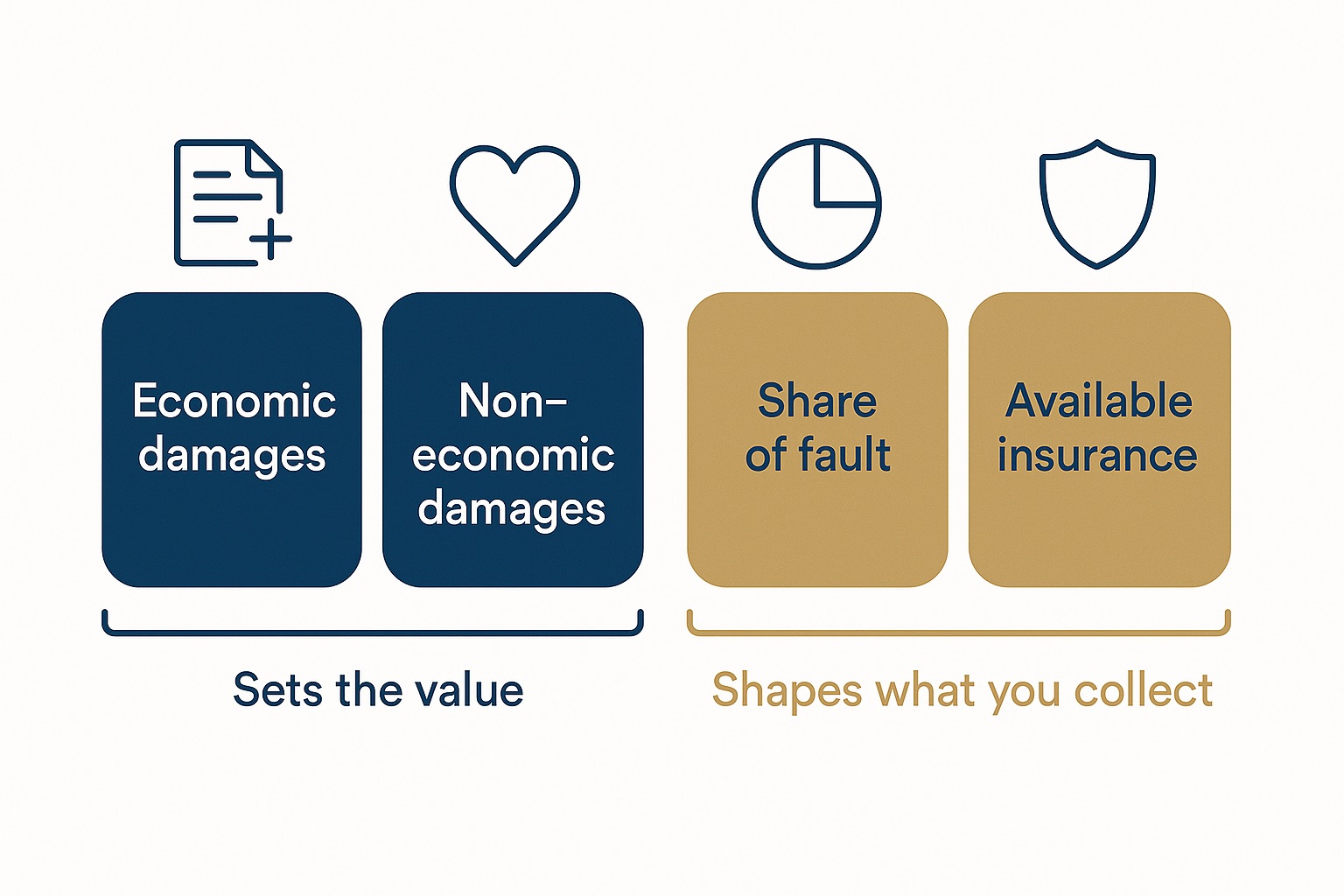
- Your economic damages: the measurable, out-of-pocket losses.
- Your non-economic damages: the human harm that is real but not billed on an invoice.
- Fault: Missouri reduces your recovery by your share of the blame.
- Available insurance: even a well-documented claim can only collect against the coverage that exists.
The first two set the gross value of the claim. The last two decide how much of that value you can realistically collect. A strong claim on paper can still be limited by a small policy, and a serious injury can still be reduced if you carried part of the fault.
Economic vs non-economic damages in Missouri
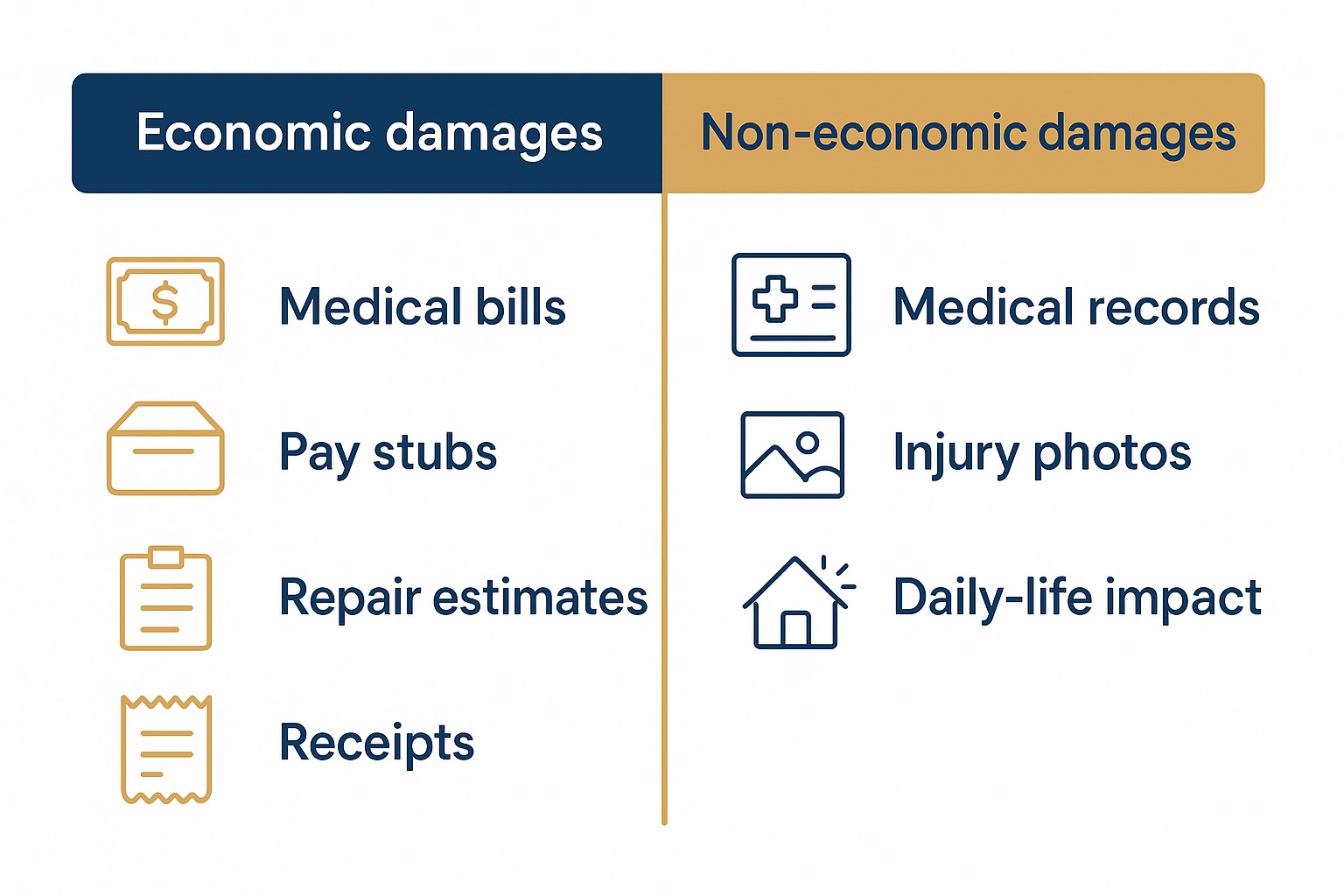
Missouri, like most states, splits compensable harm into two buckets.
Economic damages
These are your measurable financial losses. They usually include:
- Medical expenses, both what you have already been billed and the reasonable cost of care you will still need.
- Lost wages and lost earning capacity if the injury affects your ability to work.
- Property damage, including your vehicle.
- Out-of-pocket costs tied to the injury, such as mileage to appointments or hired help you would not otherwise need.
Economic damages are the part of a claim you can document with records, so building them well is mostly a matter of gathering and organizing proof.
Non-economic damages
These cover real harm that does not arrive as a bill:
- Pain and suffering.
- Emotional distress.
- Loss of the normal enjoyment of life.
- In some cases, the effect on a spouse or family relationship.
Non-economic damages are where valuation gets less mechanical. There is no formula that a Missouri court is required to use, and no fixed multiplier that insurers must honor, despite what online settlement calculators suggest. Their weight depends on the severity and permanence of the injury and how well the effect on your daily life is documented.
In an ordinary car accident negligence case, Missouri does not impose a statutory cap on non-economic damages. The well-known cap under RSMo 538.210 applies to medical-malpractice actions against health care providers, not to a routine auto claim. That does not mean a jury will award an unlimited number. It means the value is not artificially reduced by a statutory ceiling before you begin.
How Missouri's comparative fault rule changes the number
Missouri follows pure comparative fault. Under this rule, your recovery is reduced by your own percentage of fault, but you are not barred from recovering just because you share some of the blame, even if your share is large. That rule comes from Missouri case law, principally Gustafson v. Benda, 661 S.W.2d 11 (Mo. banc 1983).
A simple example shows the effect. If a claim is valued at $100,000 and you are found 20 percent at fault, your recovery is reduced by that 20 percent, to $80,000. Under pure comparative fault, even a driver found 70 percent at fault can still recover 30 percent of the total. This is different from states that bar recovery once your fault crosses a threshold, so how another state handles fault does not tell you how Missouri will.
Because fault directly scales the payout, how it is assessed is often the most contested part of a claim. That is where police reports, witness statements, photographs, and sometimes reconstruction all matter.
You can read more on our Missouri comparative fault page .
How insurance limits and UM/UIM coverage cap what you collect
A claim's value on paper is one thing. What you can collect is limited by the insurance available to pay it.
Missouri requires drivers to carry liability coverage, with minimum bodily-injury limits of $25,000 per person and $50,000 per accident. If the at-fault driver carries only the minimum and your damages exceed it, that policy alone will not make you whole. That gap is common in serious-injury cases.
This is where your own coverage matters. Missouri also requires uninsured motorist (UM) coverage under RSMo 379.203, at the same $25,000 per person and $50,000 per accident minimums, which responds when the at-fault driver has no insurance or cannot be found. Underinsured motorist (UIM) coverage, which responds when the at-fault driver has some coverage but not enough, is optional in Missouri and only applies if you bought it. Whether and how these coverages stack, offset, or apply turns on your specific policy language and the facts.
Because coverage can be the real ceiling on what you recover, one of the first steps is to check every policy that might apply: the at-fault driver's, your own UM and UIM, and sometimes another household or resident-relative policy. Our Missouri uninsured and underinsured motorist page explains how that coverage works and how policy limits factor into a settlement.
Why online settlement calculators are usually wrong
Calculators and "average settlement" figures make claim value look like arithmetic. No average knows your policy limits or your fault percentage. Treat any online number as a rough starting point, not a prediction.
Does hiring a lawyer change what a claim is worth?
It can, though not by conjuring a bigger number. A lawyer's role in valuation is to document economic damages fully, present the non-economic harm credibly, contest an unfair fault assignment, and find every applicable policy so the claim is not capped by coverage no one checked. Whether that changes the outcome depends on the facts, and no result is guaranteed.
Deadlines matter, because a claim you cannot file has no value
In Missouri, the general statute of limitations for a personal-injury claim is five years from the date of the injury, under RSMo 516.120. Different deadlines can apply to certain claims, including wrongful-death claims and claims involving a government entity, so the five-year rule is a general starting point rather than a guarantee for every case. Waiting also tends to weaken a claim as evidence fades and memories blur, which affects value regardless of the deadline. More detail is on our Missouri statute of limitations page .
Frequently asked questions
What is the average car accident settlement in Missouri?
There is no reliable "average" that will tell you what your claim is worth. Published averages combine minor and catastrophic cases, and they ignore the two factors that most affect your recovery: your percentage of fault and the insurance coverage available. A minor soft-tissue claim and a permanent-injury claim are not comparable, so an average of both predicts neither.
Does Missouri cap pain and suffering damages in a car accident case?
In an ordinary car accident negligence case, Missouri does not impose a statutory cap on non-economic (pain and suffering) damages. The cap under RSMo 538.210 applies to medical-malpractice claims against health care providers, not to routine auto claims.
How does being partly at fault affect my Missouri claim?
Missouri uses pure comparative fault, so your recovery is reduced by your percentage of fault but is not eliminated because you share some blame. If a claim is worth $100,000 and you are 20 percent at fault, you recover $80,000.
What if the other driver did not have enough insurance?
If the at-fault driver carried only Missouri's minimum limits, or none, your own coverage may fill the gap. Uninsured motorist coverage is required in Missouri and applies when the other driver has no insurance. Underinsured motorist coverage is optional and applies when the other driver has some coverage but not enough, if you purchased it. Whether these coverages apply and how they interact depends on your policy.
How long do I have to file a car accident claim in Missouri?
The general deadline for a personal-injury claim in Missouri is five years from the date of injury under RSMo 516.120. Some claims, including wrongful-death and claims against a government entity, follow different rules, so confirm your specific deadline early.
Do I have to go to court to get a settlement?
Most Missouri car accident claims resolve without a trial. A claim can settle at any stage, and filing suit does not commit you to a trial. Whether a case settles or is tried depends on the facts, the coverage, and whether the insurer values the claim fairly.
Talk through your claim with our Liberty office
If you want a straight assessment of what your Missouri car accident claim involves, we are glad to review it with you. There is no cost for the initial conversation, and no pressure to hire.
Empower Injury Law 28A Westwoods Dr, Liberty, MO 64068 Phone: 816-367-6937 Email: [email protected]
You can also learn more about how we handle Missouri car accident cases on our Liberty car accident page.
This page is general information about Missouri law, not legal advice, and it does not create an attorney-client relationship. No outcome is promised.
Author Bio

Kevin A. Jones | Personal Injury Lawyer
Kevin A. Jones, founder and managing attorney of Empower Injury Law, has been practicing law since 2009. With over $25 million in jury verdicts and settlements in his first decade, Kevin has earned a reputation as a fierce advocate for his clients.
Kevin’s approach to law is rooted in his passion for helping people who have been mistreated by corporations, insurance companies, and other powerful entities.
Whether representing individuals wronged by negligent drivers or those injured on someone else’s property, Kevin is dedicated to achieving justice. His extensive experience in the courtroom ensures that clients receive strong, personalized representation that delivers results.
Practice Areas


