How Much Is My Car Accident Claim Worth in Kansas?
There is no single formula that tells you what a Kansas car accident claim is worth, but the value comes from three things you can evaluate: the damages you can prove, how much of the crash was your fault under Kansas comparative-fault law, and whether your injury clears the Kansas no-fault threshold that controls when you can recover for pain and suffering at all. If you were hurt in Lawrence or elsewhere in Douglas County, those three things, not an online average, set the number.
Much of what you read online about claim value is written for other states. Kansas differs on the two rules that move the number most, comparative fault and no-fault (PIP).
This is general information, not legal advice, and it does not predict what any particular claim will recover.
The short answer: what a Kansas claim's value depends on
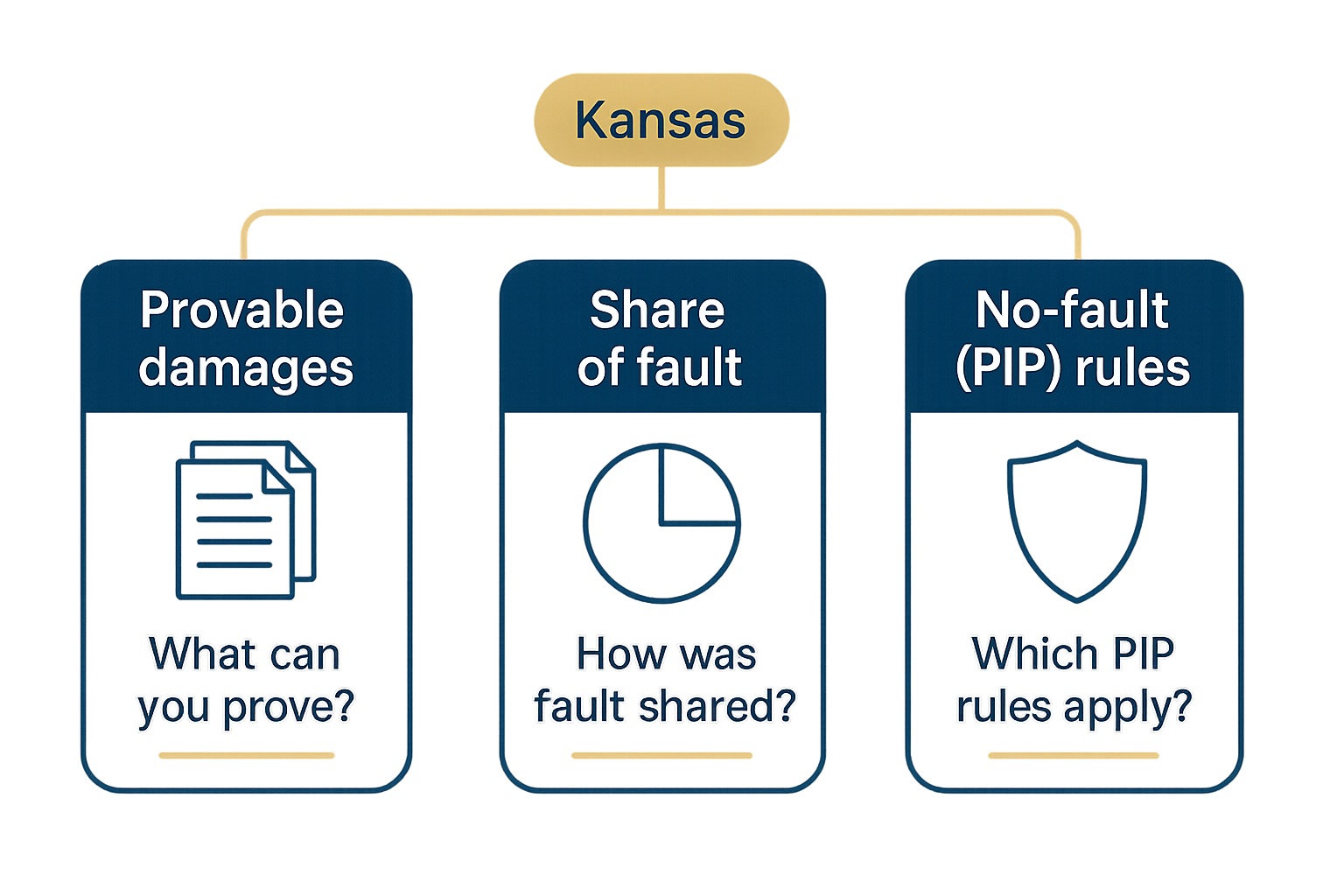
A Kansas car accident claim's value is a function of three questions:
- What are your total damages? This is everything the crash cost you, both financial losses (economic damages) and human losses (non-economic damages such as pain and suffering).
- What is your share of fault? Under Kansas modified comparative fault, your recovery is reduced by your percentage of fault, and if you are 50 percent or more at fault you recover nothing.
- Does your injury clear the Kansas no-fault threshold? Because Kansas requires personal injury protection (PIP), you can only pursue non-economic damages from the at-fault driver if your injury meets a statutory threshold.
The damages that make up a Kansas claim
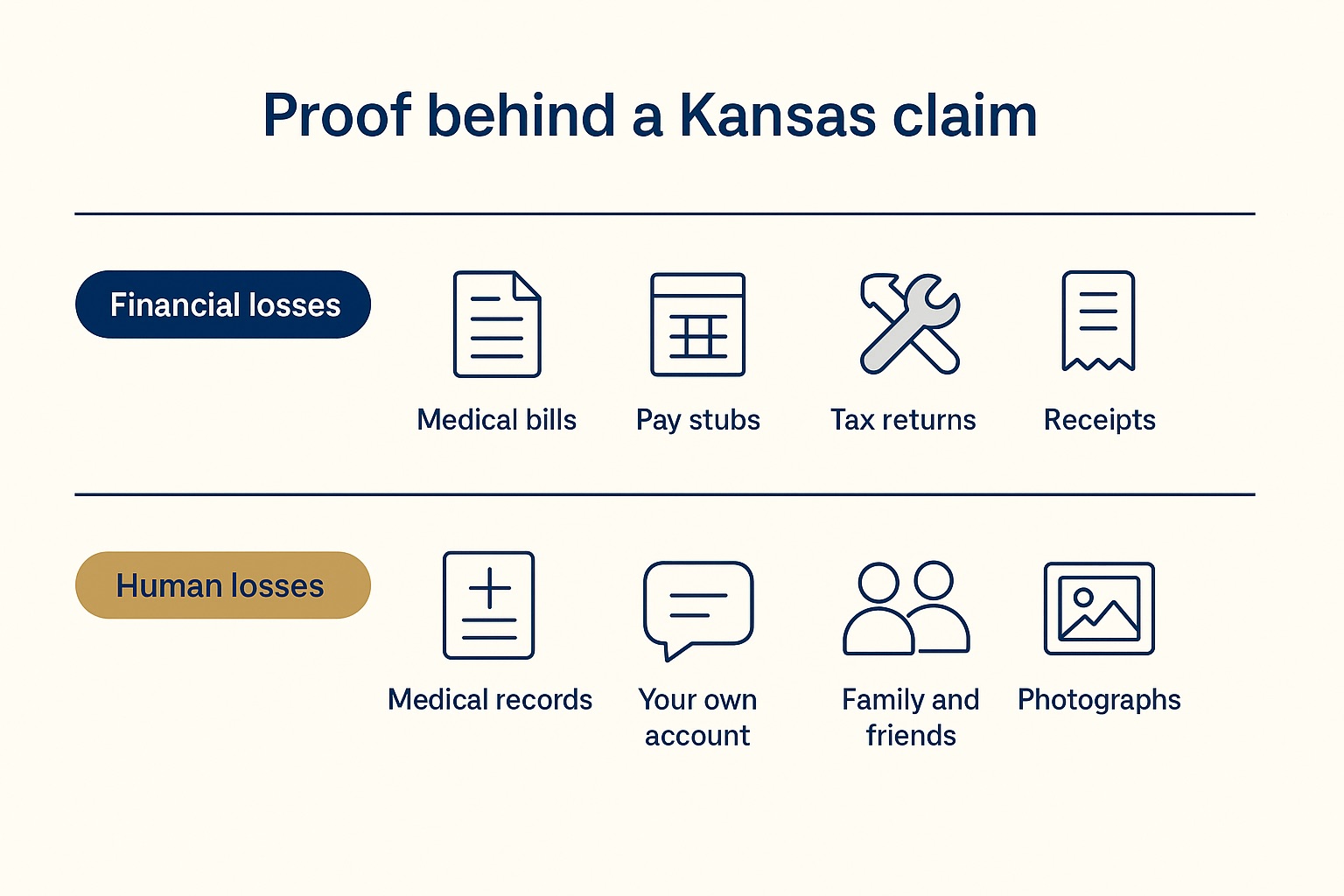
Damages fall into two broad categories in Kansas, and each is proven differently.
Economic damages (your financial losses)
Economic damages are the measurable, out-of-pocket costs of the crash. They typically include:
- Medical expenses, both the treatment you have already had and the care you will reasonably need going forward.
- Lost wages and lost earning capacity if the injury keeps you from working or limits what you can earn.
- Property damage, most commonly the repair or replacement of your vehicle.
- Other documented out-of-pocket costs tied to the injury, such as prescriptions, medical equipment, or the cost of help with tasks you can no longer do yourself.
Economic damages are proven with records. Medical bills and records, pay stubs or employer letters, tax returns, repair estimates, and receipts all build this part of the claim. Future losses (future medical care or reduced earning capacity) usually require a treating physician's opinion, and sometimes a vocational or economic expert, because you are proving what has not happened yet.
Non-economic damages (your human losses)
Non-economic damages compensate for harms that do not come with a receipt:
- Physical pain and suffering.
- Mental and emotional distress.
- Loss of enjoyment of life, meaning the activities and quality of life the injury took from you.
- Disfigurement or permanent impairment.
These are proven through your own testimony, the testimony of people who know you and have seen the change, your medical records documenting the injury and its course, and sometimes photographs. There is no meter that converts pain into dollars, which is one reason the value of two claims with similar bills can differ. In Kansas, though, non-economic damages come with an extra threshold requirement (covered below) that does not apply to your economic losses.
Kansas at one point capped non-economic damages by statute, but the Kansas Supreme Court held that cap unconstitutional in Hilburn v. Enerpipe Ltd. (2019), ruling that it violated the right to trial by jury under the Kansas Constitution. The general rule is currently that non-economic damages in a personal injury case are not subject to the general cap in K.S.A. 60-19a02, which Hilburn struck down.
How Kansas comparative fault changes the number
Kansas follows modified comparative fault with a 50 percent bar under K.S.A. 60-258a.
Your recovery is reduced by your percentage of fault. If your total damages are found to be $100,000 and you are assigned 20 percent of the fault, you recover $80,000. The higher your share of fault, the lower the number.
There is also a hard cutoff. Under the statute, a claimant may recover only if that claimant's fault is less than the fault of the party or parties being sued. In practical terms, if you are 50 percent or more responsible for the crash, Kansas bars recovery entirely, and the claim's value drops to zero regardless of how large your damages are.
This is why fault is not a side issue in valuation. It is a multiplier on the whole claim, and near the 50 percent line it becomes a switch that turns recovery on or off. Where there are multiple at-fault parties, your fault is compared against their combined fault, which is an important detail in multi-vehicle crashes.
For how fault gets assigned and disputed in practice, and how it plays out in a real Douglas County crash, our Lawrence, Kansas car accident lawyer page goes into more detail.
The Kansas no-fault (PIP) threshold and pain-and-suffering
This is the piece most often missed in general articles, and it is specific to no-fault states like Kansas.
Kansas is a no-fault state under the Kansas Automobile Injury Reparations Act (KAIRA), K.S.A. 40-3101 et seq. Every Kansas auto policy includes personal injury protection (PIP), and PIP pays your own economic losses first, regardless of who caused the crash. That means your initial medical bills and a portion of lost income are typically paid through your own PIP coverage without having to prove fault.
The catch is that no-fault limits when you can step outside that system and pursue non-economic damages (pain and suffering) from the at-fault driver. Under K.S.A. 40-3117, you can only bring a claim for non-economic damages if your injury meets a statutory threshold. That threshold can be met in one of two ways:
- A monetary threshold, meaning your reasonable medical expenses reach a set dollar amount. The current threshold is $ in qualifying medical expense.
- An injury-type threshold, meaning the injury is of a certain serious kind regardless of the bill amount. This category includes injuries such as a permanent injury, permanent disfigurement, a fracture of a weight-bearing bone, certain other fractures, permanent loss of a bodily function, or death.
If your injury clears either path, you can pursue pain-and-suffering damages against the at-fault driver. If it does not clear the threshold, your recovery from the at-fault driver may be limited to economic losses, and much of that may already be covered by PIP. This is why the same crash can support a much larger claim for one person than another: the person whose injury clears the threshold has a route to non-economic damages that the person below the threshold does not.
For how PIP itself works, see our guide to Kansas PIP and no-fault insurance.
How injury claims are valued in general
This video covers how injury claims are valued in general; the Kansas rules above still control.
How Much Is My Personal Injury Case Worth?
You can find more client-education videos on the firm's YouTube channel.
Putting it together
For a Kansas claim, the practical sequence is: total the economic and non-economic damages you can prove, check whether the injury clears the K.S.A. 40-3117 threshold so that non-economic damages are even on the table, and then account for your comparative-fault share under K.S.A. 60-258a. A claim is not worth a headline figure. It is worth what you can prove, adjusted for fault, within the limits Kansas no-fault sets. That is why a careful review of your records and the facts of the crash tells you more than any online estimate.
If you would like a review of your own situation, our Lawrence personal injury lawyer page explains how the Lawrence office works with injured people in Douglas County and across eastern Kansas.
Frequently asked questions
How is a car accident claim's value calculated in Kansas?
It starts with your provable damages, both economic (medical bills, lost income, property damage, future losses) and non-economic (pain and suffering, if your injury clears the Kansas no-fault threshold). That total is then reduced by your percentage of fault under Kansas comparative-fault law, and if you are 50 percent or more at fault you recover nothing.
Can I recover pain and suffering after a Kansas car accident?
Only if your injury meets the threshold in K.S.A. 40-3117. Because Kansas is a no-fault (PIP) state, you can pursue non-economic damages from the at-fault driver only when your reasonable medical expenses reach the statutory amount or your injury is of a serious type the statute lists, such as a permanent injury, disfigurement, or certain fractures.
What happens to my claim if I was partly at fault in Kansas?
Your recovery is reduced by your percentage of fault. Under K.S.A. 60-258a, Kansas uses modified comparative fault with a 50 percent bar, so if you are found 50 percent or more at fault you recover nothing. Below that, a claim worth $100,000 with 20 percent fault on you would recover $80,000.
Is there a cap on non-economic damages in Kansas?
Kansas previously capped non-economic damages by statute, but the Kansas Supreme Court struck that cap down in Hilburn v. Enerpipe Ltd. (2019) as a violation of the state constitutional right to a jury trial. That ruling struck down the general cap in K.S.A. 60-19a02, so it no longer limits non-economic damages in an ordinary personal injury case.
Does my own PIP coverage affect what my claim is worth?
PIP pays your own economic losses first, regardless of fault, which often covers early medical bills and part of your lost income. That does not reduce the underlying value of your claim, but it changes how the pieces are paid and coordinated, and it is tied to the same statute that controls whether you can pursue pain and suffering at all.
Do I have to accept the insurance company's valuation of my claim?
No. An adjuster's offer reflects the insurer's view of the same three factors, and it will not always account fully for your future losses, the strength of your non-economic damages, or a fair reading of comparative fault. You are free to have the claim reviewed independently before you agree to any number.
Talk to the Lawrence office
If you were injured in a crash in Lawrence or anywhere in Douglas County, you are welcome to a free consultation to talk through your specific situation and what may drive its value under Kansas law. There is no obligation, and no pressure to file anything. Call the Lawrence office at 785-367-6937, or email [email protected]. The office is at 831 Massachusetts St, Lawrence, KS 66044.
Author Bio

Kevin A. Jones | Personal Injury Lawyer
Kevin A. Jones, founder and managing attorney of Empower Injury Law, has been practicing law since 2009. With over $25 million in jury verdicts and settlements in his first decade, Kevin has earned a reputation as a fierce advocate for his clients.
Kevin’s approach to law is rooted in his passion for helping people who have been mistreated by corporations, insurance companies, and other powerful entities.
Whether representing individuals wronged by negligent drivers or those injured on someone else’s property, Kevin is dedicated to achieving justice. His extensive experience in the courtroom ensures that clients receive strong, personalized representation that delivers results.
Practice Areas


