If your own insurance company has denied, delayed, or underpaid a claim in Missouri without a good reason, the law has a name for it: vexatious refusal to pay. It is Missouri's statutory answer to an insurer that sits on money it owes, and when a policyholder proves it, the insurer can be ordered to pay a penalty and the policyholder's attorney fees on top of the benefits it should have paid all along. This page explains what vexatious refusal means, how it differs from the broader idea of insurance bad faith, whether your situation is likely to qualify, and what you can do next.
Most people who search this term have already hit a wall. You filed a claim under a policy you paid for, and your insurer is not paying, not answering, or offering a fraction of what the claim is worth. If that is happening to you in Clay County or the north Kansas City metro, our Liberty office offers a free case review at 816-367-6937. First, here is how Missouri law actually works.
What is vexatious refusal to pay in Missouri?
Vexatious refusal to pay is a statutory remedy that penalizes an insurance company for refusing to pay a valid claim without reasonable cause or excuse. It is governed by RSMo 375.420 and its companion provision RSMo 375.296. The core idea is straightforward. If an insurer owes you money under your policy, and it refuses to pay without a legitimate reason, you can recover more than just the benefits: you can also recover a statutory penalty and your reasonable attorney fees.
The key phrase is "without reasonable cause or excuse." Missouri does not punish an insurer simply because it lost a coverage argument. It punishes an insurer that had no genuine basis to withhold payment and made you fight for money that was plainly owed. That distinction runs through everything below, and it is usually the heart of the case.
Vexatious refusal most often comes up in first-party claims, meaning claims against your own insurer under your own policy. In an auto context that typically means an uninsured or underinsured motorist (UM/UIM) claim, or a medical payments (med pay) claim, where your own coverage is the source of your recovery and your own carrier decides what to offer.
Vexatious refusal vs. bad faith in Missouri
People use "bad faith" as a catch-all for an insurer behaving badly, but in Missouri the two concepts are not the same, and getting them straight matters for what you can actually claim.
There is no first-party bad-faith tort in Missouri
Some states let you sue your own insurance company for the tort of "bad faith" and recover broad tort damages. Missouri does not. Missouri does not recognize a separate first-party common-law bad-faith cause of action against your own insurer. When your own carrier mishandles a claim, your remedies are the ones the state does provide: a breach-of-contract claim to recover the benefits the policy owes you, and a vexatious-refusal claim under RSMo 375.420 and 375.296 that adds a penalty and attorney fees when the refusal was unreasonable. In practice, the vexatious-refusal statutes are Missouri's quasi-bad-faith remedy for first-party disputes. They do the work that a first-party bad-faith tort does in other states, but through a defined statutory penalty rather than open-ended tort damages.
Third-party bad-faith failure to settle is a different animal
There is a genuine bad-faith doctrine in Missouri, but it is a third-party concept. Bad-faith failure to settle arises when a liability insurer, defending its own insured against someone else's claim, refuses to settle within the policy limits when it reasonably should have, and then exposes that insured to a judgment above the limits. The duty runs from the insurer to the person it is defending, not to the injured claimant.
Here is how that can still reach an injured person. When an at-fault driver is hit with a judgment above their policy limits because their insurer would not accept a reasonable settlement, that driver may assign the resulting bad-faith claim to the injured party as part of resolving the case. Through that assignment, a claim that began as a duty owed to the at-fault driver can end up in the hands of the person who was injured. It is a real mechanism in Missouri practice, but it only works in a narrow set of cases, and whether yours is one of them is something we look at early.
The short version: if the dispute is with your own insurer, you are almost certainly in vexatious-refusal territory, not bad-faith-tort territory. If the dispute involves the at-fault driver's insurer refusing a reasonable settlement, that is where bad faith failure to settle lives.
Can I sue my insurance company for denying my claim in Missouri?
Yes, you can sue your insurance company in Missouri when it owes you money under your policy and will not pay. A denied, delayed, or underpaid first-party claim can support a breach-of-contract action to recover the benefits, and, where the refusal lacked reasonable cause or excuse, a vexatious-refusal claim on top of it. You do not have to accept a denial as final just because the insurer put it in writing.
That said, suing is not automatic and it is not always the first move. Whether a claim is worth filing depends on the policy language, the strength of the underlying loss, and how the insurer actually handled the file. An insurer that has a genuine, arguable reason to question coverage is in a different position than one that is simply stalling. The next two sections explain that line, because it decides whether you have an ordinary coverage disagreement or something the law will penalize.
My insurance company won't pay my car accident claim. Is that vexatious refusal?
Not every unpaid or underpaid claim is vexatious refusal. Missouri draws a clear line between a legitimate dispute and an unreasonable one.
An insurer is allowed to disagree with you. If there is a genuine, arguable question about whether the policy covers your loss, how much the claim is worth, or whether an exclusion applies, the insurer can take a position and litigate it. That is a coverage dispute. In that situation you may still recover the benefits you are owed if you are right, but the extra penalty for vexatious refusal generally will not apply, because the insurer had a reasonable basis to say no.
Vexatious refusal is different in kind. It targets a refusal made without reasonable cause or excuse, where the insurer is not really disputing the claim so much as declining to pay something it owes. Courts look at what the insurer knew and how the facts appeared as the claim was handled, not simply at who wins in the end. An insurer does not commit vexatious refusal just because a court later disagrees with its position, and it is not off the hook just because it can invent a reason after the fact.
Signs that a refusal may cross the line into vexatious territory include an insurer that ignores clear evidence supporting the claim, gives shifting or unexplained reasons for the denial, fails to investigate before denying, or offers far less than the documented loss with no articulated basis. None of these guarantees a vexatious-refusal finding on its own. The answer comes from the record: the claim file, the policy, and the insurer's conduct. That record is the first thing we review.
Insurance claim denied without reason in Missouri: what to do
A denial with no real explanation is one of the more common triggers for a vexatious-refusal question, and it is worth understanding the difference between a denial that has a reason you disagree with and a denial that has no genuine reason at all. Below is a practical short lead-in to the firm's video on why claims get denied, because knowing the common reasons helps you tell those two situations apart.
The firm covers this in a short client-education video on the most common reasons an injury claim gets denied.
Top 3 Reasons Your Injury Claim Will Be DENIED
More of the firm's client-education videos are on the Empower Injury Law YouTube channel.
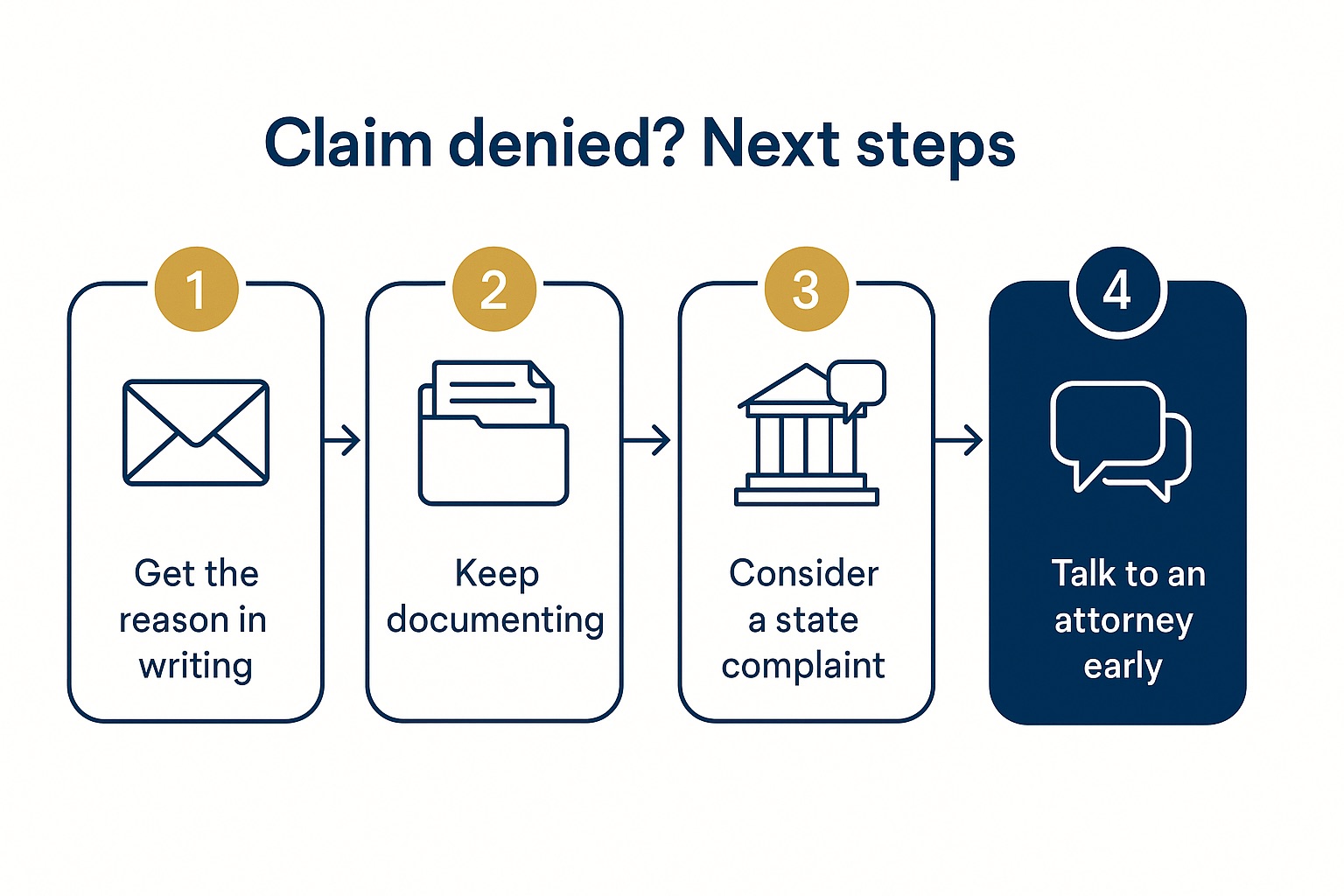
If your claim was denied without a clear reason, a few steps preserve your position while you evaluate whether the refusal was reasonable.
Get the denial and the reason in writing
Ask the insurer to state the specific basis for the denial in writing, and to identify the policy provision it is relying on. A refusal that cannot point to a coherent reason is very different from one that can. Keeping that record is useful whether the matter resolves informally or ends up in litigation.
Keep documenting the claim
Save your correspondence, keep a log of calls and adjuster names, and preserve the evidence of your loss (medical records, bills, repair estimates, wage documentation). How the facts appeared while the insurer was handling the claim is central to a vexatious-refusal analysis, so a clear paper trail matters.
Consider a complaint to the state regulator
Litigation is not always the first step. Missouri policyholders can file a complaint with the Missouri Department of Commerce and Insurance, the state agency that regulates insurers, and can reach its Insurance Consumer Hotline at 800-726-7390. A regulatory complaint does not replace a legal claim and it will not, by itself, force payment of your damages, but it creates a record and sometimes prompts a carrier to take a stalled claim seriously. It is one tool among several.
Talk to an attorney before the deadline runs
A vexatious-refusal claim and the underlying contract claim are subject to filing deadlines. In Missouri, a vexatious-refusal claim has a 5-year deadline. If the underlying claim is a UM/UIM claim on your auto policy, it is a claim on a written contract, which has a 10-year deadline under RSMo 516.110. Missing a deadline can end a claim regardless of how strong it was, so do not let a slow insurer run out your time.
How to prove vexatious refusal to pay in Missouri
Proving vexatious refusal is not about showing the insurer was wrong. It is about showing the insurer had no reasonable cause or excuse to refuse. In broad terms, a policyholder needs to establish three things: that a valid policy covered the loss, that the insurer refused to pay (or unreasonably delayed or underpaid), and that the refusal lacked reasonable cause or excuse.
The first two are usually the more straightforward part. The contest is almost always over the third. Missouri courts assess reasonableness based on how the facts appeared to the insurer as it handled the claim, which is why the claim file and the timeline matter so much. Evidence that tends to support a vexatious-refusal claim includes documentation that the loss was clearly covered, proof the insurer ignored or failed to investigate available information, inconsistent or shifting explanations for the denial, and a gap between what the loss was plainly worth and what the insurer offered without explanation.
There is often a procedural piece as well. RSMo 375.296 addresses situations where an insurer refuses to pay after the loss and the policyholder has to demand payment or bring suit, and it can affect when a penalty is available. Because these requirements can determine whether the penalty is on the table at all, this is one of the reasons it helps to involve an attorney early rather than after the claim has been mishandled for months.
What is the penalty for vexatious refusal to pay in Missouri?
If a policyholder proves vexatious refusal, the recovery goes beyond the benefits the policy owes. Under RSMo 375.420, the court or jury can add a statutory penalty calculated as a percentage of the loss, and can award the policyholder's reasonable attorney fees on top of the benefits and penalty. The purpose is to make it costly for an insurer to withhold money that was plainly owed and to force the insured to litigate to get it.
The penalty is set by a formula in the statute rather than left to open discretion, and it is tied to the amount of the loss. The two things a policyholder should take away are that the penalty is a defined percentage of the loss, and that reasonable attorney fees are part of the recovery, which is significant because it means pursuing a wrongly withheld claim does not have to come entirely out of your own pocket.
Because the precise numbers and the fee mechanics turn on the statute and how it applies to your specific coverage, treat the figures above as the structure of the remedy, not a promise of a particular amount. No attorney can tell you what a claim is worth without reviewing it.
First-party vs. third-party: which claim is yours?
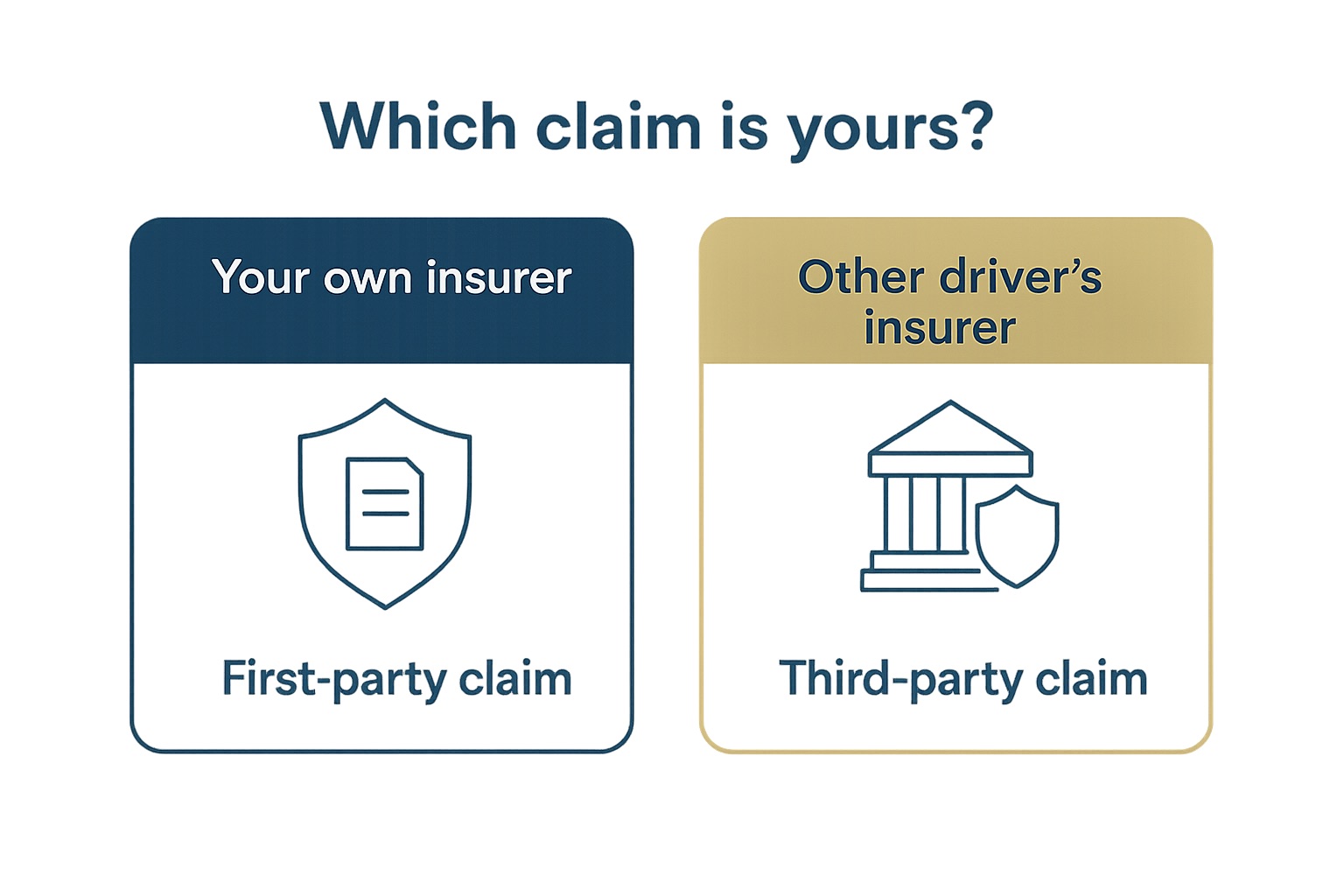
It helps to know which side of the line your situation sits on, because it changes the entire analysis.
A first-party claim is a claim against your own insurer under your own policy. You paid the premiums, and you are asking the company to perform the contract. In an auto case this is usually a UM or UIM claim (when the at-fault driver had no insurance or too little), or a med pay claim. When your own carrier will not pay a first-party claim, your remedies are breach of contract and, where the refusal was unreasonable, vexatious refusal. For a fuller walk-through of pursuing your own carrier, see the related discussion below.
A third-party claim is a claim against the at-fault driver and that driver's liability insurer. Vexatious refusal is a first-party doctrine, so it does not typically apply to your dealings with the other driver's insurer. The third-party version of insurer misconduct is bad-faith failure to settle, which, as explained above, is owed to the at-fault driver and can reach you only by assignment.
If you are not sure which category you are in, that is a normal question, and it is one an attorney can sort out quickly by looking at your policy and the crash.
Realistic expectations
A claim against your own insurer, including a vexatious-refusal claim, is a legitimate and fairly common part of the auto-injury landscape in Missouri. It is not a long shot, and it is not a windfall either. No attorney can promise a result. The outcome depends on your policy language, the strength of the underlying loss, how the insurer actually handled the file, and whether a court would view the refusal as reasonable or not. Some claims resolve once an insurer sees the file is being taken seriously; others require litigation. What we can do is tell you what your options are and how the process tends to unfold.
Talk to a Liberty, Missouri attorney about a denied or delayed claim
If your own insurer is denying, delaying, or lowballing a claim, and you are in Clay County, Liberty, or the north Kansas City metro (including Kearney, Gladstone, and North Kansas City), our Liberty office is available for a free case review. We handle Missouri auto, UM/UIM, and first-party coverage disputes, and we can review your policy and the insurer's conduct with you.
Call 816-367-6937 to reach our Liberty office. If you are still sorting out who to pursue after a crash, our overviews of a Liberty car accident claim and how we handle personal injury cases in Liberty are a good place to start.
This page is general information about Missouri law, not legal advice, and it does not create an attorney-client relationship. Every claim turns on its own facts.
Frequently asked questions
What is vexatious refusal to pay in Missouri?
Vexatious refusal to pay is Missouri's statutory remedy, under RSMo 375.420 and 375.296, for an insurer that refuses to pay a covered claim without reasonable cause or excuse. If a policyholder proves it, the recovery goes beyond the policy benefits and can include a statutory penalty plus the policyholder's reasonable attorney fees.
What is the difference between vexatious refusal and bad faith in Missouri?
Vexatious refusal is a first-party remedy against your own insurer, created by statute, because Missouri does not recognize a separate first-party bad-faith tort. Bad faith failure to settle is a third-party concept: it is a duty the at-fault driver's liability insurer owes to its own insured, and it can reach an injured person only by assignment from that at-fault driver.
Can I sue my insurance company for denying my claim in Missouri?
Yes. When your own insurer owes you money under your policy and refuses to pay, delays, or underpays, you can bring a breach-of-contract claim to recover the benefits, and, where the refusal lacked reasonable cause or excuse, a vexatious-refusal claim on top of it. Whether it is worth filing depends on the policy, the loss, and how the insurer handled the claim.
My insurance company won't pay my car accident claim. Is that automatically vexatious refusal?
No. An insurer is allowed to dispute a claim if it has a genuine, arguable basis, and that is a coverage dispute, not vexatious refusal. Vexatious refusal targets a refusal made without reasonable cause or excuse. Which side of the line a refusal falls on depends on how the insurer handled your claim.
How do I prove vexatious refusal to pay in Missouri?
You generally show that a valid policy covered the loss, that the insurer refused to pay or unreasonably delayed or underpaid, and that the refusal lacked reasonable cause or excuse. The last point is the contest, and courts assess it based on how the facts appeared to the insurer while it handled the claim, which is why the claim file and timeline matter.
What is the penalty for vexatious refusal to pay in Missouri?
Under RSMo 375.420, a policyholder who proves vexatious refusal can recover a statutory penalty calculated as a percentage of the loss, plus reasonable attorney fees, on top of the benefits owed. The exact percentage is set by the statute and depends on the amount of the loss, so treat it as the structure of the remedy rather than a promise of a specific figure.
What can I do if my insurance claim was denied without a reason in Missouri?
Ask the insurer to put the specific basis for the denial in writing, keep documenting your loss and your communications, and consider filing a complaint with the Missouri Department of Commerce and Insurance (Insurance Consumer Hotline 800-726-7390). Then talk to an attorney about whether the refusal was reasonable and whether a filing deadline is running.
What does it cost to have a lawyer review my denied or delayed claim?
Our Liberty office offers a free case review. Call 816-367-6937 to discuss a denied, delayed, or underpaid claim in Clay County or the north Kansas City metro.