Kansas Statute of Limitations for Personal Injury Claims
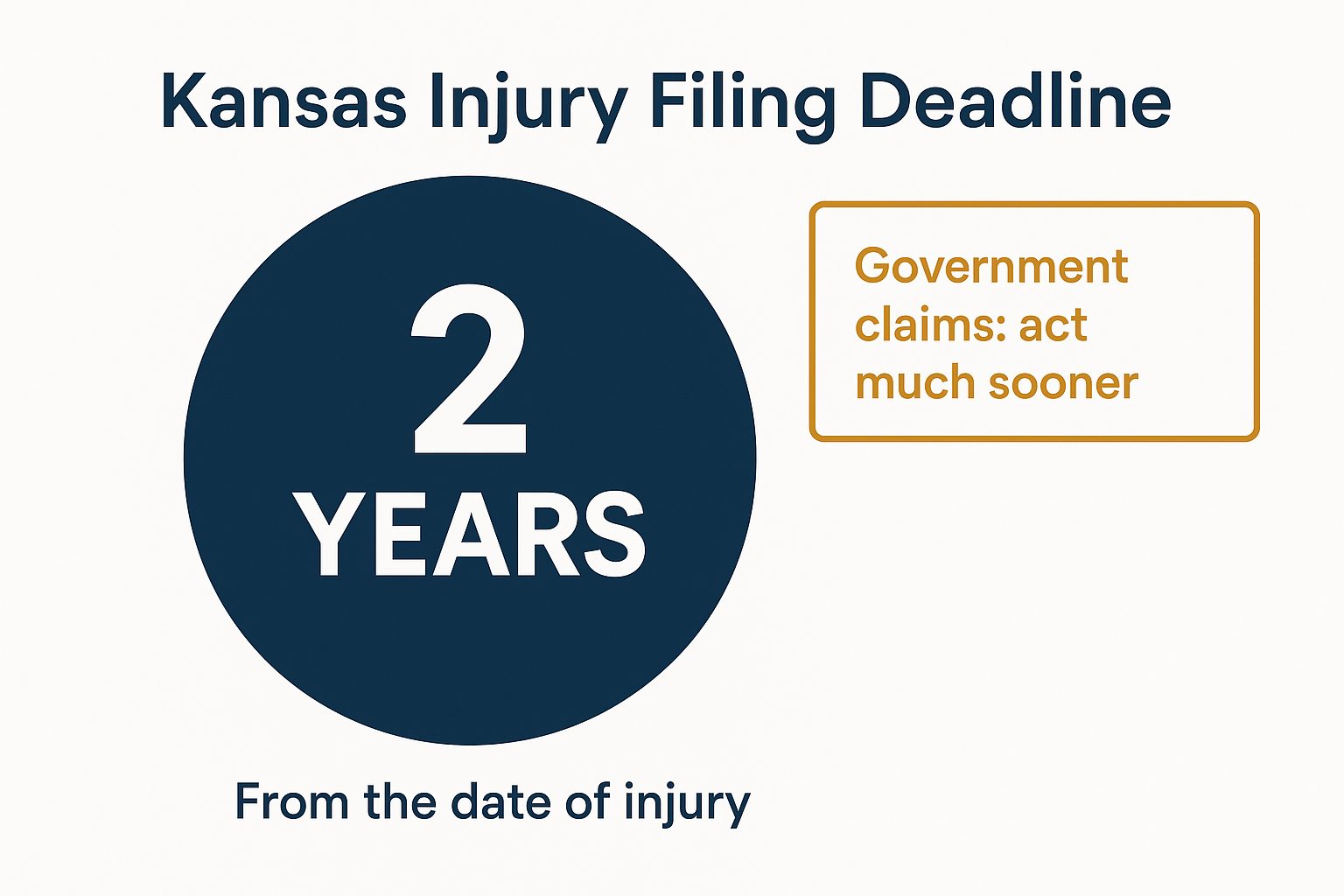
In Kansas, most personal injury claims must be filed within 2 years, and missing that deadline usually means losing the right to sue no matter how strong the case is. That 2-year period is set by K.S.A. 60-513 and it covers the kinds of claims we see most often in Douglas County and around Lawrence, including car accident injuries. Some situations carry shorter deadlines, some allow a later start date, and claims against a city, county, or the state come with their own separate notice requirement that hits far sooner. This page explains how the Kansas timeline works and why acting early matters.
If you are worried about a deadline on a Kansas injury claim, our Lawrence office serves Douglas County and the surrounding area and offers a free case review at 785-367-6937.
What is the statute of limitations in Kansas for a personal injury claim?
For most personal injury claims in Kansas, the deadline is 2 years from the date of injury under K.S.A. 60-513, which governs general negligence and auto-injury claims. A statute of limitations is the legal deadline to file a lawsuit. It is not the deadline to settle, and it is not the deadline to report the crash to your insurer. It is the last date you can file suit in court. If you file after it passes, the other side can ask the court to dismiss the case, and courts routinely do exactly that.
Because the deadline is measured from the date of injury in most cases, the safest approach is to treat the clock as running from the day the crash or injury happened, unless an attorney has confirmed a different start date applies to your situation.
When does the clock start? The Kansas discovery rule
The general rule is that the 2-year clock starts on the date you were injured. Kansas also recognizes a discovery rule for situations where the injury was not reasonably knowable right away.
Under the discovery rule, the clock does not start until the point at which the fact of injury becomes reasonably ascertainable to the injured person, rather than the date the injury technically occurred. This tends to matter in cases where harm is hidden or delayed rather than obvious, and less often in a straightforward car crash where the injury is apparent the same day. Kansas also places an outer limit on how long a claim can be brought even when discovery is delayed. Under K.S.A. 60-513(b), no action may be commenced more than 10 years after the act that caused the injury, regardless of when the injury is discovered. That 10-year cap is a statute of repose, and it operates as a hard ceiling on top of the ordinary 2-year period. Whether the discovery rule applies turns on when you could reasonably have known you were hurt, so do not count on it to extend your deadline.
Claims against a city, county, or the state: a much shorter deadline
This is the exception that catches people off guard. When your claim is against a governmental entity in Kansas, such as a city, a county, a school district, or a state agency, there is a separate notice requirement that comes long before the 2-year lawsuit deadline. It is set out in K.S.A. 12-105b.
Before you can sue a Kansas municipality, you must first file proper written notice of your claim with the entity, and there are specific rules about what that notice has to contain. You cannot commence a lawsuit until the municipality denies the claim or 120 days pass from the date you filed the notice, whichever comes first. Get that step wrong, or skip it, and the underlying claim can be barred even if you were still well within the ordinary 2-year window. If a government vehicle, a public employee, or a public property condition may be involved in your injury, treat the timeline as urgent and get advice quickly.
Minors and people under a legal disability
Kansas provides some tolling, meaning the clock can be paused, for people who are legally unable to bring a claim on their own when the injury occurs.
For minors, Kansas allows the deadline to be extended so that it does not simply run out while the person is still a child. A minor generally has until one year after turning 18 to bring a claim, subject to an outer cap so the extension is not open-ended: the total time to file cannot exceed 8 years from the date of the act that caused the injury. Kansas also recognizes tolling for a person under a legal disability, such as someone who lacks the capacity to manage their affairs, with the clock potentially paused until the disability is removed.
These provisions are protective, but they are narrow and technical. A parent should never assume a child's claim can wait, and no one should assume a disability automatically pauses a deadline without confirming it.
Wrongful death in Kansas
If a person dies from their injuries, a wrongful-death claim in Kansas is a separate claim with its own timing. A Kansas wrongful-death action must be brought within 2 years from the date of death, which is not necessarily the same as the date of the injury that caused it. Because wrongful-death timing runs from the death rather than the underlying injury, families should get specific advice rather than assuming the ordinary personal-injury deadline applies.
Kansas is not Missouri: do not rely on the wrong state's deadline
This point matters in our region because the Kansas City metro straddles the state line, and it is easy to read advice written for one state and assume it applies to the other. It does not. Kansas and Missouri have different personal-injury deadlines, and the Kansas 2-year period is shorter than the deadline Missouri applies to the same kind of claim. If your injury happened in Kansas, Kansas law and the Kansas deadline apply, and Missouri's rules are not a safe substitute. When a claim could touch both states, which state's deadline controls is itself a question for an attorney.
Why the deadline should not be your target
Knowing you have "up to 2 years" can create a false sense of comfort. In practice, the sooner a claim is investigated, the better. Evidence at a crash scene disappears, vehicles get repaired or scrapped, camera footage is overwritten, and witnesses become hard to find and less certain about what they saw. Insurers also read late claims skeptically. Waiting until the deadline is near narrows your options and can weaken an otherwise solid claim. The deadline is a hard outer boundary, not a plan.
Talk to a Kansas attorney early
If you were hurt in Kansas and are unsure how much time you have, the practical answer is to find out now rather than guess. Our Lawrence office serves Douglas County and the surrounding area and offers a free case review. Call 785-367-6937 and we can help you identify the deadline that actually applies to your situation, including any shorter government-claim notice period, before it becomes a problem.
For more on Kansas crash claims specifically, see our overview for injured drivers in the area: Lawrence, KS car accident lawyer.
This page is general information about Kansas law, not legal advice, and it does not create an attorney-client relationship. Deadlines are strict and turn on the facts of your claim. If you are not sure which one applies to you, call our Lawrence office at 785-367-6937.
Frequently asked questions
How long do I have to file a personal injury claim in Kansas?
Most Kansas personal injury claims must be filed within 2 years of the date of injury under K.S.A. 60-513. Some situations start the clock later or carry different deadlines, and claims against a government entity require much earlier notice, so confirm your specific deadline with an attorney.
When does the 2-year clock start in Kansas?
Usually on the date you were injured. Kansas also recognizes a discovery rule that can push the start date to when the injury reasonably could have been discovered, which mainly matters when harm is hidden or delayed rather than obvious. Even then, K.S.A. 60-513(b) sets a 10-year outer limit, a statute of repose, measured from the act that caused the injury.
Is the deadline shorter if my claim is against a city or the state?
Effectively, yes. Claims against a Kansas governmental entity require written notice under K.S.A. 12-105b before you can sue, and you cannot commence suit until the entity denies the claim or 120 days pass, whichever comes first. Missing the notice step can bar the claim, so act quickly if a government vehicle, employee, or property may be involved.
Does the deadline change for a child?
Yes. A minor generally has until one year after turning 18 to bring a claim, subject to an outer cap so the total time cannot exceed 8 years from the act that caused the injury. The specifics are technical, so do not assume a child's claim can wait; confirm the rule with an attorney.
How long do I have to file a wrongful-death claim in Kansas?
A Kansas wrongful-death claim must be brought within 2 years from the date of death, which is not always the same as the date of the injury that caused it. Because the clock runs from the death, confirm the timing with an attorney rather than assuming the ordinary injury deadline applies.
Is the Kansas deadline the same as Missouri's?
No. Kansas and Missouri have different personal-injury deadlines, and Kansas uses a shorter 2-year period. If your injury happened in Kansas, the Kansas deadline applies, and you should not rely on Missouri's rule. When a claim could involve both states, which deadline controls is a question for an attorney.
What should I do if my deadline might be close?
Talk to a Kansas attorney now rather than waiting. Our Lawrence office offers a free case review at 785-367-6937 and can help you identify the deadline that applies to your situation, including any earlier government-claim notice period.
Author Bio

Kevin A. Jones | Personal Injury Lawyer
Kevin A. Jones, founder and managing attorney of Empower Injury Law, has been practicing law since 2009. With over $25 million in jury verdicts and settlements in his first decade, Kevin has earned a reputation as a fierce advocate for his clients.
Kevin’s approach to law is rooted in his passion for helping people who have been mistreated by corporations, insurance companies, and other powerful entities.
Whether representing individuals wronged by negligent drivers or those injured on someone else’s property, Kevin is dedicated to achieving justice. His extensive experience in the courtroom ensures that clients receive strong, personalized representation that delivers results.
Practice Areas


