Can a Lease Waiver Block My Injury Claim? Missouri Exculpatory Clauses for Tenants
You were hurt on your rental property, maybe on a common stairway, in a shared hallway, or in a parking area the landlord controls, and now the landlord or its insurer is waving the lease at you. Somewhere in the paperwork you signed is a clause that says the landlord is not responsible if a tenant gets injured. The short answer for Missouri renters is that a clause like that does not automatically end your claim. Missouri courts enforce these waivers only when they are written in a very specific way, and even a valid one cannot cover certain kinds of conduct.
These release provisions are called exculpatory clauses. They are contract language in which one party tries to release itself in advance from liability for its own future negligence. Whether your landlord's clause does what the landlord thinks it does is a legal question with a demanding standard behind it.
This article is general information about Missouri law and is not legal advice about your specific situation.
What an exculpatory clause is, and why Missouri distrusts it
An exculpatory clause asks you to give up, before anything has happened, your right to sue the other side for harm its own carelessness causes later. Missouri allows parties to make that kind of agreement, but it does not like them. Courts treat these clauses as disfavored and read them strictly against the party that wrote the lease, which in a residential rental is the landlord.
That hostility is the reason so many of these clauses fail. The drafter gets the benefit of the doubt on nothing. Any gap, vagueness, or omission in the language is read in favor of the injured tenant, not the landlord.
The Missouri standard: the waiver has to say what it is doing
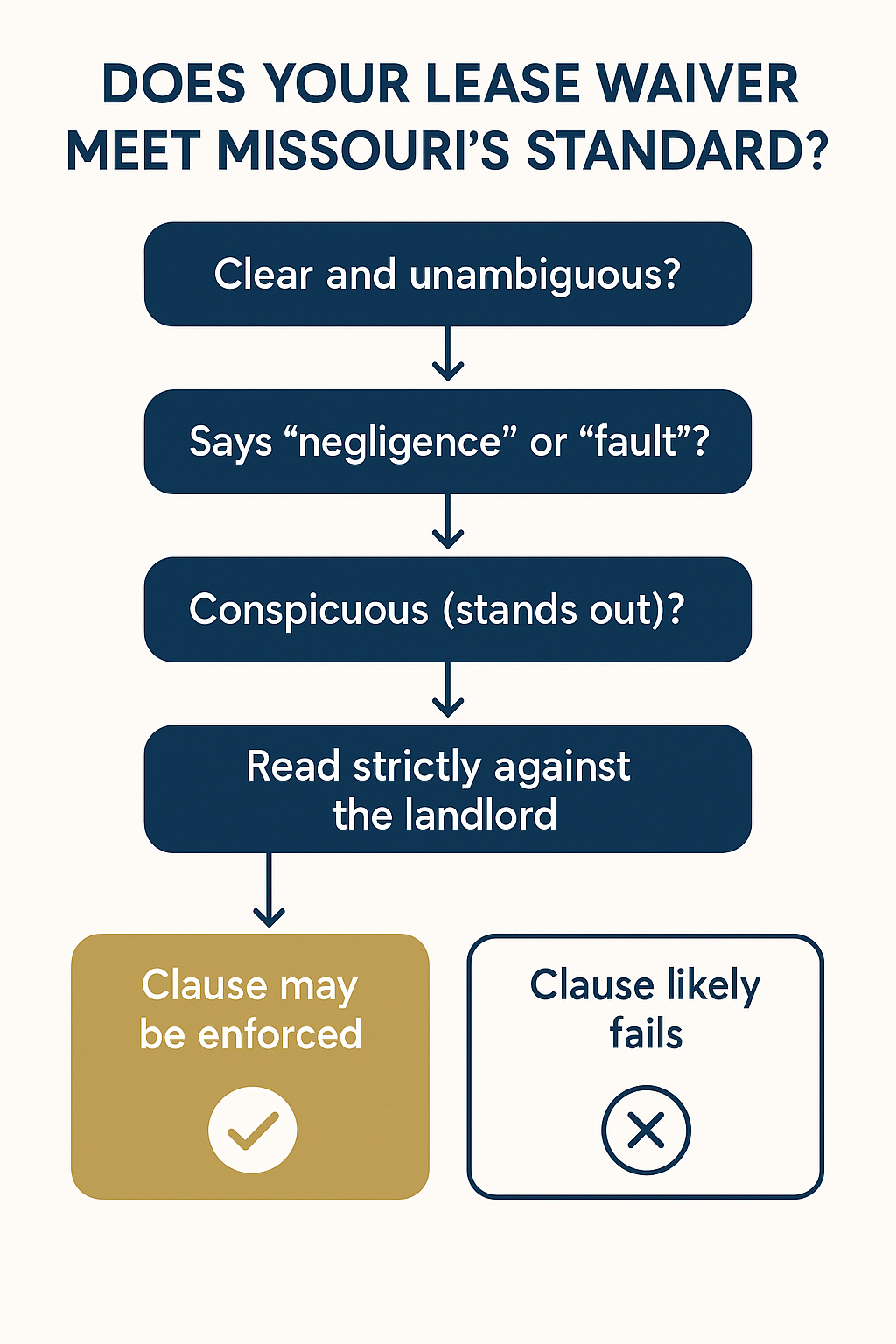
Under the Missouri Supreme Court's decision in Alack, a release of future negligence is effective only if it is clear, unambiguous, unmistakable, and conspicuous. The clause has to tell the signer, in so many words, that they are giving up the right to recover for the other party's negligence.
The practical test is the words on the page. To release a landlord from its own negligence, the clause generally must use the word "negligence" or "fault," or a clear legal equivalent, so that the tenant understands exactly what right is being surrendered.
This is where a lot of landlord language collapses. A clause that releases the landlord from "any and all claims," or "all liability," or "any loss or damage" sounds broad, but Missouri has held that general catch-all language like that is not enough to release a party from its own future negligence.
So the size of the font the lease used, and the fact that you signed it, are not the whole story. If the clause never squarely tells you that you are giving up negligence claims, it may not bar your case at all, even with your signature on it.
What a waiver can never do
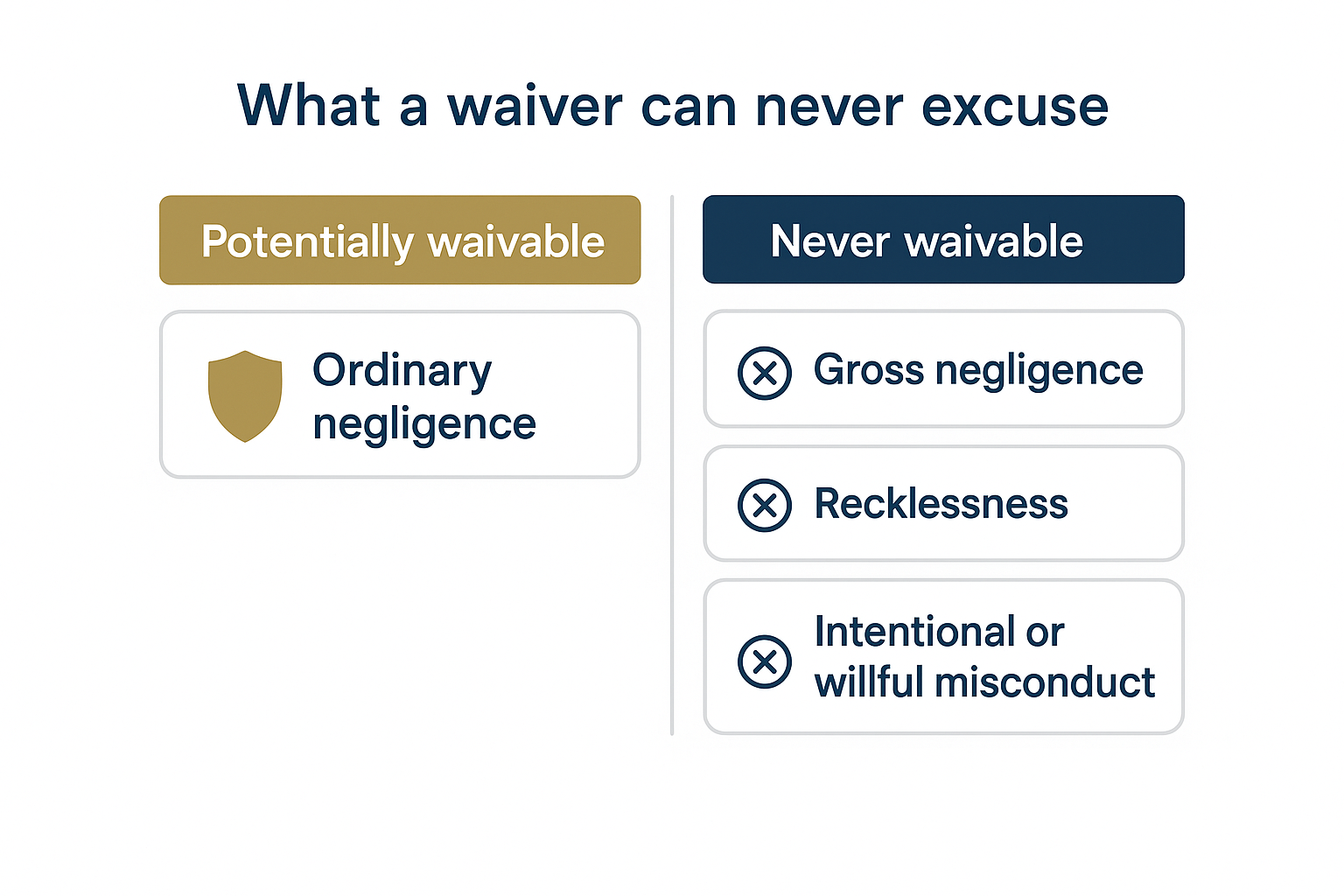
There is a ceiling on what any release can reach. A valid exculpatory clause can, at most, excuse ordinary negligence. It cannot be used to excuse gross negligence, reckless conduct, or intentional or willful misconduct.
For a tenant, that ceiling matters. If a landlord ignored a known, dangerous defect in a common stairway for months, or disregarded repeated complaints about a hazard it had a duty to fix, the conduct may rise above ordinary negligence. A waiver drafted to cover garden-variety carelessness does not shield behavior that crosses into gross negligence or worse.
How Missouri applied this test to an actual lease
The standard above comes from a health-club release, but Missouri courts have carried it into the landlord-tenant setting. In Fuller v. TLC Property Management, LLC, a Missouri appellate court took the Alack standard and applied it to the exculpatory clause in a residential lease, asking whether the lease language clearly and unmistakably released the landlord from liability for its own negligence.
One more note on Fuller. Some of the judges wrote separately to say they would go further and hold that exculpatory clauses in residential leases raise public-policy concerns of their own. That separate writing is a concurrence, meaning it reflects the view of individual judges and not the court's binding holding. The argument is useful background, but the rule you can rely on is the strict Alack standard the court applied.
What this means for your claim
A lease "waiver" is not the end of the conversation, and it is not a reason to assume you have no case. Whether it blocks your claim turns on two things: whether the clause meets Missouri's strict standard for releasing negligence, and what kind of conduct your injury involved.
- If the clause is vague, buried, or never uses "negligence" or "fault" or a clear equivalent, it may not release your landlord at all.
- Even a clause that clears that bar reaches only ordinary negligence, so conduct that rises to gross negligence, recklessness, or intentional wrongdoing stays on the table.
- The specific words of your lease, the condition that hurt you, and what the landlord knew all shape the answer.
Because the language is what controls, have the actual lease read closely rather than taking the landlord's or the adjuster's word for what it does. Two leases can use very different wording and reach opposite results.
Even if a waiver is knocked out, Missouri still compares fault between the parties. If the landlord argues you share some responsibility for the fall, Missouri's pure comparative fault rule governs how that affects what you can recover, rather than ending the claim outright.
This kind of injury usually falls under premises liability, and when the hazard is a slippery or defective walking surface it often overlaps with a slip-and-fall claim. You can read more about how we handle these cases at our Liberty premises liability page and our Liberty slip-and-fall page. Renters injured across the river can see our Kansas City slip-and-fall page.
Talk to a Liberty premises liability lawyer
If a landlord is pointing to a lease clause to turn you away, you can have the clause and your injury looked at before you accept that answer. Empower Injury Law's Liberty office serves Clay County and the north Kansas City metro, including Kearney, Gladstone, and North Kansas City. Call 816-367-6937 for a free consultation, or reach out through our Liberty personal injury page. There is no cost to find out whether the waiver holds up.
Frequently asked questions
Does signing a lease with a liability waiver mean I cannot sue my landlord in Missouri?
No, not by itself. Missouri enforces these clauses only when they are clear, unambiguous, unmistakable, and conspicuous, and generally only when they use the word "negligence" or "fault" or a clear equivalent. If the clause does not meet that standard, your signature does not bar the claim.
My lease says the landlord is not responsible for "any and all claims." Is that enough to stop my case?
Missouri has held that broad catch-all language like "any and all claims" is not enough, on its own, to release a party from liability for its own future negligence. Language that general often fails the test, which is why the exact wording of your lease matters so much.
Can a waiver protect my landlord if the injury was caused by something worse than carelessness?
No. A release reaches ordinary negligence at most. It cannot excuse gross negligence, reckless conduct, or intentional or willful misconduct, so a landlord who ignored a known serious hazard may not be shielded even by a valid clause.
How long do I have to bring a personal injury claim in Missouri?
Missouri's statute of limitations for most personal injury claims is 5 years under RSMo 516.120. That is a firm deadline, so it is better to have your claim reviewed well before it approaches.
Should I have my lease reviewed before I give up on a claim?
Yes. Because the specific words of the clause control the outcome, two tenants with similar injuries can get different answers depending on how their leases are written. Having the lease and the facts of your injury looked at is the most reliable way to learn whether the waiver has any effect on your case.
Author Bio

Kevin A. Jones | Personal Injury Lawyer
Kevin A. Jones, founder and managing attorney of Empower Injury Law, has been practicing law since 2009. With over $25 million in jury verdicts and settlements in his first decade, Kevin has earned a reputation as a fierce advocate for his clients.
Kevin’s approach to law is rooted in his passion for helping people who have been mistreated by corporations, insurance companies, and other powerful entities.
Whether representing individuals wronged by negligent drivers or those injured on someone else’s property, Kevin is dedicated to achieving justice. His extensive experience in the courtroom ensures that clients receive strong, personalized representation that delivers results.
Practice Areas


