Negligent Security in Missouri: When Is a Property Owner Liable for an Assault by Someone Else?
If you were attacked at a Missouri business, apartment complex, or parking lot, you may be able to hold the property owner responsible even though a different person committed the assault. This is the area of premises liability known as negligent security, and in Missouri a property owner can be liable for an assault by a third party when the attack was reasonably foreseeable and the owner failed to take reasonable steps to prevent it. The rule has limits, and whether it applies turns on the specific facts. For people in Clay County and the north Kansas City area trying to understand their options after a violent incident on someone else's property, here is how Missouri courts look at these claims.
The starting point: no general duty for someone else's crime
Missouri law begins with a rule that often surprises people. A property owner or business ordinarily owes no duty to protect visitors from the criminal acts of third parties. The reasoning is that crime by an independent person is not something the owner set in motion, and the law does not make a landowner the insurer of everyone's safety against every stranger who might do harm.
That default is why these cases turn on their facts. The question is not simply whether you were hurt on the property, but whether the owner had reason to anticipate this kind of harm and a fair chance to guard against it.
When a Missouri property owner can be liable
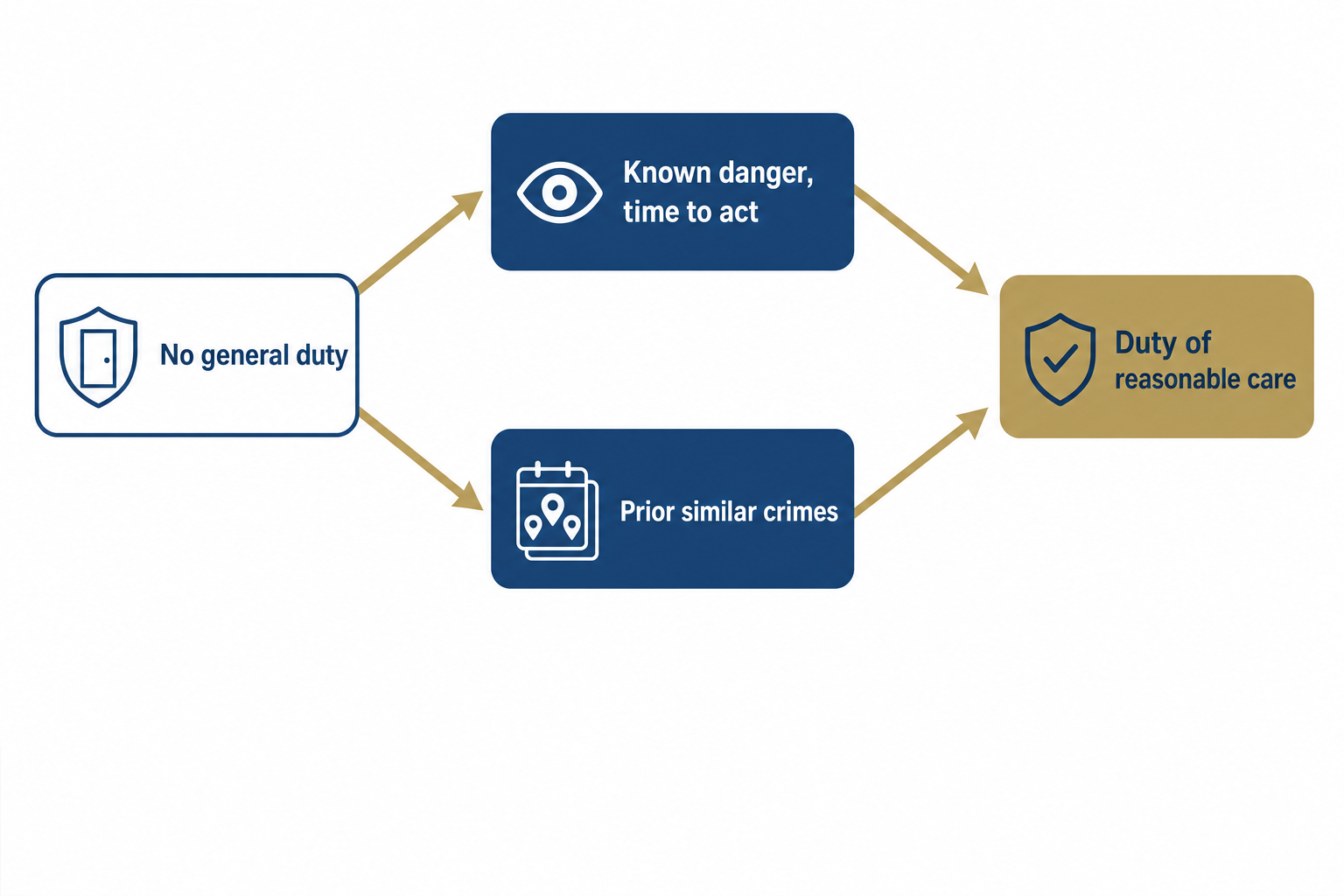
There are two situations Missouri courts have recognized where the duty exists. Both come down to foreseeability, which is the legal word for whether the owner should have seen the risk coming.
A known, violent person is present and there is time to act
The first exception applies when a person known to be violent is on the premises, or when someone is acting in a way that signals danger, and the owner has enough time to do something about it before the harm occurs.
This is the most immediate version of foreseeability. A bar that keeps serving a patron who is openly threatening other customers, a store that sees a confrontation escalating and does nothing, an apartment manager who knows a specific individual has menaced tenants and still takes no step, each of these can put the owner on notice in the moment. The point is that the danger was visible and there was a window to respond.
Williams v. Barnes & Noble, Inc., 174 S.W.3d 556 (Mo. App. 2005), shows the limit from the other direction. A customer at the Country Club Plaza store was knocked down when a store employee chased a shoplifter out the door and the fleeing shoplifter pushed her. The court held that nothing in the pleaded facts fit an exception, so the claim could not go forward. There was no allegation that the shoplifter was known to be dangerous or that staff had time to prevent the sudden shove. Without facts that bring the injury inside one of the exceptions, the general no-duty rule controls.
Prior similar crime made this crime foreseeable
The second route is broader and is where most negligent security cases live. Under the special facts and circumstances approach, a duty can arise when prior violent crime on or near the premises made further violent crime reasonably foreseeable.
Missouri's leading decision here is L.A.C. ex rel. D.C. v. Ward Parkway Shopping Center Co., 75 S.W.3d 247 (Mo. banc 2002). A 12-year-old was assaulted at a Kansas City shopping mall. The plaintiff came forward with records of numerous prior crimes at the mall, and the Missouri Supreme Court held that a jury could find the assault was foreseeable, so the owners and managers owed a duty to take reasonable care to protect their customers. The court reversed the summary judgment that had thrown the case out. The decision is often read for the idea that a documented history of violent incidents at a location can supply the foreseeability that turns "no duty" into "duty."
What counts as a prior similar incident is contested in almost every one of these cases. How recent the earlier crimes were, how close they happened, and how alike they were to the attack on the client are all fought over, and courts do not treat every past police call as proof of foreseeability. This is the part of a negligent security claim that usually decides it.
What reasonable security looks like

Once a duty exists, the owner is held to reasonable care, not perfection, and not a guarantee that nothing bad will ever happen. Depending on the property and the risk, reasonable measures can include functioning locks and lighting, controlled entry, trained or sufficient security staff, working cameras, and sensible response procedures. Whether what the owner did was reasonable is measured against the risk the owner knew or should have known about. A quiet retail strip with no history of violence is not held to the same standard as a venue with repeated assaults in its parking lot.
Proving the claim also means connecting the gap in security to the harm. Even where an owner's precautions fell short, you still have to show that reasonable security would have made a difference. These are evidence-heavy cases built on incident records, security contracts, and testimony about what the owner knew.
Comparative fault and the time limit
Missouri follows pure comparative fault, so if you are found partly at fault for what happened, your recovery is reduced by your percentage of fault rather than barred outright. In a negligent security case a defense will often try to assign some responsibility to the injured person, which is one more reason the facts of the incident matter.
There is also a deadline. Most Missouri personal injury claims must be filed within five years under RSMo 516.120. Because exceptions and different limitation periods can apply depending on the circumstances, have us check the timing for your specific situation rather than assume the general rule fits.
Talk through your situation
Negligent security claims are among the more fact-intensive premises cases in Missouri, and the difference between a claim that moves forward and one that does not often comes down to what the owner knew about prior crime and whether they responded reasonably. If you were assaulted on another party's property in the Northland or the Kansas City metro, our Liberty premises liability team can look at the facts with you and explain where your situation stands. You can also read our overview of Missouri premises liability claims or, if the incident happened in the KC metro, our page for Kansas City premises liability cases. A first conversation is free and carries no obligation.
This article is general information about Missouri law, not legal advice about your case, and reading it does not create an attorney-client relationship.
Frequently asked questions
Can a property owner in Missouri be sued for an assault committed by someone else?
Sometimes. A Missouri property owner ordinarily has no duty to protect visitors from a third party's crime, but a duty can arise when the attack was reasonably foreseeable, for example when a known dangerous person was present with time to act, or when prior violent crime on or near the property made further violence foreseeable. Which facts control is specific to what happened in your situation.
What is negligent security?
Negligent security is a type of premises liability claim. It applies when a property owner who could reasonably foresee violent crime on the property fails to take reasonable protective measures, such as adequate lighting, locks, controlled access, or security staffing, and someone is assaulted as a result.
How do you prove an assault was foreseeable?
Foreseeability usually turns on the history of the location. Records of prior violent crimes on or near the premises, police data for the area, and evidence of what the owner knew are commonly used to show the owner should have anticipated the risk. How recent, how close, and how similar the earlier incidents were are all contested in these cases.
How long do I have to file a negligent security claim in Missouri?
Most Missouri personal injury claims have a five-year deadline under RSMo 516.120. Different periods or exceptions can apply depending on the facts, so confirm the deadline for your situation with us rather than assuming the general rule applies.
Does it matter that the attacker was also at fault or was never caught?
No, not to whether you can pursue the property owner. A negligent security claim is about the owner's failure to provide reasonable security in the face of a foreseeable risk, which is separate from the criminal's own responsibility. You can have a claim against the owner even if the attacker was never identified or caught.
Author Bio

Kevin A. Jones | Personal Injury Lawyer
Kevin A. Jones, founder and managing attorney of Empower Injury Law, has been practicing law since 2009. With over $25 million in jury verdicts and settlements in his first decade, Kevin has earned a reputation as a fierce advocate for his clients.
Kevin’s approach to law is rooted in his passion for helping people who have been mistreated by corporations, insurance companies, and other powerful entities.
Whether representing individuals wronged by negligent drivers or those injured on someone else’s property, Kevin is dedicated to achieving justice. His extensive experience in the courtroom ensures that clients receive strong, personalized representation that delivers results.
Practice Areas


