Open and Obvious Hazards in Missouri Slip-and-Fall Cases: Can You Still Recover?
After a fall on someone else's property in Clay County or the north Kansas City metro, one of the first things an insurance adjuster tends to say is that the hazard was open and obvious, so there is nothing to pay. It is a tidy line, and it is often wrong. Under Missouri law, the fact that you could have seen the condition that caused your fall does not end the question of whether the property owner is liable. In many cases you can still recover, and an obvious hazard usually goes to how fault is divided rather than to whether you have a claim at all. We handle these cases from our Liberty office, and the sections that follow lay out what Missouri law requires.
What duty does a Missouri property owner owe a visitor?
Missouri sorts visitors by their relationship to the property, and that relationship sets the standard of care the owner owes (invitee, licensee, or trespasser each get a different level of protection, which is its own subject). Most slip-and-fall cases involve an invitee: a customer in a store, a patient at a clinic, a guest somewhere the owner has opened to the public for its own benefit.
For an invitee, a possessor of land is liable for harm from a dangerous condition only if three things are true. First, the possessor knows of the condition, or by using reasonable care would discover it, and should realize it involves an unreasonable risk to the invitee. Second, the possessor should expect that the invitee will not discover or realize the danger, or will fail to protect against it. Third, the possessor fails to use reasonable care to protect the invitee against the danger.
That framework comes from Harris v. Niehaus, 857 S.W.2d 222 (Mo. banc 1993) , which Missouri courts still rely on today.
How does the open-and-obvious rule work?
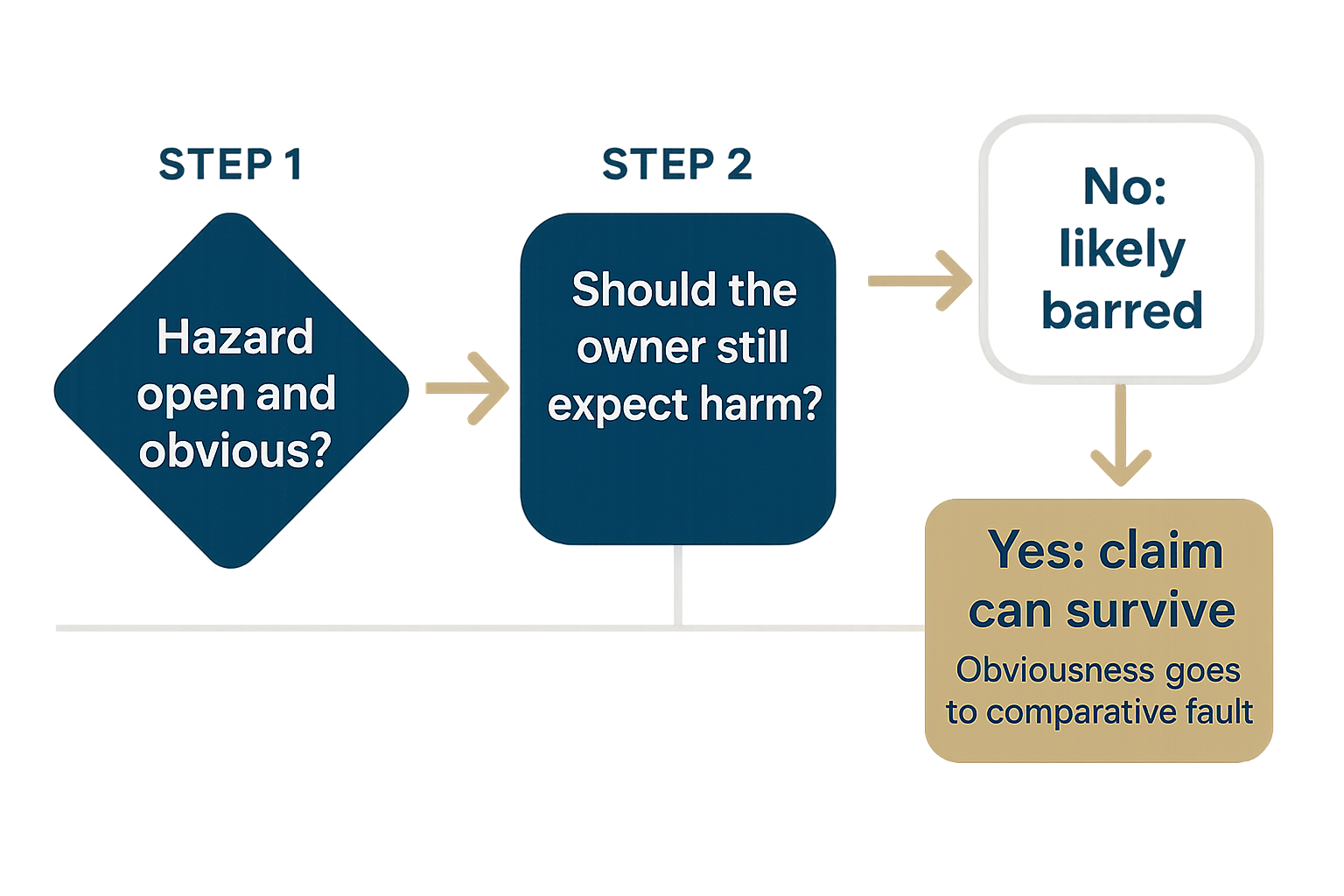
The second part of the invitee standard is where obviousness lives. When a condition is so open and obvious that the invitee should reasonably be expected to discover it and realize the danger, the owner usually does not breach the duty owed to invitees. That is the part insurers quote. They tend to stop there.
The rule does not stop there. The owner can still be liable, even for an open and obvious condition, if the owner should anticipate the harm despite the invitee's knowledge of the hazard or its obviousness. An owner who knows people will be distracted, hurried, carrying things, or funneled across the hazard anyway cannot always rely on obviousness as a shield. That "should anticipate the harm anyway" exception is what keeps many of these claims alive.
That principle was restated most recently in Anslinger v. Christian Hospital Northeast-Northwest, No. ED111387 (Mo. App. E.D. 2024) .
Does an obvious hazard automatically lose the case?
No. Whether a condition is open and obvious is a question of law for the court to decide, not an automatic label the defense gets to pin on your fall. That matters in a specific way. Even if an injured person agrees on the witness stand that a hazard was "open and obvious," that concession does not control the court's decision. The legal question stays with the court regardless of how a nervous plaintiff describes things under cross-examination.
Visibility alone is also not the test. The fact that you could have seen an unobscured hazard does not, by itself, make it open and obvious as a matter of law. Whether you were keeping a careful lookout is a question for the finder of fact at trial, and obviousness becomes one factor a jury weighs when it allocates fault. In other words, the adjuster treats "you could have seen it" as the end of the analysis. Missouri treats it as a fact for the jury.
Trip hazards on a walking surface are treated differently
Not every hazard is analyzed the same way. A trip hazard on a walking surface is generally not open and obvious as a matter of law, in contrast to a large physical structure or a natural or regular condition of the land. A retaining wall or a visible drop-off is one thing. A raised edge, a gap, or an uneven spot on a floor people are expected to walk across is another, and courts do not simply assume a walker should have caught it.
Anslinger is a useful illustration. A hospital visitor tripped where two rubber floor mats met in a vestibule. The case went to a jury, which assigned 35 percent of the fault to the visitor and 65 percent to the hospital. She still recovered. The jury found damages of $150,000, which produced a judgment of $97,500 after her share was subtracted, and the appeals court affirmed.
How obviousness plays out in practice: comparative fault
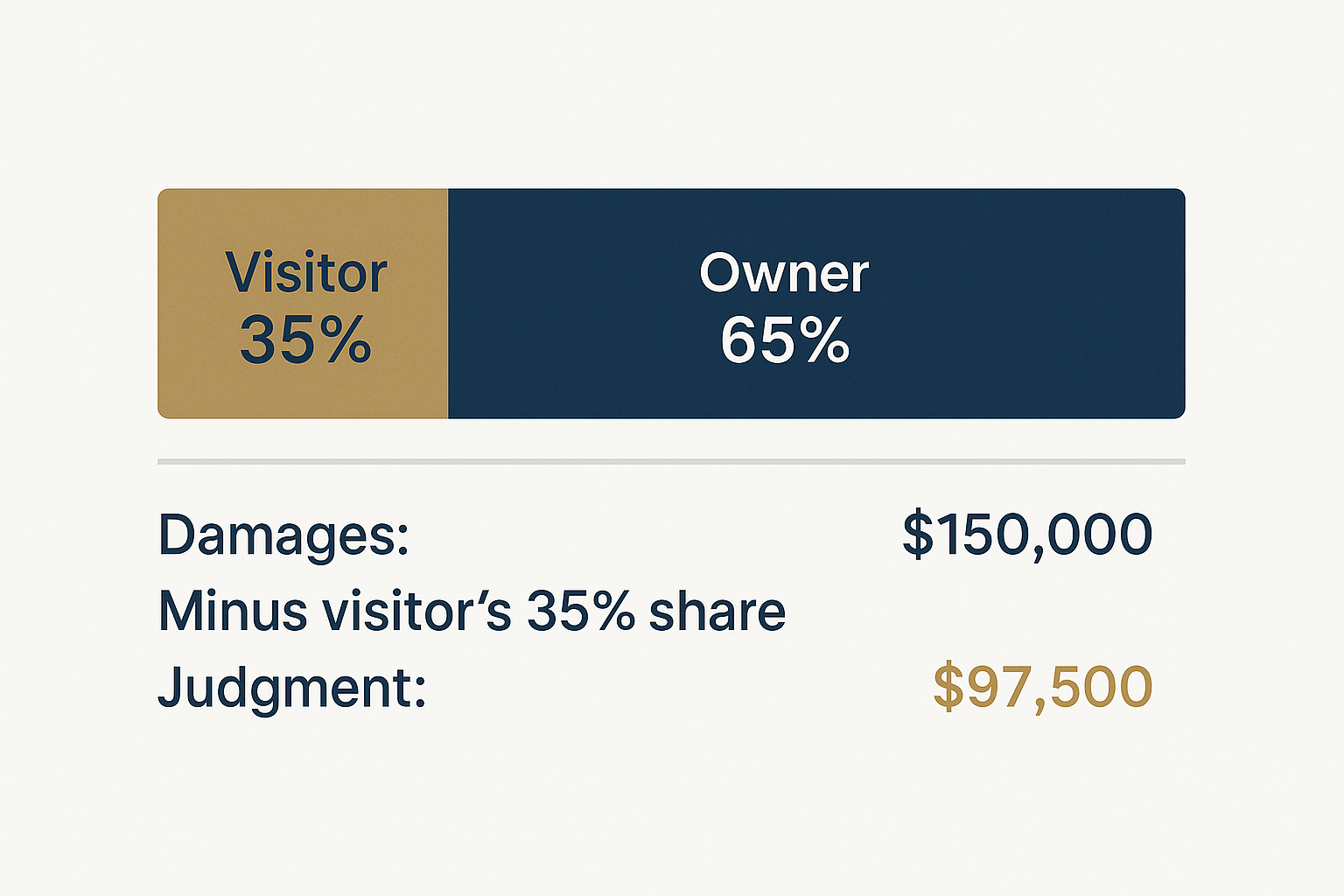
Here is the mechanism the adjuster leaves out. Missouri follows pure comparative fault, so if you were partly to blame for not noticing an obvious hazard, your recovery is reduced by your percentage of fault rather than wiped out. That is exactly what happened to the visitor in the hospital case above.
This is why "it was obvious" is rarely the knockout the defense wants it to be. Obviousness is usually an argument about your share of the fault, which is a question of degree, not a switch that turns the claim off. For how that split is calculated and what it means for a recovery, see our explainer on Missouri comparative fault.
How long do you have to file in Missouri?
Most Missouri personal injury claims, including slip-and-fall claims, must be filed within 5 years under RSMo 516.120. That window is not a reason to wait. The condition that caused your fall tends to disappear fast. Mats get rearranged, spills are cleaned, broken edges are repaired, and video is overwritten. The sooner the scene and the records are preserved, the stronger the proof of what the hazard was and whether the owner should have anticipated the harm.
What to do after a fall in Clay County
If you were hurt in a fall on someone else's property in Liberty, Kearney, Gladstone, North Kansas City, or elsewhere in the north metro, get medical care, photograph the hazard and the surrounding area if you safely can, note anyone who saw it happen, and keep whatever you were wearing. Then have the facts reviewed before you give the insurer a recorded statement. An adjuster's "open and obvious" line is a legal conclusion dressed up as common sense, and it is one a court, not the adjuster, gets to decide.
We offer a free consultation on Missouri slip-and-fall and premises claims. Call our Liberty office at 816-367-6937, or read more about how we handle slip-and-fall and premises-liability cases. For help specific to this area, see our pages on Liberty slip-and-fall, Kansas City slip-and-fall, Liberty premises-liability, and Liberty personal injury.
This post is general information about Missouri law, not legal advice, and reading it does not create an attorney-client relationship; for advice about your own fall, speak with us directly.
Frequently asked questions
Can I still recover in Missouri if the hazard that caused my fall was obvious?
Often, yes. An open and obvious condition does not automatically defeat a Missouri slip-and-fall claim. The property owner can still be liable if the owner should have anticipated that someone would be harmed despite the hazard being obvious, and obviousness usually affects how fault is divided rather than whether you have a claim.
Who decides whether a condition was open and obvious?
The court decides, as a question of law. Even if an injured person agrees on the witness stand that a hazard was obvious, that statement does not bind the court. The legal question stays with the judge.
Does the fact that I could have seen the hazard mean it was open and obvious?
No. Visibility alone is not the test. That you could have seen an unobscured hazard does not make it open and obvious as a matter of law. Whether you were keeping a careful lookout is a question for the jury, which weighs obviousness as one factor when it allocates fault.
Are trip hazards on a floor treated the same as large structures?
No. A trip hazard on a walking surface is generally not open and obvious as a matter of law, unlike a large physical structure or a natural or regular condition of the land. Courts do not simply assume a person should have spotted a raised edge or gap on a floor they were expected to cross.
How does being partly at fault affect my recovery in Missouri?
Missouri follows pure comparative fault, so your recovery is reduced by your percentage of fault rather than barred. If a jury finds your damages are $150,000 and assigns you 35 percent of the fault, you recover $97,500. That is what happened to the visitor in the Anslinger hospital case.
How long do I have to file a slip-and-fall claim in Missouri?
Most Missouri personal injury claims must be filed within 5 years under RSMo 516.120. Waiting is still risky, because the condition that caused your fall is often cleaned up, repaired, or recorded over long before that deadline.
The adjuster told me my case is worthless because the hazard was obvious. Is that right?
Not necessarily. "Open and obvious" is a legal conclusion that a court decides, not the insurance company. Before you accept that answer or give a recorded statement, have the facts reviewed. You can reach our Liberty office at 816-367-6937 for a free consultation.
Author Bio

Kevin A. Jones | Personal Injury Lawyer
Kevin A. Jones, founder and managing attorney of Empower Injury Law, has been practicing law since 2009. With over $25 million in jury verdicts and settlements in his first decade, Kevin has earned a reputation as a fierce advocate for his clients.
Kevin’s approach to law is rooted in his passion for helping people who have been mistreated by corporations, insurance companies, and other powerful entities.
Whether representing individuals wronged by negligent drivers or those injured on someone else’s property, Kevin is dedicated to achieving justice. His extensive experience in the courtroom ensures that clients receive strong, personalized representation that delivers results.
Practice Areas


