Who Is Liable for a Snow or Ice Slip-and-Fall in Missouri?
If you slipped on snow or ice on someone's property in Clay County or the north Kansas City area, the hardest fact to hear first is this: in Missouri, the property owner often is not liable. Our courts follow what is called the Massachusetts rule, and it means a landowner usually owes no duty to clear snow or ice that built up naturally from the weather. That is the starting point, not the whole story. There are real exceptions, and whether one of them fits your fall is what decides your case. We handle these claims out of our Liberty office, and this is how Missouri law works.
The short answer: Missouri's Massachusetts rule
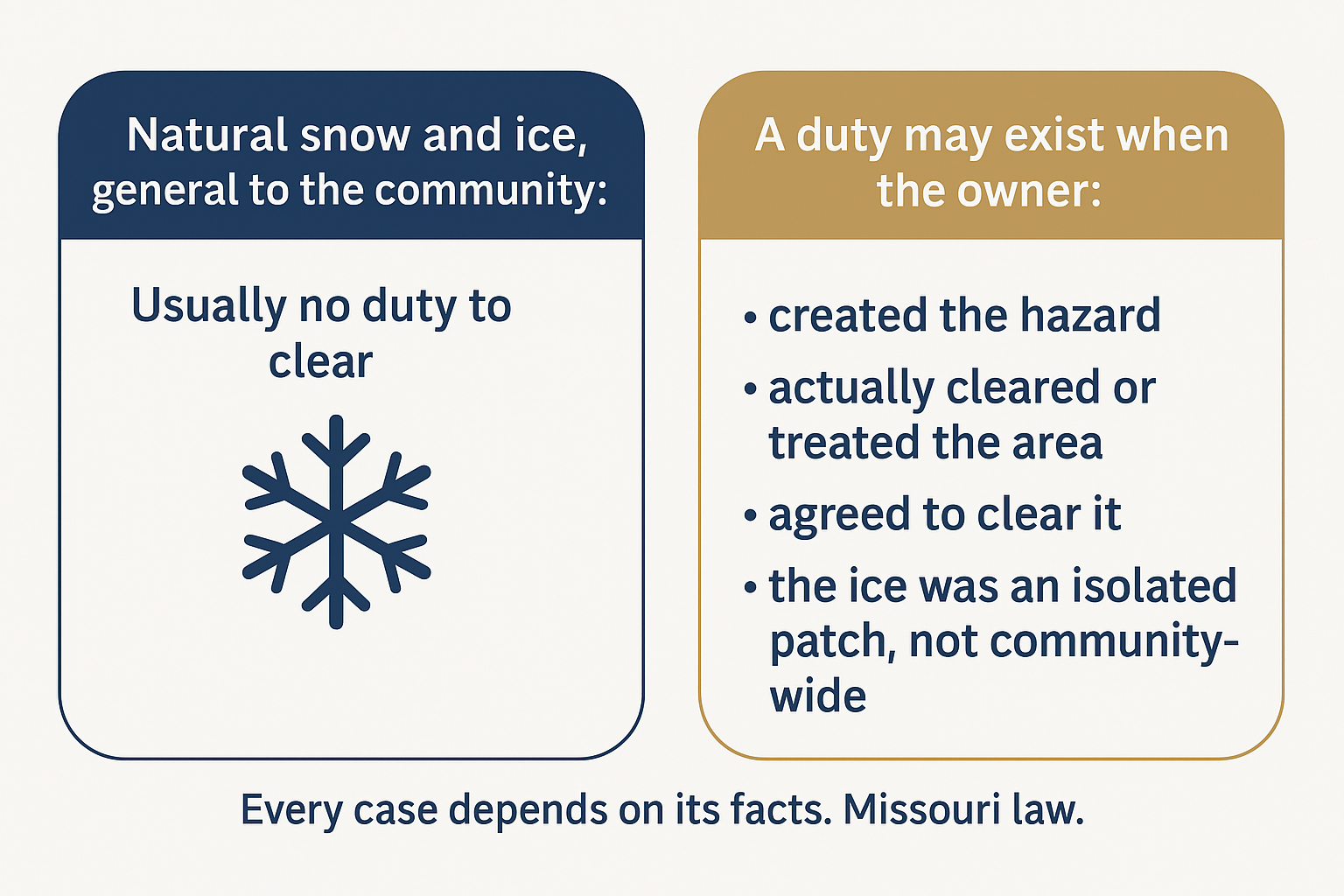
Missouri follows what courts call the Massachusetts rule. Under it, a property owner generally has no duty to remove snow or ice that accumulates naturally and is a condition general to the community. The Missouri Court of Appeals restated the rule in 2021 in O'Donnell v. PNK (River City), LLC, 619 S.W.3d 162 , and declined to abolish it, noting that only the Missouri Supreme Court can do that. So if it snowed across the whole Northland and you slipped on a parking lot that looked the same as every other parking lot that morning, the owner usually is not responsible, even if the surface was genuinely dangerous.
Courts explain the rule this way: when ice or snow covers the whole area, it is a hazard to everyone who goes out, and an owner's efforts could do little to lessen it. Missouri courts have applied this reasoning for decades. In Willis v. Springfield General Osteopathic Hospital, 804 S.W.2d 416 , the court upheld an instruction telling the jury not to assign fault to a hospital if a general condition of ice existed throughout the city and the hospital's lot was not a special, isolated hazard. Missouri courts have also said an owner does not have to clear freezing rain, sleet, or snow from an open parking lot while it is still falling.
What counts as a "natural" accumulation?
Natural accumulation is snow or ice left by ordinary weather: the snowfall, sleet, or freezing rain that reaches a property the same way it reaches the rest of the neighborhood. A parking lot glazed over after an overnight ice storm, a sidewalk still snow-covered after a storm that hit all of Liberty, a set of steps slick from freezing rain that fell across Clay County, these are the classic examples.
The condition being general to the community is the key. Courts ask whether the danger was the same one everyone in the area faced that day, or whether something specific about this property made it worse. That distinction is what the exceptions below turn on.
When an owner may have a duty
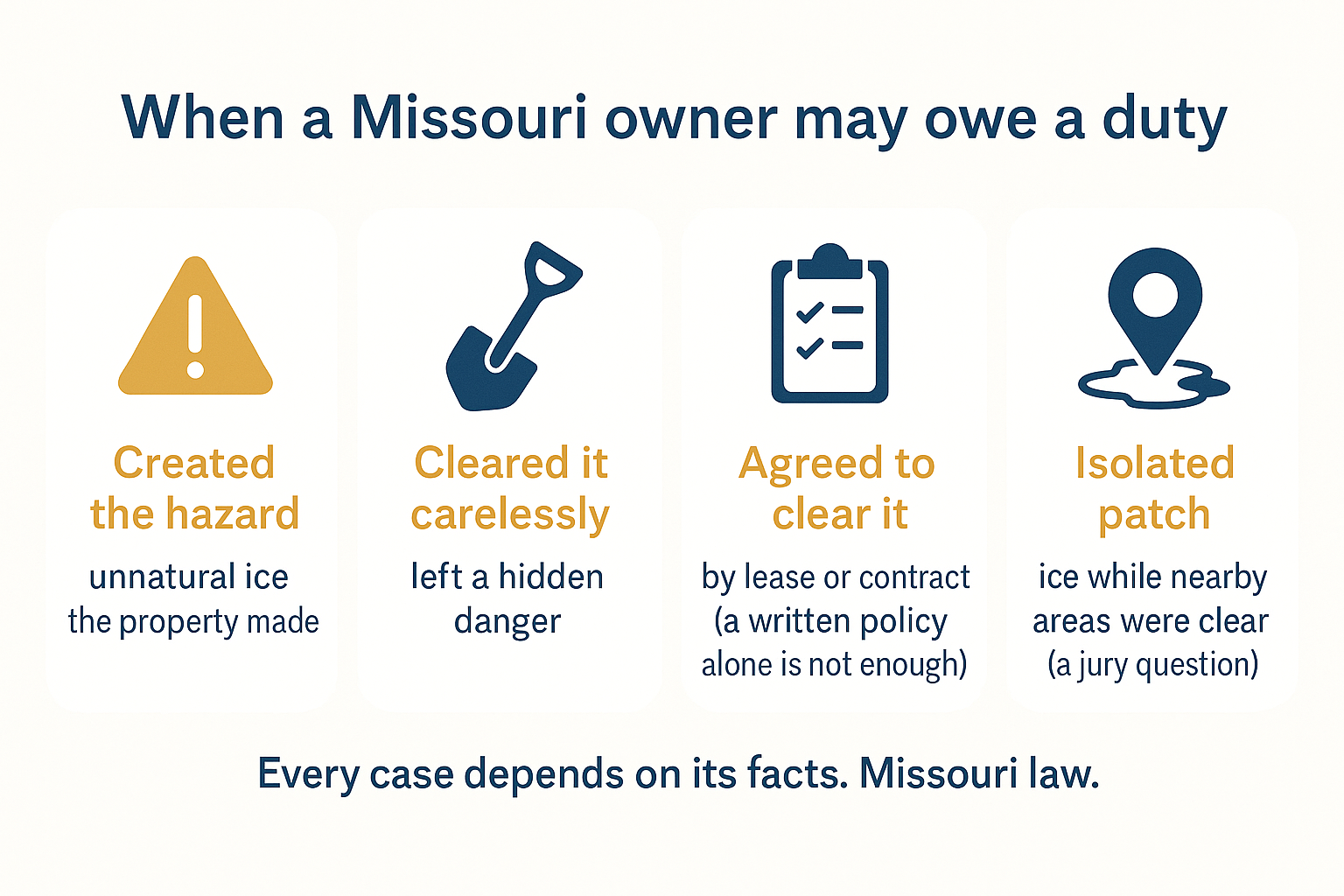
The rule has limits. Missouri cases have found that an owner may owe a duty in these situations.
The owner created the hazard
If an owner's own actions or negligence create an unnatural accumulation, the general rule may not apply. A common example is water draining off a canopy and refreezing on the sidewalk below, or a downspout, a broken drainage pipe, or grading that funnels meltwater onto a walkway where it refreezes. The water may have started as weather, but the property turned it into a hazard that was not general to the community. (Cooper v. Capital Investment, LLC, 204 S.W.3d 331 .)
The owner took on the job of clearing snow and ice
An owner who removes or treats snow and ice over time, such as by plowing or salting, may assume a duty to do it with reasonable care. Courts have required that the owner actually change the condition of the snow or ice. Warning visitors or calling a snow removal company, without more, has not been enough. The point is not that clearing snow is required; it is that once an owner alters the snow or ice, doing it carelessly and leaving a worse or hidden danger can create liability that would not otherwise exist. (O'Donnell, 619 S.W.3d at 167-68.)
The owner agreed to clear it
A lease, contract, or other agreement can create a duty to remove snow and ice. A written snow removal policy, by itself, does not. (O'Donnell, 619 S.W.3d at 168.)
The ice was not a community-wide condition
The rule covers snow and ice that are general to the community. If the ice where someone fell was an isolated patch while surrounding areas were clear, a jury may decide whether the general rule applies. How general the condition was turns on the facts: how much fell, how long ago, the temperatures since, and whether the rest of the area had thawed and been cleared while one property's walkway stayed iced over. (Cooper, 204 S.W.3d at 335.)
When a snow removal contractor is involved
The property owner is not always the only party to look at. A snow removal company that agreed by contract to plow or salt a property may owe a duty to people using it, depending on what the contract required and whether its terms were triggered before the fall. (O'Donnell, 619 S.W.3d at 169-70; Richey v. DP Properties, LP, 252 S.W.3d 249 .)
Does it matter that I slipped at a store, an apartment, or a private home?
The Massachusetts rule applies across property types, so the starting point is the same whether you fell at a grocery store in Gladstone, an apartment complex in Kearney, or a neighbor's driveway. What changes is where the exceptions tend to show up. Commercial lots and apartment complexes are more likely to have maintenance contracts, plowing crews, and drainage systems, which is exactly where the created-hazard and course-of-conduct questions arise. The fall at an apartment or business is not automatically stronger, but there are usually more facts to examine. If you rent your home, check whether your lease includes a release of the landlord's liability, because Missouri courts read these clauses narrowly and whether one applies depends on its exact wording and where the fall happened (Fuller v. TLC Property Management, LLC, 402 S.W.3d 101 ). Our Liberty premises-liability page explains how we work through those facts, and our Liberty slip-and-fall page covers slip-and-fall claims more broadly.
This page is about falling on someone's property. If you were hurt in a crash on an icy road rather than on foot, that is a different area of law with different rules, and our Missouri premises-liability practice page and our Liberty car accident page point you to the right place.
Other things Missouri looks at
Missouri law also looks at why the injured person was on the property, because the duty owed to a customer differs from the duty owed to a social guest, and our Missouri premises-liability page covers how that status works. Even when a hazard could be seen, Missouri courts often leave it to a jury to weigh how careful each person was, rather than ending the case (Anslinger v. Christian Hospital Northeast-Northwest, No. ED111387 (Mo. App. E.D. 2024) ).
What if I was partly at fault for my own fall?
Being partly at fault does not automatically end a Missouri claim. Missouri uses pure comparative fault. If you are found partly at fault, your recovery is reduced by your share of fault, but it is not barred. If a jury found your damages were $100,000 and put 30 percent of the fault on you for ignoring an obvious patch of ice or wearing the wrong shoes, you would recover $70,000. The same carelessness that an insurer will raise to deny your claim does not necessarily defeat it; it adjusts the number. We go through how this works on our Missouri comparative fault page.
How long do I have to file a Missouri slip-and-fall claim?
In Missouri, most personal injury claims must be filed within 5 years, under RSMo 516.120. That is more generous than many states, but it is not a reason to wait. Snow and ice melt within hours, weather records get harder to pull, and witnesses forget what the lot looked like that morning. In a snow or ice case, the evidence that proves an exception (the downspout, the refrozen plow pile, the timing) disappears fastest of all.
What to do after a snow or ice fall in the Northland
Photograph the exact spot before anything melts or gets cleared, from several angles, including whatever caused the ice if you can see it: a downspout, a drain, a plow pile. Note the date and time and what the weather had been doing. Report the fall to the store, landlord, or property manager and ask for a written incident report. Get the names of anyone who saw it. Keep the footwear you had on. See a doctor promptly, both for your health and because a gap in treatment is the first thing an insurer points to. Save anything that shows the condition of the rest of the area that day, which is what tells a jury whether the danger was general or specific to that property.
Talk to a Liberty premises-liability lawyer
Snow and ice cases are won or lost on the exceptions, and the facts that prove them do not survive long. If you were hurt in a fall in Clay County or the north Kansas City area, we are glad to look at what happened and tell you honestly whether an exception fits. Call our Liberty office at 816-367-6937 for a free consultation. You can also see our Liberty personal injury page for how we handle these claims, or watch our video library for plain-language explainers.
This article is general information about Missouri law, not legal advice, and it does not create an attorney-client relationship. Outcomes depend on the specific facts of each claim.
Frequently asked questions
Is a property owner in Missouri always liable if I slip on ice on their property?
No. Under Missouri's Massachusetts rule, an owner generally owes no duty to remove snow or ice that accumulated naturally and is a condition general to the community. Liability usually requires one of the recognized situations: the owner created the hazard, the owner took on the job of clearing and did it carelessly, the owner agreed by lease or contract to clear it, or the ice was an isolated patch rather than a community-wide condition.
What is an "unnatural accumulation" of ice?
It is ice or snow that was created or made worse by the owner's own actions or negligence rather than by ordinary weather. A common example is water draining from a canopy or a misdirected downspout that channels water across a walkway where it refreezes. Because the property turned ordinary precipitation into a hazard that was not general to the area, the owner can be responsible for it.
Is a business responsible if I slip on ice in its parking lot during a storm?
Usually not while the storm is ongoing, if the ice is natural and general across the area. A business that agreed to clear the lot, or that began clearing it, may owe a duty. The facts of each fall matter.
Can a store be liable if it plowed the lot but I still fell?
Possibly. Once an owner clears or treats snow or ice, it has to be done with reasonable care. If the plowing or shoveling created a new danger, such as a melt-and-refreeze pile across the walkway or a concealed sheet of ice where you would expect clear pavement, the owner can be liable for that condition even though it had no duty to clear the lot in the first place.
Can a snow removal company be responsible?
Yes, it can. A snow removal company that agreed by contract to plow or salt a property may owe a duty to people using it, depending on what the contract required and whether its terms were triggered before the fall.
How long do I have to sue for a slip-and-fall in Missouri?
Missouri's statute of limitations for personal injury is 5 years from the date of injury, under RSMo 516.120. Acting well before that deadline matters in snow and ice cases, because the physical evidence and weather conditions that prove an exception disappear within hours or days.
Does it hurt my case if I was being careless when I fell?
Not necessarily. Missouri follows pure comparative fault, so your own carelessness reduces your recovery by your percentage of fault rather than barring it. If you are found 30 percent at fault, you recover 70 percent of your damages.
What should I do right after falling on ice on someone's property?
Photograph the spot and anything that caused the ice before it melts or is cleared, report the fall and ask for a written incident report, get witness names, keep your footwear, and see a doctor promptly. Then have the fall reviewed, because whether an exception applies turns on facts that do not last long.
Author Bio

Kevin A. Jones | Personal Injury Lawyer
Kevin A. Jones, founder and managing attorney of Empower Injury Law, has been practicing law since 2009. With over $25 million in jury verdicts and settlements in his first decade, Kevin has earned a reputation as a fierce advocate for his clients.
Kevin’s approach to law is rooted in his passion for helping people who have been mistreated by corporations, insurance companies, and other powerful entities.
Whether representing individuals wronged by negligent drivers or those injured on someone else’s property, Kevin is dedicated to achieving justice. His extensive experience in the courtroom ensures that clients receive strong, personalized representation that delivers results.
Practice Areas


