What to Say (and Not Say) to an Insurance Adjuster After a Kansas Crash
After a car accident in Kansas, the safest thing to say to an insurance adjuster is very little. You can confirm the basic facts (who you are, the date, the location, that a collision happened) and then decline to go further until you understand your rights. You are generally not required to give the at-fault driver's insurer a recorded statement, and there is no reason to rush. Kansas gives you 2 years to bring a personal-injury claim under K.S.A. 60-513, so a phone call a few days after a Lawrence or Douglas County crash is almost never something you have to handle on the spot. What you say on that first call still matters, because under Kansas comparative fault one casual sentence can be used to push fault onto you.
The information here is general and is not legal advice for your specific situation.
What should I say to an insurance adjuster after a car accident in Kansas?
Keep it short, factual, and neutral. You can give an adjuster the information needed to identify the claim without discussing fault, your injuries in detail, or how the crash happened.
Safe things to say or confirm:
- Your name, and that you were involved in the accident.
- The date, approximate time, and general location of the crash.
- The name of your own insurance company and your policy number (to your own insurer).
- That you are still being evaluated medically and are not able to describe your injuries yet.
- That you will follow up in writing, or that you would like to speak with an attorney first.
That is usually enough. You are allowed to be polite and cooperative while still declining to answer questions you are not ready to answer.
What should I not say to an insurance adjuster?
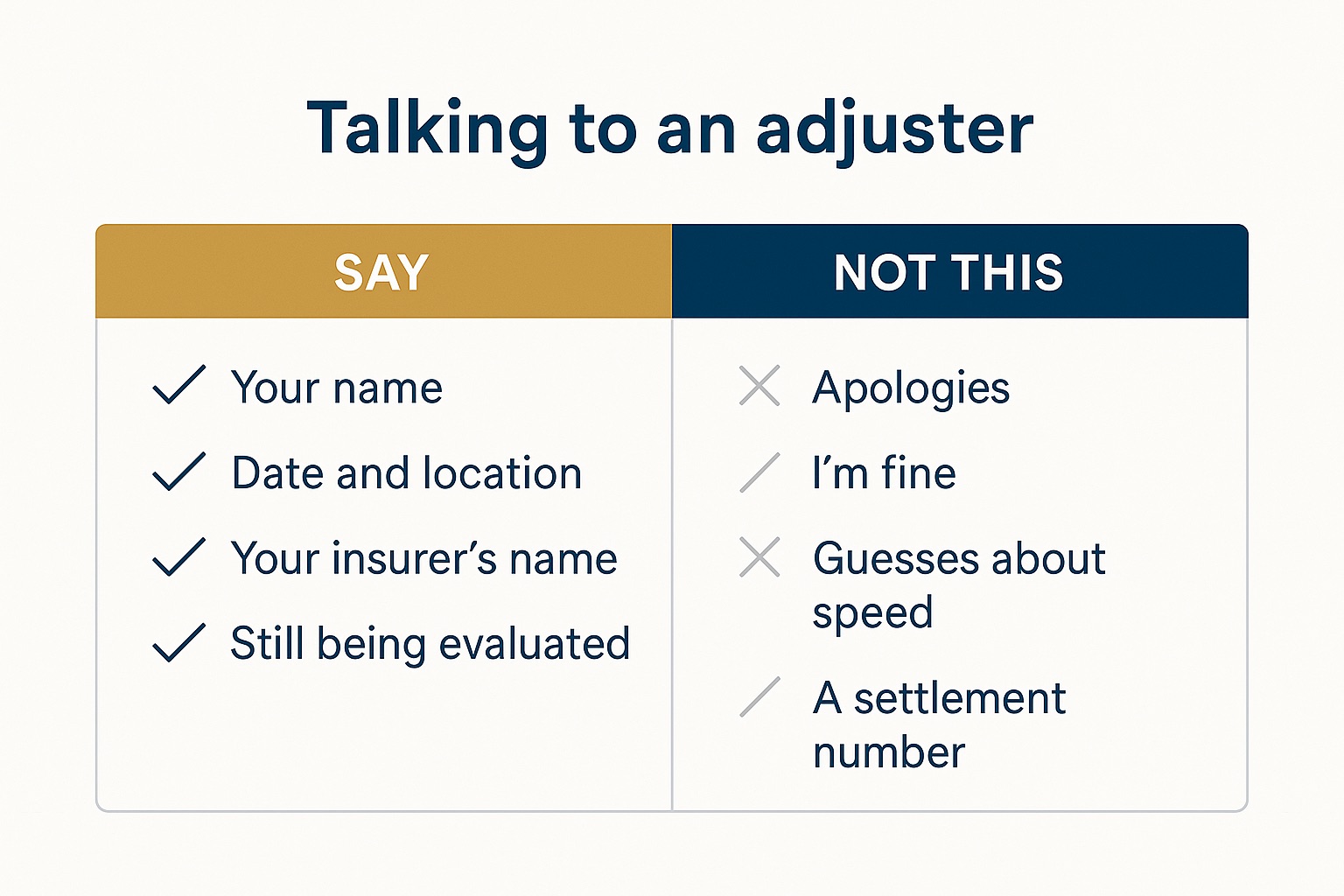
The list of things to avoid is shorter but more important. Most of it comes down to not guessing, not speculating, and not apologizing in a way that sounds like an admission.
Things to avoid saying:
- "I'm sorry, I didn't see you." An apology feels natural, but an adjuster can treat it as an admission of fault.
- "I'm fine" or "I'm not really hurt." Many injuries, including soft-tissue and neck injuries, show up hours or days later.
- Any guess about speed, distance, or who had the right of way when you are not certain.
- A detailed, blow-by-blow account of the crash before you have seen the police report or your own records.
- Agreement to a recorded statement for the at-fault driver's insurer without understanding whether you have to give one.
- Any number, such as a demand or a settlement figure, before you know the full extent of your injuries and treatment.
You are not being evasive by declining to speculate. You are avoiding statements that could be misread later.
Do I have to give a recorded statement to the other driver's insurer in Kansas?
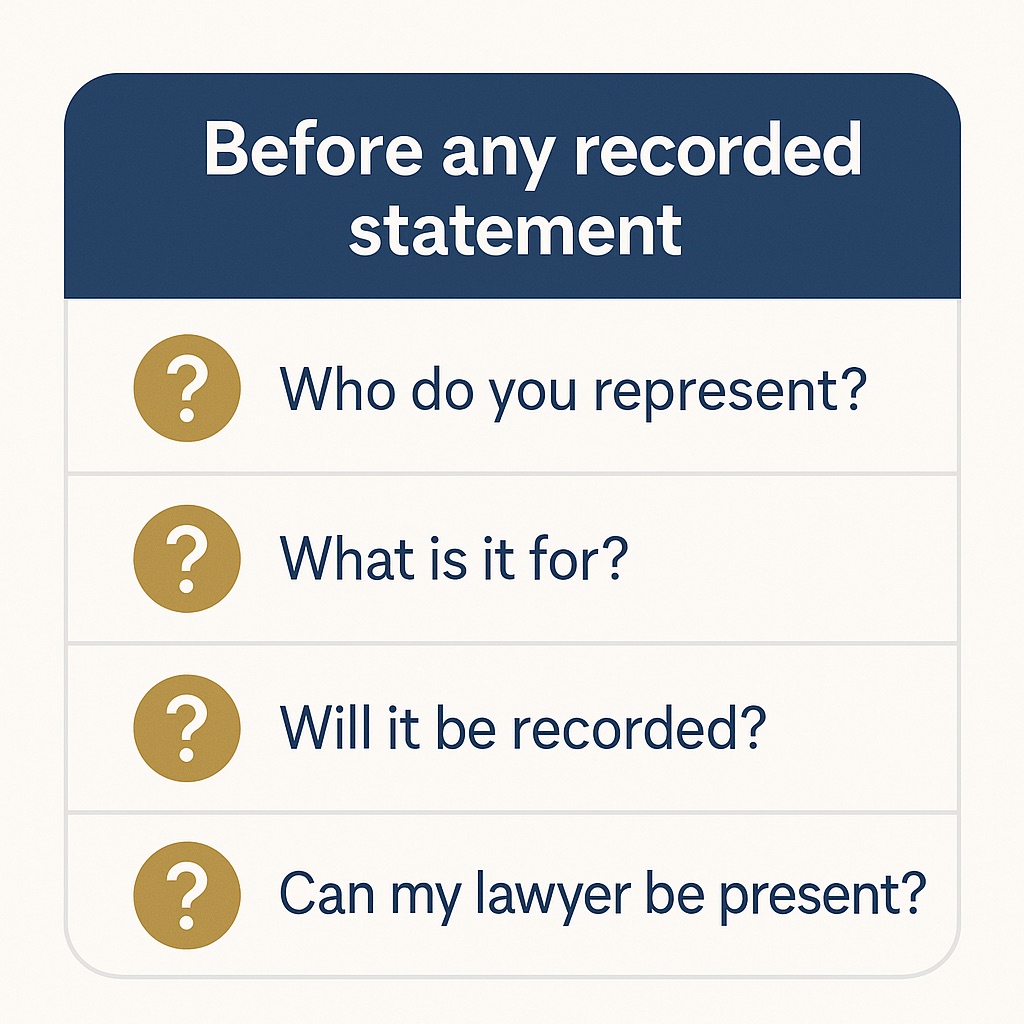
There is an important difference between the two insurance companies that may call you, and it changes what you owe them.
The at-fault driver's insurer is a third-party carrier. It is not your insurance company, and you generally do not have a contract with it. Because of that, you generally have no contractual duty to give the at-fault driver's insurer a recorded statement. The adjuster may ask for one, and may frame it as routine, but a request is not the same as a requirement.
Your own insurer is a first-party carrier. Your auto policy usually contains a cooperation clause, which typically requires you to cooperate with your own company's investigation of a claim you make under your policy, and that duty can include a statement. Even then, you can ask questions before agreeing: what the statement is for, whether it will be recorded, and whether you can have counsel present.
Before you agree to a recorded statement for either company, talk to a lawyer.
Why one careless sentence can matter: Kansas comparative fault
Kansas is a modified comparative-fault state with a 50 percent bar under K.S.A. 60-258a, and that statute is the reason to be careful about what you say to an adjuster.
Your recovery is reduced by your own percentage of fault. If your damages are $100,000 and you are found 20 percent at fault, your recovery is reduced by that 20 percent.
There is also a threshold. Under the statute, a claimant may recover only if their negligence was less than the causal negligence of the party or parties against whom the claim is made, and the award is then reduced by the claimant's own percentage. If your share of fault is 50 percent or more, your recovery is barred entirely.
This is where a casual comment does real damage. An offhand "I'm sorry, I didn't see you" can be used to argue that your fault percentage should be higher. Pushing your percentage up costs you money at every level, and if it pushes you past the bar, it can cost you the claim. That is not a reason to be dishonest. It is a reason not to volunteer conclusions about fault before anyone has investigated what happened.
You can read more about how the 50 percent bar works in our overview of Kansas comparative fault.
You are not on the clock the way the adjuster suggests
Adjusters sometimes create a sense of urgency, as if you need to give a statement or accept an offer quickly. In Kansas, the deadline that matters for a personal-injury claim is the 2-year statute of limitations under K.S.A. 60-513. That is a separate deadline from any phone call, and it is measured in years, not days.
Kansas also requires personal injury protection (PIP), or no-fault, coverage on every auto policy. That means your own PIP coverage generally pays initial medical expenses and certain wage-loss benefits regardless of who was at fault. Because those first benefits do not depend on winning a fault dispute, there is usually no financial reason to feel rushed into a recorded statement with the other driver's carrier. For a general overview of Kansas auto coverage, the Kansas Insurance Department consumer auto page is a neutral starting point.
If the other driver turns out to be uninsured or underinsured, your own uninsured and underinsured motorist coverage may come into play, which is another reason to be careful about statements before you know which policies are involved.
A short video on dealing with adjusters
We put together a short video with practical tips for talking with insurance adjusters after a crash.
You can find more client-education videos on the Empower Injury Law YouTube channel.
Talk to a Lawrence attorney before the next call
If an adjuster has already called, or you expect one to, you do not have to handle it alone. Empower Injury Law offers a free consultation from its Lawrence, Kansas office, serving Douglas County and the surrounding area. You can call 785-367-6937 to talk through what happened and what to say before you commit to anything. There is no pressure and no obligation.
Frequently asked questions
Do I have to talk to the other driver's insurance company after a Kansas accident?
Generally, no. The at-fault driver's insurer is a third-party carrier you usually have no contract with, so you generally have no obligation to give it a recorded statement. You can confirm basic facts and decline to say more until you have spoken with an attorney.
Can saying "I'm sorry" hurt my Kansas injury claim?
It can. Kansas uses modified comparative fault with a 50 percent bar under K.S.A. 60-258a, so anything that sounds like an admission can be used to raise your assigned percentage of fault. A higher percentage reduces your recovery, and past the bar it can eliminate it. Be polite, but do not volunteer conclusions about who was at fault.
How long do I have to file a car accident claim in Kansas?
Kansas generally allows 2 years from the date of injury to bring a personal-injury claim under K.S.A. 60-513. That deadline is separate from any adjuster's phone call, so there is usually no need to rush into a recorded statement.
Should I give my own insurance company a recorded statement?
Your own policy usually includes a cooperation clause, which can require you to cooperate with your insurer's investigation of your claim, and that may include a statement. You can still ask what it is for and whether you can consult counsel first.
What if I already gave the adjuster a statement?
You are not without options. A single conversation is not the whole case, and the facts, the police report, and your medical records still matter. Go over what you said with a lawyer, who can put it in context.
Will my medical bills be covered while my claim is pending?
Kansas requires PIP (no-fault) coverage on every auto policy, so your own PIP generally pays initial medical expenses and certain wage losses regardless of fault. That is one reason not to feel pressured to settle or give a statement quickly.
Author Bio

Kevin A. Jones | Personal Injury Lawyer
Kevin A. Jones, founder and managing attorney of Empower Injury Law, has been practicing law since 2009. With over $25 million in jury verdicts and settlements in his first decade, Kevin has earned a reputation as a fierce advocate for his clients.
Kevin’s approach to law is rooted in his passion for helping people who have been mistreated by corporations, insurance companies, and other powerful entities.
Whether representing individuals wronged by negligent drivers or those injured on someone else’s property, Kevin is dedicated to achieving justice. His extensive experience in the courtroom ensures that clients receive strong, personalized representation that delivers results.
Practice Areas


