Do I Have to Give the Insurance Company a Recorded Statement After a Missouri Crash?
After a car accident in Missouri, you generally do not have to give a recorded statement to the other driver's insurance company. That insurer works for the person who hit you, not for you, and Missouri law does not require you to sit for a recorded interview with them. Your own insurer is a different situation, because your policy is a contract and it usually includes a duty to cooperate. This post explains the difference, why a recorded statement matters, and what to do instead when an adjuster calls.
Nothing here is legal advice, and every crash has its own facts. If you want your specific situation reviewed, the Liberty office of Empower Injury Law offers a free consultation. You can reach us at 816-367-6937 or [email protected].
Do I have to give a recorded statement at all?
It depends entirely on whose insurance company is asking.
For the at-fault driver's insurer, the short answer in Missouri is no. You are not their policyholder, you have no contract with them, and you are under no general legal obligation to give them a recorded statement about how the crash happened or how you are injured. An adjuster may call within days and ask to "get your side on the record," but that request is for their convenience and their file, not a legal command you have to obey.
For your own insurer, the answer is usually different, and it turns on the wording of your policy rather than on a statute. Most auto policies include a cooperation clause, which is a promise you made when you bought the coverage to work with the company on a claim. That can include providing information about the accident.
The Missouri Department of Commerce & Insurance, the state agency that regulates insurers, publishes consumer guidance on handling auto claims and dealing with adjusters, which is a useful neutral starting point. You can find it at insurance.mo.gov. The Federal Trade Commission also offers general consumer guidance on dealing with insurance companies.
Is it different for the other driver's insurer vs my own insurer?
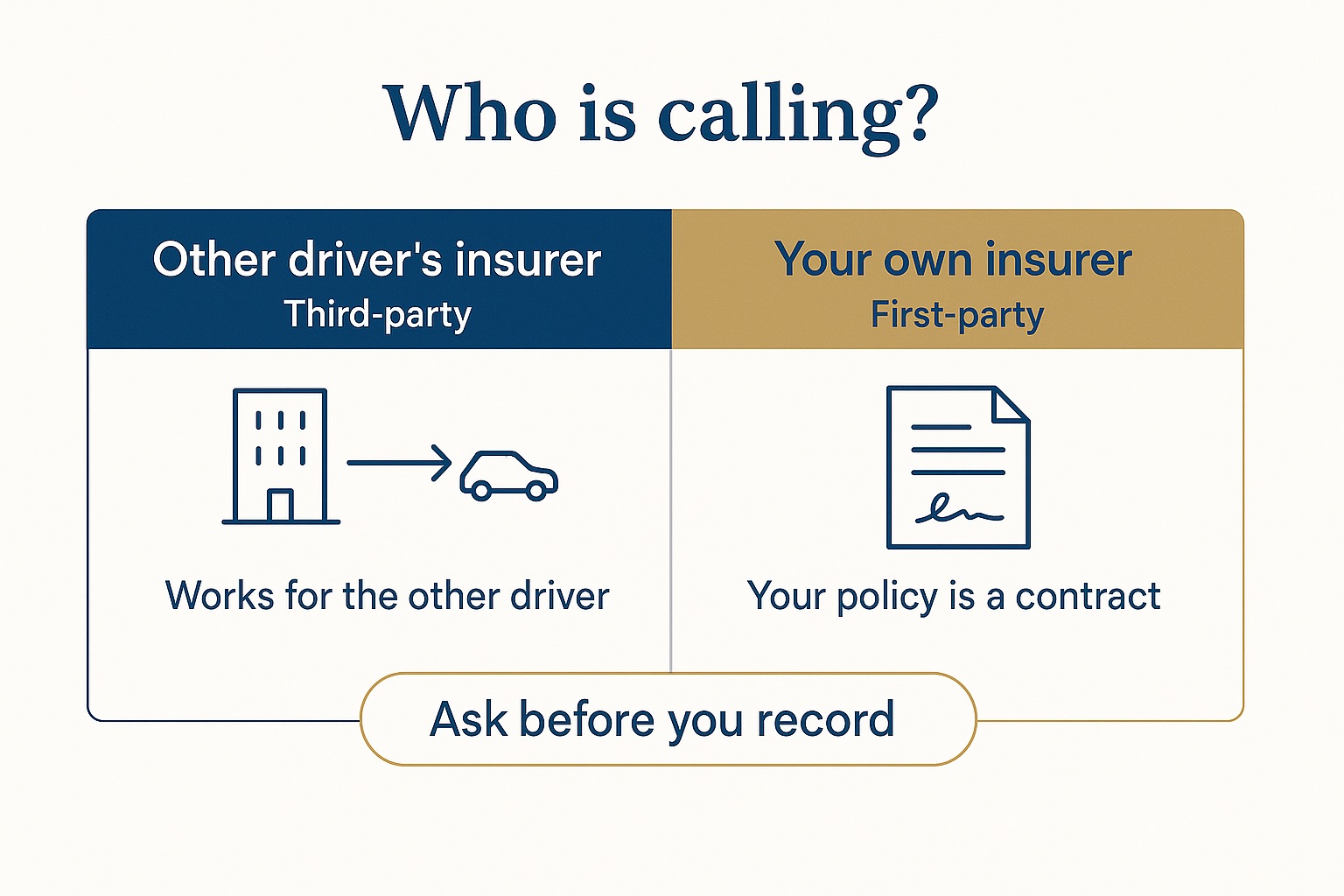
Yes. This is the single most important distinction to understand, and it is where people most often get tripped up.
The other driver's insurer (the third-party insurer)
When the person who caused the crash has insurance, their company is the third-party insurer from your point of view. You are making a claim against their policyholder. You do not have a contract with them, so you do not owe them cooperation, and you generally do not have to give them a recorded statement in Missouri. Their adjuster is gathering information to evaluate, reduce, or defend against your claim. Being polite is fine. Confirming basic facts like the date and location is fine. Sitting for a recorded question-and-answer session about fault and the full extent of your injuries, days after a crash, usually is not necessary and often is not in your interest.
Your own insurer (the first-party insurer)
When you turn to your own policy, you are making a first-party claim. This happens with uninsured or underinsured motorist coverage, medical payments coverage, or collision coverage. Here you do have a contract, and the cooperation clause in that contract is what changes the picture. Your insurer can generally ask you for information and documentation to process the claim. Whether that cooperation duty extends to a formal recorded statement, and how far it goes, depends on your policy language and Missouri law.
If your claim runs through your own uninsured or underinsured motorist coverage, it helps to understand how that coverage works before you talk to anyone. We cover that in our guide to uninsured and underinsured motorist claims in Missouri.
What is a duty to cooperate, and does it force a recorded statement to my own insurer?
A duty to cooperate, often called a cooperation clause, is a standard condition in most auto insurance policies. In plain terms, it says that when you make a claim under your policy, you agree to help the company investigate it. That can mean sending documents, answering reasonable questions, and making yourself available.
The clause exists because your insurer is paying out under a contract with you and is entitled to verify the claim. What the clause does not automatically mean is that you must submit to any and every demand, in any format, at any time. There is a difference between cooperating in good faith and handing over a recorded statement that a first-party insurer could later use to narrow what it pays you. Whether the cooperation duty specifically compels a recorded statement, and what happens if you decline that one format while still cooperating in other ways, is a Missouri-specific question worth getting right.
A practical point: even where some cooperation is owed, you are usually allowed to have a lawyer present, to know what will be asked, and to correct the record. You do not have to be interviewed cold, from memory, while you are still injured and stressed.
Can a recorded statement be used against me later?
Yes. A recorded statement is exactly what it sounds like, a recording of your answers that becomes part of the claim file and can be transcribed and used later.
This matters for a few reasons. Right after a crash, you may not know the full extent of your injuries, because some symptoms surface days or weeks later. If you tell an adjuster you feel "okay" or "fine," those words can be used to argue your injuries are minor. You also may not know exactly how the crash happened, and a guess said out loud on tape can be treated as a fact. Adjusters are trained to ask questions in a particular order and phrasing, and an offhand answer can be read against you when the claim is valued. None of this means the adjuster is acting in bad faith by asking. It means the recording is a tool built for their file, and once you have given it, you cannot take it back.
Can the insurer deny or jeopardize my claim if I refuse?
This is where the two situations split again.
The other driver's insurer cannot deny "your claim" by punishing you for declining a recorded statement, because there is no policy between you and them to enforce. They can still dispute fault or the value of your injuries, which they may do regardless. Declining the recording does not hand them a contractual reason to walk away.
Your own insurer is different, because the cooperation clause is a condition of the policy. In a first-party claim, including an uninsured or underinsured motorist claim, an insurer may take the position that a failure to cooperate affects the claim. Missouri law places real limits on that, and an insurer generally cannot use a technical objection as a shortcut to avoid paying a valid claim. Whether refusing a recorded statement can cost you a first-party or UM claim depends on the wording of your policy and on what else you gave the insurer.
If your own insurer is leaning on you, dragging out a first-party claim, or treating a valid claim as a bargaining problem, that pressure can sometimes cross a line Missouri law recognizes. We explain your options, including when an insurer's conduct may support a claim against it, in our guides on whether you can sue your own insurance company in Missouri and on insurance bad faith and vexatious refusal in Missouri.
What should I say when the adjuster calls?
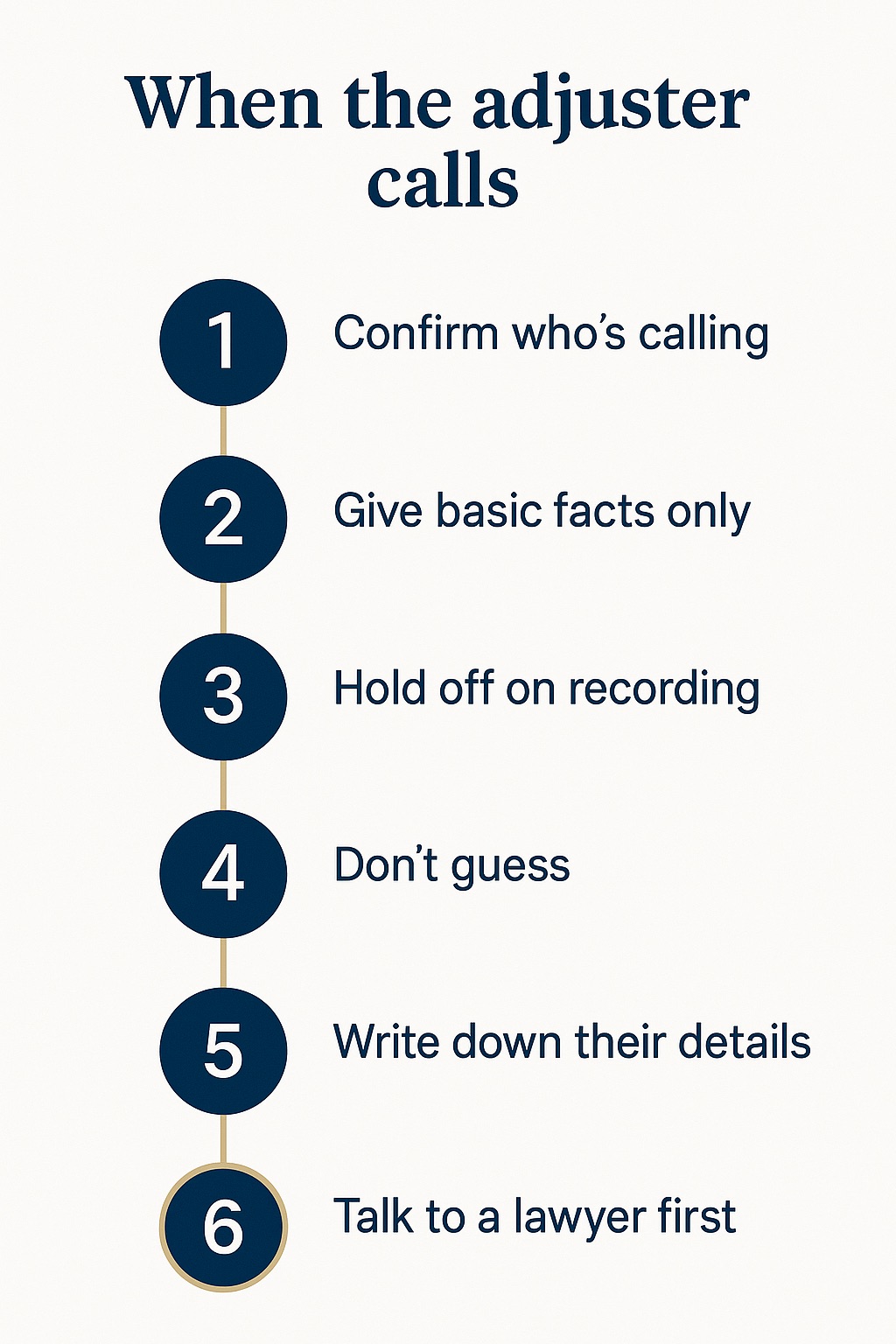
You do not have to decide anything on the first call, and you do not have to be on the record to be reasonable. Here is a calm way to handle it.
- Confirm who is calling and which insurer they represent. Ask whether they are the at-fault driver's insurer or contacting you about your own policy, because your answer changes based on that.
- Give only basic identifying facts if asked, such as your name, the date of the crash, and the general location. You do not have to narrate fault or describe your injuries.
- Decline a recorded statement for now. You can simply say you are not ready to give a recorded statement and will follow up. That is a normal thing to say.
- Do not guess or speculate. If you do not know something, "I don't know" or "I'm not sure yet" is an honest and safe answer.
- Do not accept a quick settlement offer or sign anything, including a medical authorization, before you understand what it covers.
- Write down the adjuster's name, number, and claim number, and note the date and time of the call.
- Talk to a lawyer before giving any statement, especially to your own insurer, so you understand what you actually owe under your policy.
For short, plain-language explanations of situations like this, the firm also posts client-education videos on its YouTube channel.
Talk to the Liberty office before you go on the record
If an adjuster has already called, or you are not sure what your own policy requires, it costs nothing to ask before you give a recorded statement. The Liberty, Missouri office of Empower Injury Law handles Missouri car accident and insurance claims, and we can walk you through what you do and do not have to do in your specific situation. You can read more about how we handle these cases on our Liberty car accident page, or call us at 816-367-6937 for a free consultation. You can also email [email protected].
This article is general information about Missouri law and is not legal advice. It does not create an attorney-client relationship, and it does not promise any particular outcome. For advice about your own crash, speak with a licensed Missouri attorney.
Frequently asked questions
Do I have to give the other driver's insurance company a recorded statement in Missouri?
Generally no. You have no contract with the at-fault driver's insurer, and Missouri law does not require you to give them a recorded statement. You can decline that request while still being polite and confirming basic facts like the date and location of the crash.
Do I have to give my own insurance company a recorded statement?
It depends on your policy. Most auto policies include a cooperation clause, which is a contractual duty to help your insurer investigate a claim. Whether that duty specifically requires a recorded statement is a Missouri-specific question that turns on your policy language, so it is worth reviewing before you agree.
Can a recorded statement hurt my claim?
It can. A recorded statement becomes part of the claim file and can be used later. Early comments about how you feel or how the crash happened, made before you know the full picture, can be used to reduce or dispute your claim.
Can an insurer deny my claim if I refuse a recorded statement?
The at-fault driver's insurer cannot deny "your claim" for refusing, because you have no policy with them. Your own insurer may raise the cooperation clause in a first-party or uninsured or underinsured motorist claim, but Missouri law limits how far an insurer can push that. The specifics are fact-dependent and worth confirming with an attorney.
What should I do when an adjuster calls after a Missouri crash?
Confirm who they represent, give only basic identifying facts, decline a recorded statement for now, do not guess or accept a quick offer, write down the adjuster's details, and talk to a lawyer before giving any statement, especially to your own insurer.
Author Bio

Kevin A. Jones | Personal Injury Lawyer
Kevin A. Jones, founder and managing attorney of Empower Injury Law, has been practicing law since 2009. With over $25 million in jury verdicts and settlements in his first decade, Kevin has earned a reputation as a fierce advocate for his clients.
Kevin’s approach to law is rooted in his passion for helping people who have been mistreated by corporations, insurance companies, and other powerful entities.
Whether representing individuals wronged by negligent drivers or those injured on someone else’s property, Kevin is dedicated to achieving justice. His extensive experience in the courtroom ensures that clients receive strong, personalized representation that delivers results.
Practice Areas


