Hurt in a Car Crash While Working in Kansas: Workers’ Comp or a Third-Party Claim?
If you were driving for work in Kansas and another driver hit you, you may have two claims, not one. Workers' compensation covers your injury through your employer regardless of who caused the crash. Separately, because the crash was the fault of someone outside your workplace, you can also bring a personal injury claim against that at-fault driver. Many injured workers around Lawrence and Douglas County file the comp claim, assume that is the end of it, and never pursue the second claim that is often worth far more. These two tracks run at the same time, and they are not alternatives you have to choose between.
The comp side belongs to your employer and its comp insurer. The claim against the other driver is ours to handle, and it is the focus of the rest of this page.
Can you sue the other driver if workers' comp is already paying?
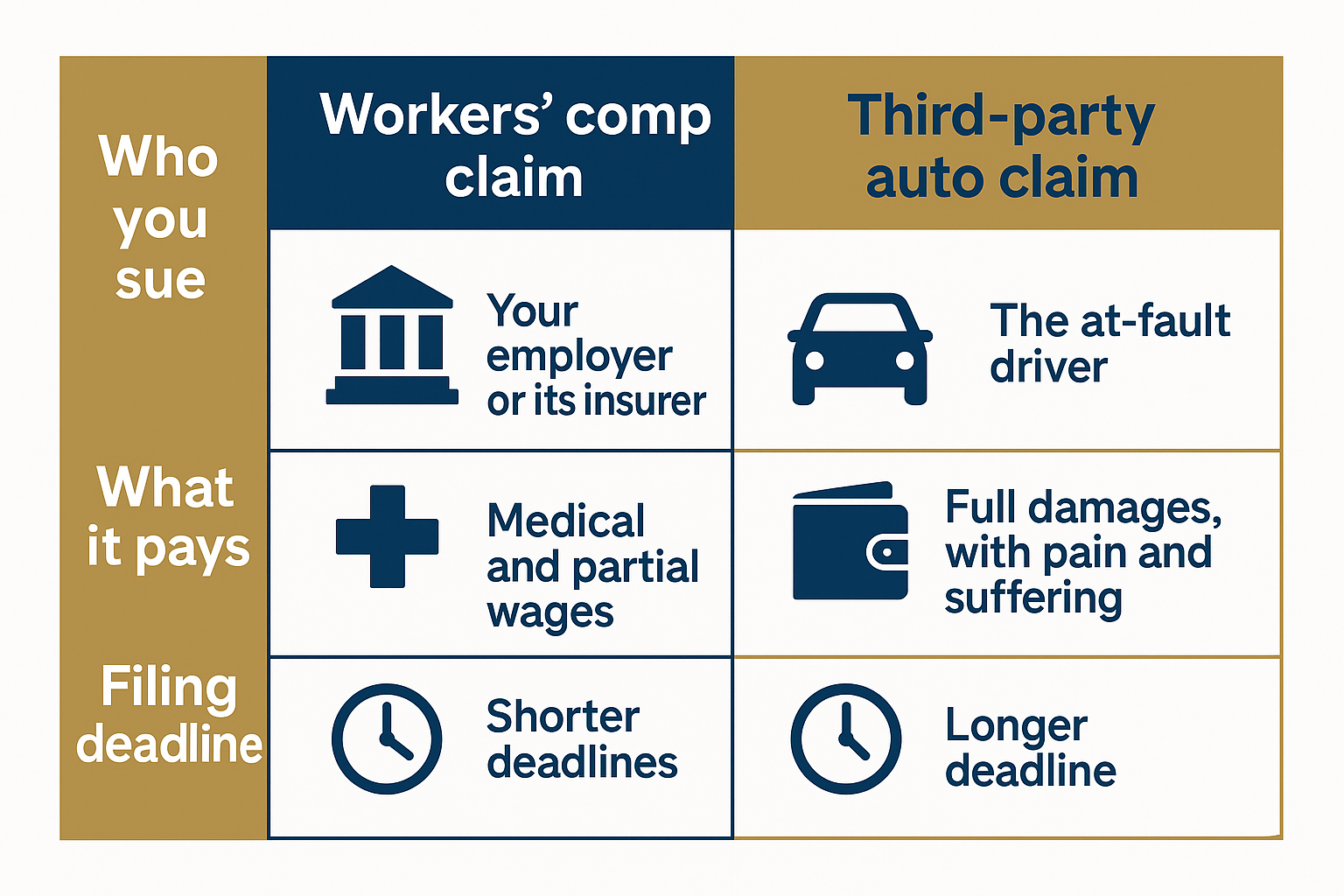
Yes. Workers' compensation is the exclusive remedy against your employer under K.S.A. 44-501b, which means you generally cannot sue your own employer for a work injury. That exclusivity stops at your employer. It does not protect the stranger who ran the red light at 23rd and Iowa or drifted into your lane on K-10. Kansas keeps your right to pursue a negligent third party intact while you collect comp.
The two claims pay for different things. Comp pays your medical treatment and a portion of your lost wages, on a schedule set by statute, and it pays nothing for pain and suffering. A claim against the at-fault driver reaches the full range of your damages: your medical bills, your full lost earnings (not just the comp fraction), future losses, and the human cost of the injury that comp ignores. That gap is the reason the third-party claim matters.
Who counts as a "third party" here
A third party is anyone legally responsible for the crash who is not your employer or a co-worker acting in the course of the same job. In a driving-for-work injury that is almost always the other motorist. It can also include a separate company whose driver hit you, or in some cases the party responsible for a dangerous road condition. The common thread is that the claim runs against someone outside your own employment.
Who this comes up for
Kansas workers hurt in crashes on the job are rarely desk workers. The pattern we see around Douglas County is delivery and rideshare drivers on US-59 and Iowa Street, home-health aides driving between clients in Eudora and Baldwin City, outside sales reps covering the Lawrence-to-Topeka corridor, and trades workers hauling tools between job sites toward Tonganoxie and the Johnson County line. If your job had you behind the wheel when the other driver hit you, the two-claim analysis applies to you.
How the workers' comp lien works against your auto recovery
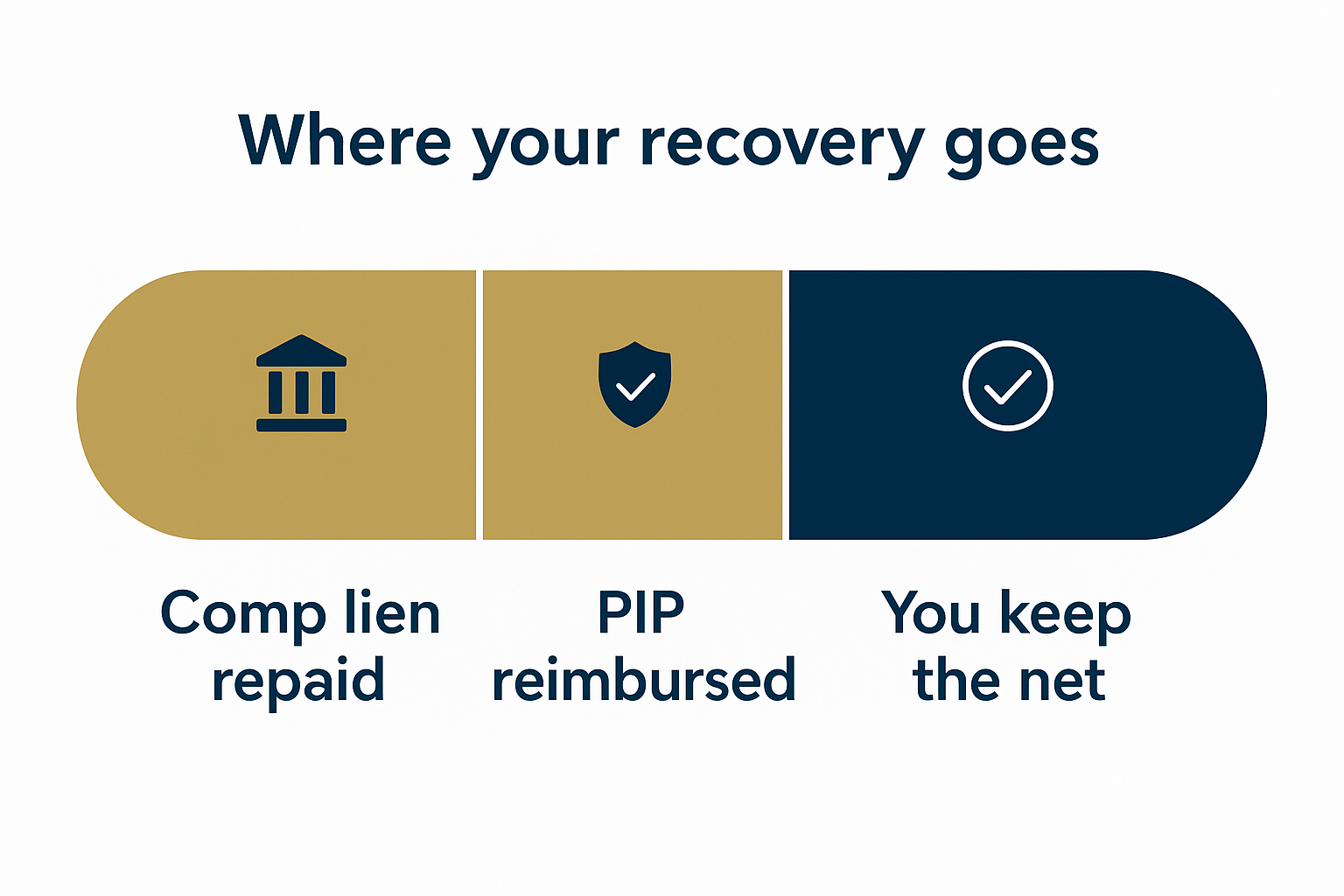
Here is the part that surprises people. When you recover money from the at-fault driver, your employer's comp insurer can be repaid out of that recovery for what it already spent on you. Kansas gives the comp carrier a subrogation lien against the third-party recovery for the benefits it paid, under K.S.A. 44-504, so the same medical bill is not paid twice.
This is not a reason to skip the auto claim. A lien reduces a recovery; it does not erase it. The comp carrier is repaid only for what it actually paid, and the categories comp never covered (your pain and suffering, the wages comp did not replace) are not subject to the same dollar-for-dollar repayment. Handled well, the third-party claim is structured so the lien is negotiated down and you keep a meaningful net. Letting the auto claim lapse, by contrast, leaves that money with the at-fault driver's insurer and does nothing for your lien.
The deadlines are different, and the auto one is longer
The clock on your claim against the at-fault driver is separate from, and generally longer than, the clock on your comp claim.
For the personal injury claim against the other driver, Kansas gives you 2 years from the date of the crash to file suit, under K.S.A. 60-513.
The workers' comp side runs on its own, shorter deadlines. Comp has prompt-notice requirements for telling your employer about the injury and a separate deadline to file the comp claim itself, and those windows are shorter than the 2-year tort deadline. Missing a comp deadline does not extend your time to sue the driver, and the reverse is also true.
Because the two tracks keep separate time, the safe move is to treat them as two deadlines, report the injury to your employer right away, and preserve the auto claim well before the 2-year mark. See our overview of Kansas personal injury deadlines through a Lawrence lens for how the tort clock interacts with investigation and evidence.
PIP: it depends on whose vehicle you were driving
Kansas is a no-fault state for the first layer of auto medical and wage benefits, which come through personal injury protection (PIP) under the Kansas Automobile Injury Reparations Act (K.S.A. 40-3101 et seq.), with PIP required in every Kansas auto policy under K.S.A. 40-3107. PIP pays early, regardless of fault, and which policy pays first depends on the vehicle.
If you were driving your employer's vehicle, PIP generally comes from the policy on that employer vehicle. If you were driving your own personal vehicle for work, your own auto policy's PIP is typically the one that responds. In a driving-for-work crash you can end up with workers' comp, PIP, and the third-party claim all in play at once, which is exactly why coordination matters.
PIP carries its own repayment mechanic too. If your PIP insurer paid benefits and you later recover from the at-fault driver, the PIP carrier can be reimbursed out of that recovery to the extent its benefits duplicated what you recovered, under K.S.A. 40-3113a, so you are not paid twice for the same loss.
With comp, PIP, and the third-party claim overlapping, two separate liens can attach to one settlement. Sorting that out before you settle is most of the work, and it is why a crash-on-the-job claim is handled differently from an ordinary Kansas car accident claim.
Your own fault can reduce or bar the auto claim
Workers' comp does not care who caused the crash; you get benefits either way. The claim against the other driver is different, because Kansas applies comparative fault to it.
Kansas follows a 50 percent modified comparative fault rule. If you are found partly at fault, your recovery against the other driver is reduced by your percentage of fault. If your share of the total fault reaches 50 percent or more, you recover nothing from the third-party claim. This threshold is Kansas law under K.S.A. 60-258a; it is not the rule in every state, so do not assume a figure you read for somewhere else applies here.
This is another place the two claims diverge. A finding that you were 30 percent at fault does not touch your comp benefits, but it cuts the third-party recovery by 30 percent. Fault is contested in most serious crashes, so how it is investigated and documented early can decide whether the auto claim survives at all.
When the at-fault driver has little or no insurance
Some work crashes involve a driver who is uninsured, who flees, or who carries minimum limits that do not cover a serious injury. That does not close the door. The uninsured and underinsured motorist coverage on the vehicle you were driving, or on your own policy, can step into the at-fault driver's place. How that coverage works alongside comp and PIP is its own subject, covered in our guide to uninsured and underinsured motorist coverage in Kansas.
Crashes on the fast-moving stretches many Lawrence workers drive, like the K-10 corridor, tend to be high-energy and high-injury. If your crash happened there, our page on K-10 crash claims near Lawrence covers the local specifics.
What to do if you were hurt driving for work
Report the injury to your employer promptly so the comp claim is preserved, and get medical care documented from the start. Keep anything that shows you were working at the time: your route, the delivery or job ticket, dispatch records, mileage logs. Get the other driver's insurance information and the crash report. Then have the third-party claim looked at before the 2-year window gets close, because the comp carrier and the PIP carrier will each be looking to be repaid out of whatever you recover, and the structure of the settlement is where that gets decided.
We handle the claim against the at-fault driver and coordinate it with your comp and PIP so the liens do not quietly consume your recovery. We do not take over your workers' comp claim itself; that stays with your comp attorney or the comp carrier, and we work alongside it.
Talk to a Lawrence car accident lawyer
If you were hurt in a crash while working anywhere in Douglas County, Eudora, Baldwin City, or the surrounding area, we can look at the crash and tell you whether a third-party claim is worth pursuing alongside your comp. The consultation is free and there is no pressure to hire us.
Empower Injury Law, 831 Massachusetts St, Lawrence, KS 66044. Call 785-367-6937. You can also see our work for injured drivers on our Lawrence car accident and Lawrence motor vehicle accident pages, our statewide Kansas personal injury overview, and short explainers on our YouTube channel.
This page is general information about Kansas law, not legal advice about your specific situation, and it does not create an attorney-client relationship.
Frequently asked questions
If I get workers' comp, can I still sue the driver who hit me?
Yes. Workers' comp is the exclusive remedy against your employer, but Kansas keeps your right to pursue the at-fault driver as a separate claim. You can collect comp and bring the third-party claim at the same time.
Why bother with the third-party claim if comp already pays my bills?
Comp pays medical treatment and only a portion of your lost wages, and nothing for pain and suffering. The claim against the at-fault driver reaches your full damages, including the losses comp does not cover, which is usually why the second claim is where the real recovery is.
Will my employer's insurer take part of my settlement?
The comp insurer can be repaid out of your third-party recovery for the benefits it already paid you, through a subrogation lien under K.S.A. 44-504. It is repaid only what it actually spent, and the lien is often negotiated down, so a recovery still leaves you with a net.
How long do I have to file against the at-fault driver in Kansas?
Generally 2 years from the date of the crash, under K.S.A. 60-513. Your workers' comp deadlines are separate and shorter, so do not let either clock run out.
Does my own fault affect the claim?
For the comp claim, no. For the claim against the other driver, Kansas applies 50 percent modified comparative fault: your recovery is reduced by your share of fault, and you recover nothing if your share is 50 percent or more.
Which PIP pays if I was driving for work?
It depends on the vehicle. If you were in your employer's vehicle, PIP generally comes from that vehicle's policy; if you were in your own car, your own policy's PIP typically responds. PIP, comp, and the third-party claim can all apply at once, and the liens have to be coordinated.
Author Bio

Kevin A. Jones | Personal Injury Lawyer
Kevin A. Jones, founder and managing attorney of Empower Injury Law, has been practicing law since 2009. With over $25 million in jury verdicts and settlements in his first decade, Kevin has earned a reputation as a fierce advocate for his clients.
Kevin’s approach to law is rooted in his passion for helping people who have been mistreated by corporations, insurance companies, and other powerful entities.
Whether representing individuals wronged by negligent drivers or those injured on someone else’s property, Kevin is dedicated to achieving justice. His extensive experience in the courtroom ensures that clients receive strong, personalized representation that delivers results.
Practice Areas


