If you were hurt in a crash on K-10, the South Lawrence Trafficway, our office at 831 Massachusetts St in Lawrence handles Kansas car accident claims on that corridor and across Douglas County. The call is free, there is no fee unless we recover for you, and you can reach us at 785-367-6937. Below is what a K-10 crash looks like under Kansas law, the deadlines that apply, and how we work a claim, so you can decide what to do next without pressure.
The stretch of K-10 that wraps the south and west edges of Lawrence is one of the busier and harder-driving roads in the county. Between W 6th Street and U.S. 59, there were 403 motor vehicle crashes from 2019 through 2023, with 9 deaths and 75 injuries in those crashes, according to figures the Kansas Department of Transportation cited in reporting on the corridor. Those are not small numbers for a 7-mile arc of highway.
Why K-10 produces the crashes it does
The South Lawrence Trafficway was built to move traffic quickly around the city, and it does. Speeds are high, the interchanges mix fast through-traffic with drivers slowing to exit, and for years much of the corridor carried two-way traffic on a single undivided roadway. A head-on or crossover crash at those speeds is rarely minor.
KDOT is in the middle of a $171 million project to widen K-10 to a four-lane divided highway between the U.S. 59 (Iowa Street) interchange and the 6th Street (U.S. 40) interchange, with reconstructed interchanges at 27th Street and Wakarusa Drive and at Clinton Parkway, where the existing curve is being softened. Construction began in September 2024 on the eastbound side and is scheduled to run into 2028. The work is meant to reduce exactly the kind of crossover and intersection crashes the corridor has seen. In the meantime, an active work zone adds its own hazards: shifted lanes, narrowed shoulders, reduced speed limits that not everyone obeys, and equipment near live traffic.
Common K-10 crash patterns we see on this corridor include:
- Rear-end collisions where through-traffic closes on a car braking for an exit or for backed-up ramp traffic.
- Crossover and head-on crashes on the undivided segments that have not yet been widened.
- Merge and interchange crashes at Wakarusa Drive, Clinton Parkway, and the U.S. 59 and 6th Street interchanges.
- Work-zone crashes tied to lane shifts, sudden slowdowns, and reduced-speed enforcement.
- Single-vehicle run-off-road crashes at highway speed, which often involve a serious injury even without a second car.
A crash on this stretch can send you to LMH Health in Lawrence or, for the most serious injuries, on to a Kansas City trauma center. Medical bills stack up fast, and the first call you get is usually from an insurance adjuster, not from anyone checking on your recovery.
What to do after a K-10 crash
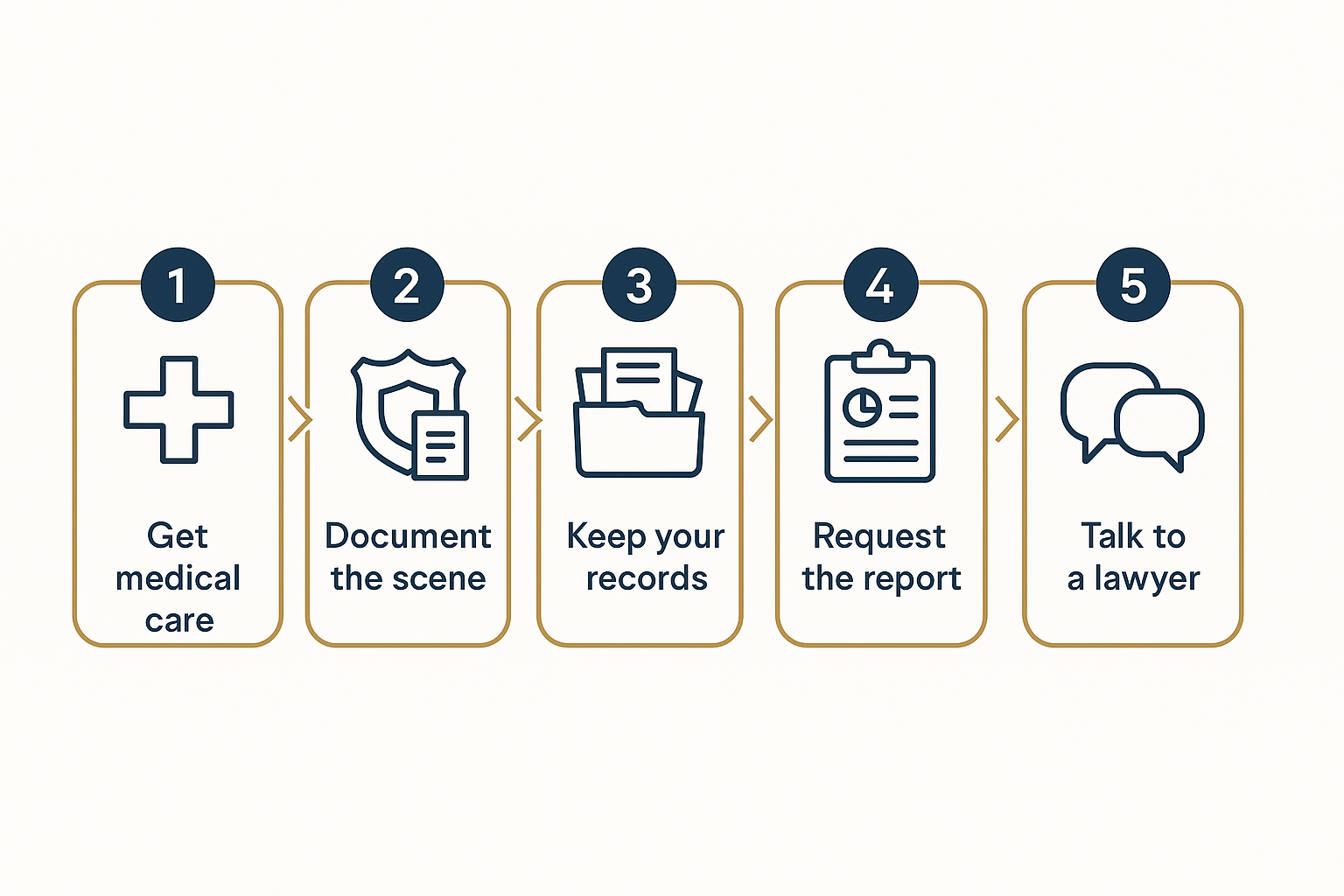
The hours and days after a highway crash set up everything that follows. A few steps protect both your health and any claim you later decide to bring.
At the scene and the first week
Get medical care first, even if you feel able to walk away. Highway-speed crashes produce injuries that do not announce themselves for a day or two, and a gap between the crash and your first treatment is the first thing an adjuster will point to. Call law enforcement so a crash is documented; on K-10 that is usually the Kansas Highway Patrol or the Douglas County Sheriff, depending on where the crash falls. Photograph the vehicles, the lane configuration, any work-zone signs or barriers, and the wider scene before anything is moved. Get names and numbers for any witnesses, because strangers who stop to help do not always leave contact information on their own.
Once you are home, keep every bill, every discharge instruction, and a short running note of how the injury affects your days. When you are ready, you can request the official crash report through our Lawrence, KS accident report guide, which walks through where the report comes from and how long it takes to be available.
The video below runs through the same basic steps in a few minutes. It is general guidance that applies to any car crash, not legal advice for your specific claim.
Watch: 5 Steps to Take After Being in a Car Accident on our YouTube channel.
Be careful what you say to the insurer
The at-fault driver's insurer will often call within a day or two, friendly and quick to offer something. You are not required to give a recorded statement to the other driver's insurance company, and an early number rarely reflects what an injury costs once the full picture is in. Before you describe the crash or accept anything, read what to say to a Kansas insurance adjuster after a car accident, or call us first.
How a Kansas car accident claim works
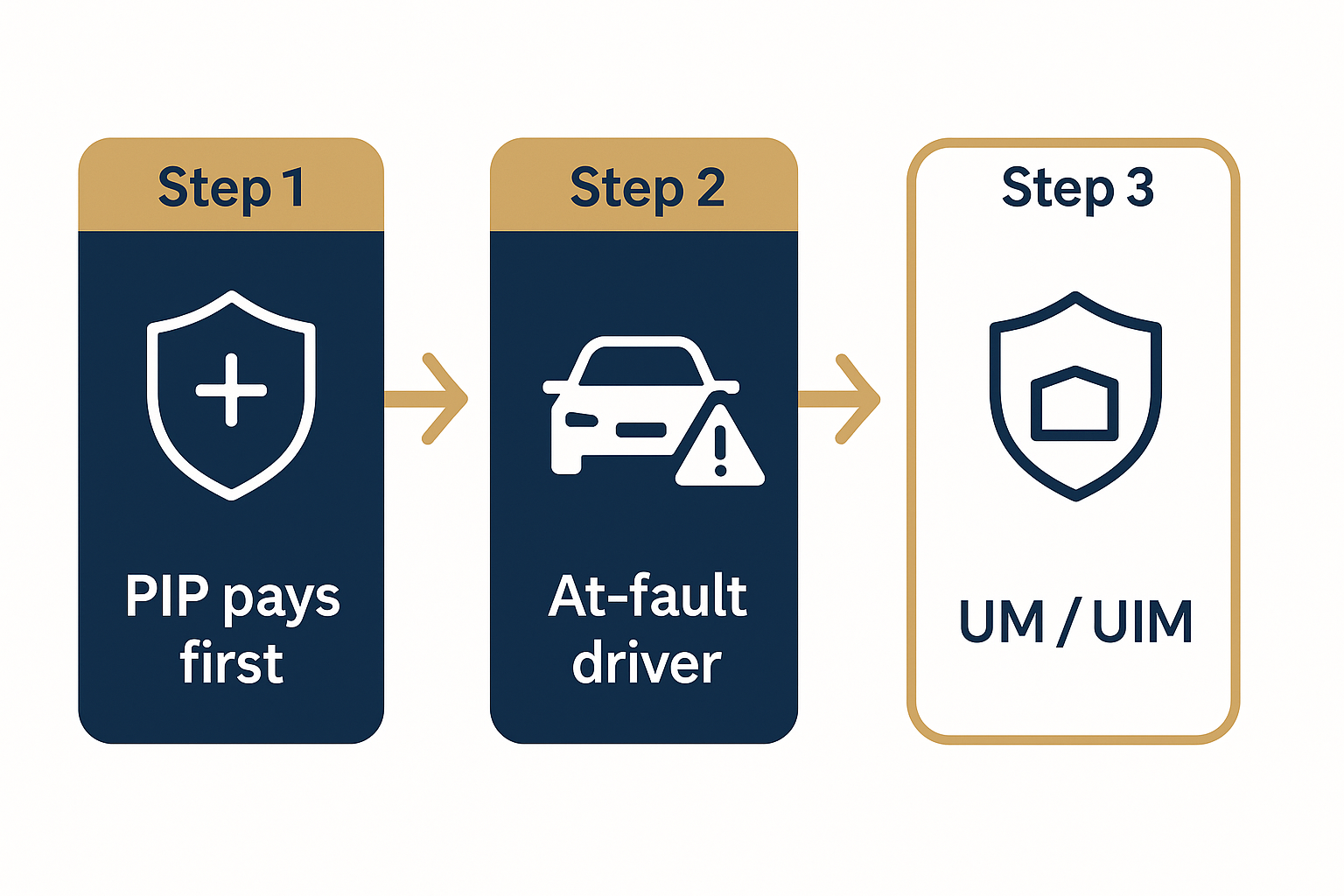
Kansas is a no-fault state for the first layer of coverage, and that shapes the opening weeks of a claim differently from how a crash would work in Missouri.
Your own PIP coverage pays first
Every Kansas auto policy carries personal injury protection, known as PIP or no-fault benefits. After a crash, your own PIP pays your initial medical bills and a portion of lost wages regardless of who caused the collision, up to the limits on your policy. That coverage exists so you are not waiting on a fault fight to get treatment. The amounts and how PIP coordinates with the rest of a claim are set out on our Kansas PIP and no-fault page.
PIP is a first layer, not the whole claim. For a serious K-10 injury, your damages usually run past what PIP covers, which is where a claim against the at-fault driver comes in. Kansas does not let you collect twice for the same loss, so to the extent your PIP already paid a bill, your PIP carrier is reimbursed out of what you later recover from the at-fault driver rather than you keeping both.
A claim against the at-fault driver
Once your injury crosses the threshold Kansas sets for stepping outside the no-fault system, under K.S.A. 40-3117, you can pursue the at-fault driver (and that driver's liability insurer) for the full range of your losses: medical bills, lost income, future care, and pain and suffering. The threshold turns on reaching a set level of medical expense or on certain kinds of injury, such as permanent disfigurement, a fracture, or a permanent injury.
The two-year deadline
Kansas gives you a limited window to file suit. Under K.S.A. 60-513, an injury claim generally must be filed within 2 years. Miss it and the claim is barred, no matter how strong it was. Two years can disappear quickly while you are focused on treatment, so know the deadline early. The full set of Kansas timing rules, including the discovery rule and how the clock runs in unusual situations, is on our Kansas statute of limitations page.
How fault is divided in Kansas
Kansas uses modified comparative fault with a 50 percent bar. Under K.S.A. 60-258a, your recovery is reduced by your own share of the fault, and if your share is 50 percent or more, you recover nothing. A driver found 20 percent at fault for a K-10 crash still recovers, with the award cut by that 20 percent. A driver found half or more at fault recovers nothing at all. When more than one other driver is involved, your share is measured against the total fault on the whole claim, and each defendant pays only its own proportionate share. We explain this in plainer detail, with examples, on our Kansas comparative fault page.
Because fault directly controls what you can recover, the other side's insurer has every reason to pin as much of it on you as possible. Securing the crash report, photos, and witnesses early is how that gets rebutted.
When the at-fault driver has no insurance or too little
A serious K-10 crash can easily exceed a minimum-limits liability policy, and some at-fault drivers carry no insurance at all. Kansas requires uninsured and underinsured motorist coverage on every auto policy, which means your own policy may cover the gap between what the at-fault driver can pay and what your injury is truly worth. How that coverage works, and how it coordinates with PIP, is covered on our Kansas UM/UIM coverage page. If the driver who hit you had no coverage at all, or fled the scene, start with our page on being hit by an uninsured driver in Kansas.
Crashes in a K-10 work zone, and claims against a government entity
A work-zone crash is still, in most cases, a crash between drivers, and the claim runs against whichever driver was at fault under the ordinary rules above. Sometimes, though, the condition of the road, the design of a lane shift, or the way a work zone was set up is part of the story. A claim that points at a government entity (KDOT, a county, or a city) is a different animal from a claim against another driver. The Kansas Tort Claims Act requires written notice to the government before suit, and those deadlines are short and separate from the 2-year deadline that applies to a claim against a driver. Missing a government-notice deadline can end that part of a claim before it starts.
To be clear, pointing to road conditions does not make KDOT or the State a defendant on its own; most K-10 claims are resolved as driver-against-driver matters. But if a government claim is in play, it has to be evaluated and preserved early. We cover the notice deadlines in our Kansas Tort Claims Act guide (coming soon).
Which county a K-10 case is filed in
Most of the K-10 corridor around Lawrence sits in Douglas County, and most crashes there are filed in Douglas County District Court. Toward the eastern end, K-10 runs toward the Johnson County line, and a crash near that line can raise a question about the proper county.
How we help with a K-10 claim
What we do on a corridor crash is straightforward. We pull the crash report and the scene evidence while it still exists, including any work-zone documentation if the crash happened in an active zone. We make sure your PIP benefits are opened and paying so you are not fronting medical bills. We deal with the adjusters so you are not talking your own claim down. We value the full claim, current bills and future care alike, rather than the number the insurer opens with. And if the at-fault driver's coverage runs short, we look to your own UM/UIM coverage to close the gap.
We are a Lawrence firm, not a call center. The office is at 831 Massachusetts St, and we handle car accident and injury matters across Douglas County. You can see the broader scope of our Lawrence car accident and Lawrence personal injury work, both of which include corridor crashes like these.
No two crashes resolve the same way, and nothing here is a promise about yours. What we can tell you up front is what your options look like and what the deadlines are. Call 785-367-6937 or email [email protected] for a free, no-pressure consultation.
Frequently asked questions
How long do I have to file a claim after a K-10 crash in Kansas?
In most cases, 2 years from the date of the crash, under K.S.A. 60-513. If your claim points at a government entity over road or work-zone conditions, a separate and shorter written-notice deadline applies under the Kansas Tort Claims Act, so a possible government claim should be evaluated well before the 2-year mark.
Does my own insurance pay my medical bills after a K-10 crash?
Yes. Kansas is a no-fault state, so your own personal injury protection (PIP) coverage pays your initial medical bills and part of your lost wages regardless of who caused the crash, up to your policy limits. PIP is the first layer; a serious injury usually also supports a claim against the at-fault driver.
What if the K-10 crash was partly my fault?
You can still recover as long as your share of the fault is under 50 percent, under K.S.A. 60-258a. Your award is reduced by your percentage of fault. If you are found 50 percent or more at fault, Kansas law bars recovery entirely.
The driver who hit me on K-10 had no insurance. What now?
Kansas requires uninsured and underinsured motorist coverage on every auto policy, so your own UM/UIM coverage may pay when the at-fault driver has no insurance or not enough to cover your injury. The same applies to a hit-and-run. These are claims under your own policy, and we can help you open and pursue them.
Can I sue KDOT if construction on K-10 caused my crash?
Possibly, but a claim against KDOT or any government entity is separate from a claim against another driver and is governed by the Kansas Tort Claims Act, which requires written notice to the government on a short deadline. Most work-zone crashes are still resolved as driver-against-driver claims. If a government claim is in play, it needs to be evaluated quickly so the notice deadline is not lost.
Which court handles a K-10 crash near the Johnson County line?
Most K-10 crashes around Lawrence are filed in Douglas County District Court. Near the eastern end of the corridor, where K-10 runs toward the Johnson County line, the proper county can depend on exactly where the crash happened and the parties involved, so ask a lawyer to confirm the right venue for your specific crash rather than assuming.
How much does it cost to hire you for a K-10 accident claim?
The consultation is free, and we handle injury claims on a contingency fee, which means there is no fee unless we recover for you. You can call 785-367-6937 to talk through your crash before deciding anything.