What Happens to a Child’s Car Accident Settlement in Kansas
When your child is hurt in a car crash in Kansas, the settlement does not work the way an adult's does. A child cannot legally sign a release, so Kansas builds in extra protection for the money. A child car accident settlement in Kansas either goes through a short affidavit process a parent can handle, or, when the amount is large enough, through a conservator and a judge who has to decide the settlement is fair before any release is signed. If your family is in Lawrence, Eudora, Baldwin City, or elsewhere in Douglas County, the path depends on the size of the child's recovery, and so does how the money is protected once the case settles.
The short version: the size of the child's net recovery decides the path. Smaller settlements can be approved by the parent or person with legal custody through a signed affidavit, with the money locked away for the child. Larger ones require a conservator and court approval. Either way, the goal is the same, which is to make sure the money reaches the child and not anyone else.
Why a child's settlement is treated differently
A minor cannot enter a binding contract, and a settlement release is a contract. If a parent simply signed away the child's claim and pocketed a check, the child could, in theory, reopen the claim years later. Insurers know this, so they will not pay a minor's claim without a process that makes the release stick. The process also protects the child from a release signed too cheaply or from funds that never make it into the child's hands.
Two deadlines sit in the background, and they are not the same deadline. The general Kansas personal injury statute of limitations is 2 years (K.S.A. 60-513). A child's own injury claim, though, is tolled: under K.S.A. 60-515, the minor generally has until one year after turning 18 to bring the claim, subject to an 8-year outer cap. So the clock on the child's underlying claim usually runs longer than the ordinary 2 years. That is reassuring, but it is a reason to act deliberately, not a reason to wait. Evidence and witness memory fade long before any deadline does.
The two paths a child's settlement can take in Kansas
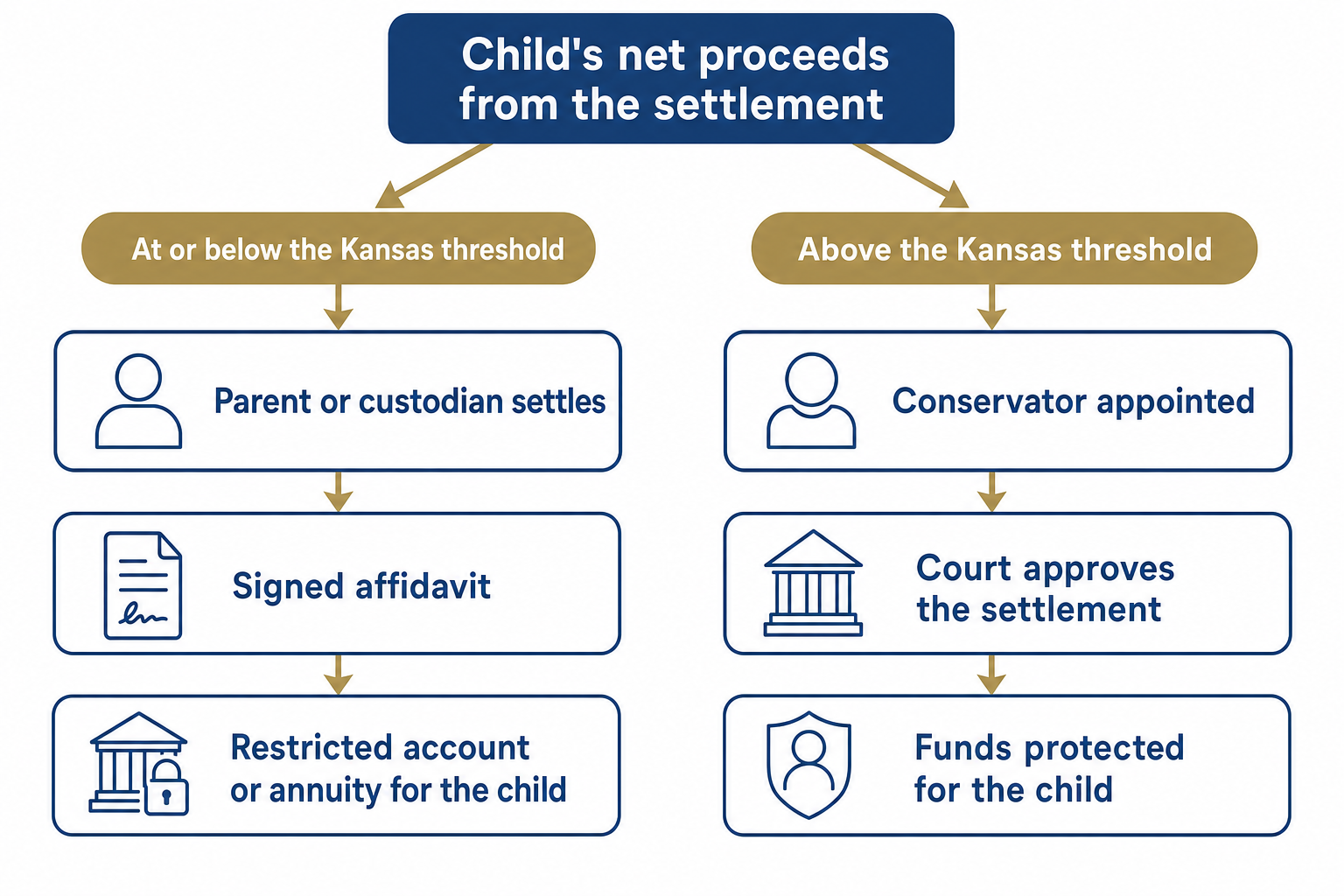
Kansas law lets a parent or person with legal custody settle a child's claim on their own, without a conservator or a judge, when the child's net recovery is small enough. Above that line, a conservator has to be appointed and a court has to approve the settlement.
The dividing line is the child's net proceeds, meaning what is left for the child after the bills and costs come out of the gross settlement, not the headline settlement figure. A $40,000 settlement can easily net the child far less once medical bills and fees are paid, which can change which path applies.
Path 1: A parent settles without a conservator or court approval
A person with legal custody of a minor may settle the child's claim without a guardian or conservator being appointed when the child's net proceeds fall at or below the Kansas threshold, after subtracting all medical expenses, medical liens, other liens, and reasonable attorney fees and costs. The controlling statute is K.S.A. 38-152.
On this path, the custodian signs an affidavit, a verified statement, saying that the child is fully compensated or that there is no practical way to recover more, and acknowledging the duty to protect the funds for the child. The net money cannot simply be deposited in a regular account. It has to go into a restricted savings or investment account that blocks withdrawals except as the statute allows, or be used to buy an annuity with the child as the sole beneficiary. If an attorney handles the settlement, the attorney keeps the affidavit on file for 5 years.
This path is faster and less expensive because it avoids a court proceeding, but it is only available when the net figure stays at or below the threshold. The affidavit is not a formality. By signing it, the custodian is representing that the amount is fair and that the funds will be preserved for the child.
Path 2: A conservator is appointed and the court approves the settlement
When the child's net proceeds rise above the threshold, the affidavit route is not available. Instead, a conservator has to be appointed to represent the child's financial interests, and a court has to approve the settlement before it becomes final.
The conservator is the person the court authorizes to receive and manage the child's money. Often it is a parent, but the court appoints and oversees the role either way. The approval itself happens in the local district court. For Douglas County families, that is the Douglas County District Court in Lawrence; you can read about the Kansas court system generally on the Kansas Judicial Branch site.
How the court decides whether a settlement is in the child's best interest
The judge is not a rubber stamp. The court makes its own, independent decision about whether the settlement serves the child, separate from what the parents and the insurer have agreed to.
In practice, a court reviewing a minor's settlement looks at the nature and severity of the child's injuries, the medical treatment and prognosis, how the total settlement breaks down between the child and any other claimants, the attorney fees and costs being charged, any liens against the recovery, and how the net money will be held and protected until the child is an adult. The judge can ask questions, request more information, and decline to approve terms that shortchange the child. This review is the point of the process. It exists so that no one settles the child's claim too cheaply or diverts the money.
What counts toward the threshold
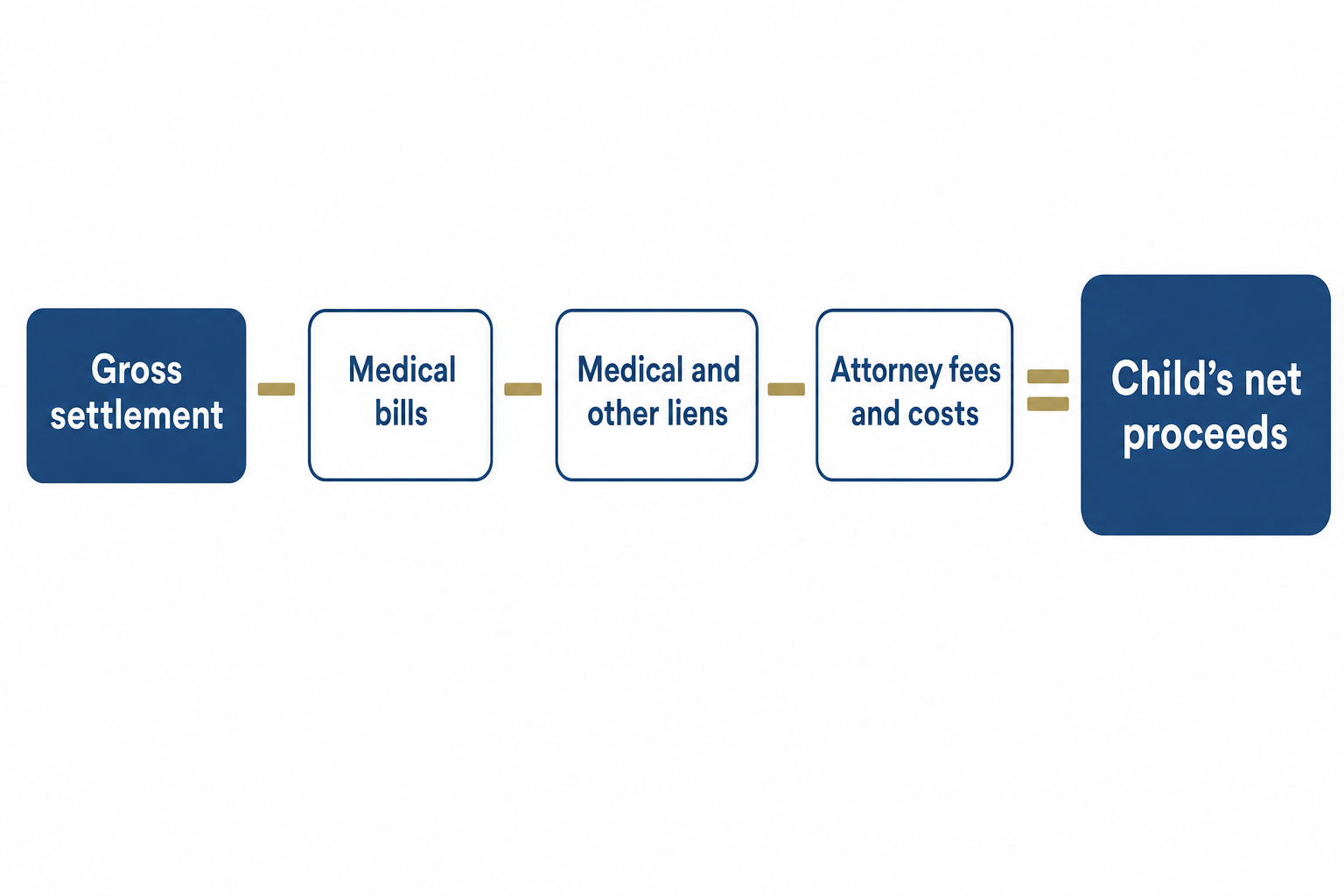
Because the threshold is measured by the child's net recovery, the deductions matter as much as the settlement amount. Several things come out of a gross settlement before you reach the child's net figure: medical expenses, medical liens, any other liens, and reasonable attorney fees and costs.
Medical liens are often the largest reduction, and Kansas no-fault rules shape them. Kansas is a no-fault state, so personal injury protection (PIP) benefits usually pay the child's early medical bills regardless of fault. You can read how that works on our Kansas PIP and no-fault insurance page. Kansas does not let anyone collect twice for the same loss, so if a PIP carrier paid the child's medical bills and the family later recovers from the at-fault driver, the carrier has a right of reimbursement against the duplicative part of that recovery under K.S.A. 40-3113a. That reimbursement does not reduce the coverage available, but it does affect the net proceeds, which in turn can affect which settlement path applies.
Fault can affect the number too. Kansas follows modified comparative fault, so a recovery is reduced by the child's share of fault and is barred entirely if that share reaches 50 percent or more. Our Kansas comparative fault page explains how that works in a crash case.
A few things to know before settling a child's claim
A few parts of a child's claim are easy to miss, and they are worth checking before any settlement is signed.
Watch for a serious coverage gap. If the driver who hit your child had no insurance or too little of it, the family's own uninsured and underinsured motorist coverage may be where most of the recovery comes from. That coverage is often the difference between a small settlement and a fair one.
Think past the immediate bills. A child's injuries can affect them for years, and a settlement closes the claim. Future medical needs and the long-term effect of an injury belong in the evaluation before anyone signs, not after.
Watch the net figure, not the gross. Because the path turns on net proceeds, a settlement that looks large can still fall on the simpler side of the line once bills and fees are deducted, and one that looks modest can land on the other. Knowing where it falls early helps you plan.
We handle car accident claims for families across Douglas County from our Lawrence office, including cases where a child was hurt. You can learn more about our work on our Lawrence car accident lawyer page.
Watch this before you settle any injury claim
Some of the same principles apply to any injury settlement, whether it is yours or your child's. This short video from our channel covers three things worth understanding before you agree to settle.
Watch: 3 Things You NEED to Know Before Settling Your Injury Case on our YouTube channel.
Frequently asked questions
Can I settle my child's car accident claim in Kansas without going to court?
Sometimes. A parent or person with legal custody can settle a child's claim without a conservator or court approval when the child's net proceeds, after medical expenses, liens, and reasonable attorney fees and costs, fall at or below the Kansas threshold. The custodian signs an affidavit and the net money goes into a restricted account or an annuity for the child. Above that threshold, a conservator must be appointed and a court has to approve the settlement.
When is a conservator required for a child's settlement in Kansas?
A conservator is required when the child's net recovery is large enough that it exceeds the threshold for the parent-affidavit process. The conservator is the person the court authorizes to receive and manage the child's money, and the settlement must be approved by the court before it is final.
Who gets the money from a child's car accident settlement in Kansas?
The child does. On the affidavit path, the net proceeds go into a restricted savings or investment account that blocks withdrawals except as the law allows, or into an annuity with the child as the sole beneficiary. On the court-approval path, the court oversees how the funds are held and protected until the child becomes an adult. The point of the process is to keep the money for the child.
How long does my child have to bring a car accident claim in Kansas?
The general personal injury deadline in Kansas is 2 years, but a child's own claim is tolled. Under K.S.A. 60-515, a minor generally has until one year after turning 18, subject to an 8-year outer cap. Even so, it is better to act while evidence and witness memories are fresh rather than wait.
Does the court decide whether my child's settlement is fair?
Yes. On the court-approval path, the judge makes an independent decision about whether the settlement is in the child's best interest, separate from the agreement between the parents and the insurer. The court can ask questions, request more information, and decline terms that do not serve the child.
What reduces the amount my child receives?
Medical expenses, medical liens, other liens, and reasonable attorney fees and costs come out of the gross settlement to reach the child's net figure. In Kansas, PIP benefits that paid the child's early medical bills can carry a reimbursement right against a later recovery for the same bills, which affects the net proceeds. That net figure is also what decides whether the affidavit path or the court-approval path applies.
Talk to us about your child's claim
If your child was injured in a crash in Lawrence or anywhere in Douglas County, we are glad to talk through your options and which settlement path is likely to apply, at no cost and with no pressure. Call our Lawrence office at 785-367-6937 for a free consultation.
This page is general information about Kansas law, not legal advice, and it does not create an attorney-client relationship. The right answer for your family depends on the facts of your case.
Author Bio

Kevin A. Jones | Personal Injury Lawyer
Kevin A. Jones, founder and managing attorney of Empower Injury Law, has been practicing law since 2009. With over $25 million in jury verdicts and settlements in his first decade, Kevin has earned a reputation as a fierce advocate for his clients.
Kevin’s approach to law is rooted in his passion for helping people who have been mistreated by corporations, insurance companies, and other powerful entities.
Whether representing individuals wronged by negligent drivers or those injured on someone else’s property, Kevin is dedicated to achieving justice. His extensive experience in the courtroom ensures that clients receive strong, personalized representation that delivers results.
Practice Areas


