If you were hurt in a car accident as a college student in Lawrence, KS, and you are not sure whose insurance is supposed to help, here is the short answer. Kansas is a no-fault state, so your own medical bills and lost income are usually paid first by personal injury protection (PIP) coverage, no matter who caused the crash. That PIP often comes from the policy on the car you were in, which for many KU students is a parent's out-of-state policy. Whether the at-fault driver pays anything beyond that depends on how badly you were hurt and how fault is divided.
The harder student questions come next: a parent's policy written in another state, an at-fault driver carrying only the minimum, partial fault, and the 2-year deadline. If you want a person to walk through it with you, we offer a free consultation and there is no pressure to hire anyone.
This article is general information about Kansas law, not legal advice about your specific accident. Some of the coverage questions below turn on facts we would need to look at.
I was not driving my own car. Does that matter in Kansas?
Usually not for your basic benefits. Kansas PIP generally follows the injured person, covering you whether you were the driver, a passenger, or a pedestrian struck by a car. So if you were a passenger in a friend's car, or you were driving a car titled to your parents, you can generally still claim PIP benefits after a Lawrence crash. Which policy pays first is a separate question.
You do not have to own the car, own the policy, or be the named insured to be covered. Being injured in or by a motor vehicle is what triggers PIP under the Kansas no-fault system.
Is Kansas a no-fault state? What that means for a student
Yes. Kansas requires personal injury protection (PIP) on every insured vehicle under K.S.A. 40-3103. No-fault means your own PIP pays your medical bills and certain other losses first, regardless of who caused the accident. You do not have to prove the other driver was at fault to get PIP moving, and you do not have to wait for a liability investigation to finish before your medical bills start getting paid.
No-fault does not mean no one is responsible and it does not mean you can never pursue the at-fault driver. It means there is a first layer of coverage that responds quickly, and a second layer (a claim against the driver who caused the crash) that may open up when your injuries are serious enough.
What does Kansas PIP pay for?
Kansas sets minimum PIP benefits by statute. A policy can offer more, but under K.S.A. 40-3103 the required minimums are at least:
- Medical expenses: at least $4,500.
- Rehabilitation expenses: at least $4,500.
- Disability and loss of income: at least $900 per month for up to 1 year.
- Substitution and essential services (help with tasks you cannot do while hurt): up to $25 per day for up to 365 days.
- Funeral and burial expenses: up to $2,000.
- Survivors' benefits: at least $900 per month for up to 1 year.
For a student, the medical and the substitution benefits often matter most. Substitution benefits can help pay for things you normally do yourself but cannot while injured, and the disability benefit can replace some income if you work while attending KU.
What PIP does not cover
PIP is a first layer, not the whole picture. It does not pay for pain and suffering, and its dollar limits are modest. If your medical bills, lost income, or long-term effects go beyond what PIP covers, the next step is usually a claim against the driver who caused the crash. That is where fault, the other driver's liability coverage, and your own uninsured or underinsured motorist coverage come in.
My parents' insurance is from another state. Am I covered in Lawrence?
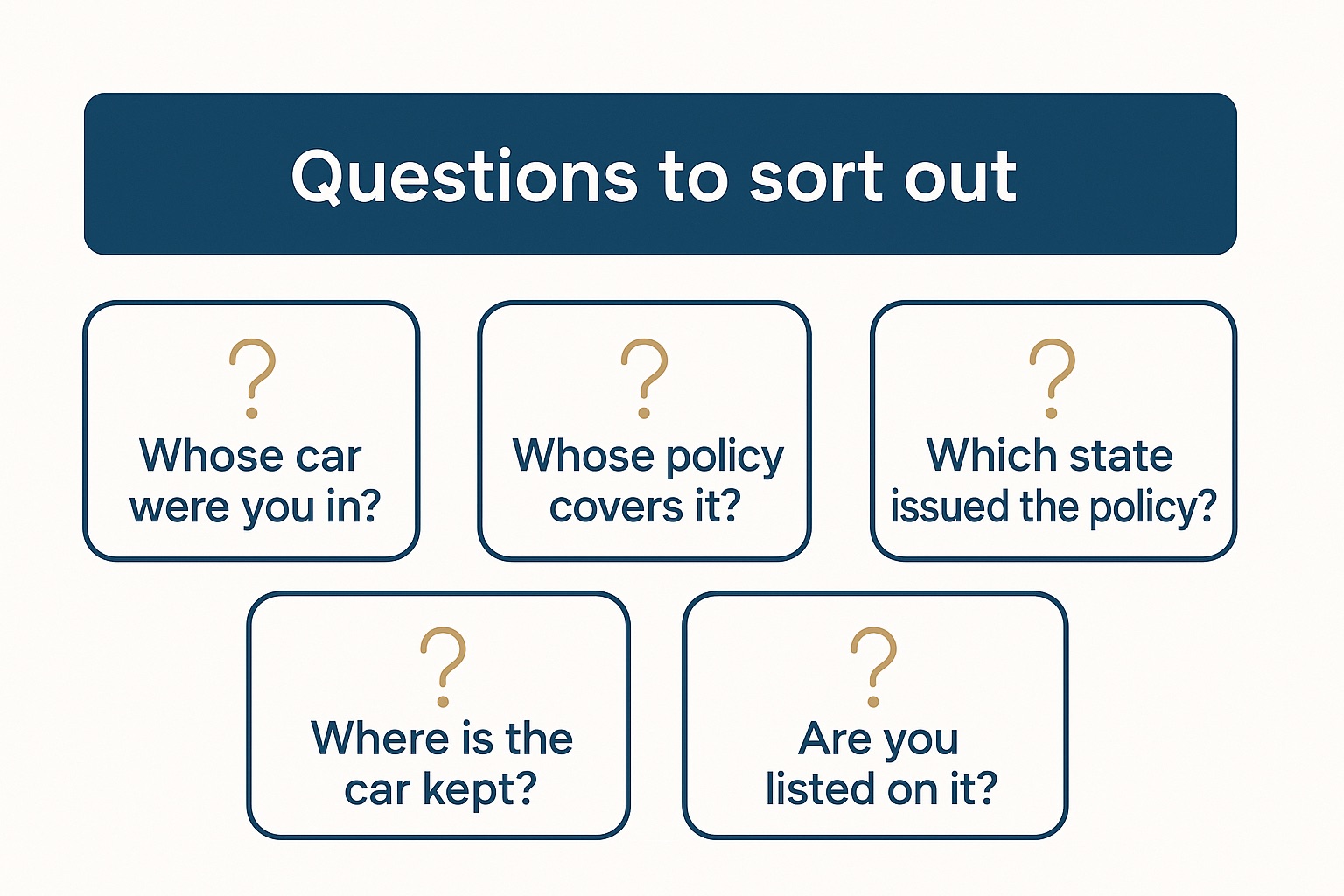
This is the most common question we hear from KU students, and the answer depends on how the car and the policy are set up. Many students living in Lawrence are still listed on a parent's auto policy issued in another state, sometimes because the car is titled at home and sometimes because the student just never came off the policy.
Kansas law has a mechanism for applying Kansas PIP rules to vehicles used and driven in Kansas, even when the policy was written elsewhere. Kansas courts have applied PIP benefits to nonresident and out-of-state situations in some cases. Whether your parents' out-of-state policy is amended by operation of law to include Kansas PIP because the car is driven or garaged in Kansas, and the exact statutory basis for that (the framework in K.S.A. 40-3109 and the purpose of the no-fault act in K.S.A. 40-3102), depends on the specific policy, the insurer, and where the vehicle is registered and kept. We would need to read the policy.
Whether you are still covered as an insured under a parent's out-of-state policy while living in Lawrence can turn on where you live and where the car is kept. Insurers sometimes argue a student who has moved and keeps the car in Kansas is no longer a covered household member or is garaged in a different rating territory.
Do not cancel, do not assume, and do not take an adjuster's first read as final. Keep your parents' policy information, tell us where the car is normally kept, and let us look at the actual policy language.
For how PIP works in general, see our guide to Kansas PIP and no-fault insurance.
Do I use my PIP or the other driver's insurance?
For your first-layer medical and wage benefits, you generally use PIP, not the other driver's liability insurance. In a no-fault state, PIP is the coverage that responds to your own injuries right away, and it usually comes from the policy on the car you occupied (or your own policy, depending on the situation). The at-fault driver's liability insurance is a separate, later claim for the damages PIP does not cover, such as pain and suffering and the medical bills above your PIP limits.
So the order most students experience is:
1. PIP first, from the policy covering the car you were in (for many students, a parent's policy), for immediate medical bills and lost income. 2. A liability claim against the at-fault driver for the rest, if your injuries are serious enough to open that door and if fault supports it. 3. Uninsured or underinsured motorist (UM/UIM) coverage if the at-fault driver had no insurance or not enough. You can learn more about how Kansas UM/UIM works on our Lawrence car accident page.
In some cases, the owner of a car or a parent may also have separate exposure. Whether a parent or vehicle owner is separately liable through vicarious liability or negligent entrustment (for example, if they let someone they knew was unfit drive their car) depends on who owns the car, whether the driver had permission, and what the owner knew. This can matter when the driver who caused your crash was using someone else's car.
The other driver was a student with only minimum coverage. Now what?
This is common in a college town. Kansas minimum liability limits are low, and a lot of drivers around campus carry only the minimum. If the driver who hit you has minimum coverage and your injuries are worth more than that, the liability policy can run out before your losses are fully paid.
When that happens, the next place to look is underinsured motorist (UIM) coverage on the policy that covers you (often your parents' policy). UIM is designed for exactly this situation: the other driver had some insurance, but not enough. If the at-fault driver had no insurance at all, uninsured motorist (UM) coverage does similar work. How much UM/UIM is available, and how it interacts with PIP, is one of the more technical parts of a Kansas claim. We read the policies to sort this out. Our Lawrence car accident page goes deeper on UM/UIM in Kansas.
What if the accident was partly my fault?
Kansas uses modified comparative fault with a 50 percent bar under K.S.A. 60-258a. In plain terms, you can still recover as long as your share of the fault is less than the other side's. If you are found 50 percent or more at fault, you recover nothing. If you are found partly at fault but under that line, your recovery is reduced by your percentage.
Here is a simple example. Say your damages are $20,000 and you are found 20 percent at fault. Your recovery is reduced by 20 percent, to $16,000. This is different from some other states, so do not assume a friend's experience elsewhere applies to your Lawrence crash.
Adjusters sometimes push an early theory that you were partly to blame (you were on your phone, you were speeding, you stepped into a crosswalk against the signal). What gets written down early can shape the fault split later, which is a good reason to be careful about giving a recorded statement before you understand your position.
How long do I have to file after a Lawrence car accident?
In Kansas, the personal injury statute of limitations is generally 2 years under K.S.A. 60-513. Miss it, and you usually lose the right to sue, no matter how strong the claim was. Our Kansas statute of limitations page explains the deadline and its exceptions in more detail.
A minor's clock can be tolled, meaning the deadline may not run in the normal way while the injured person is under 18. Under K.S.A. 60-515, a person injured as a minor generally has until one year after turning 18 to file, but no more than 8 years after the injury. Most KU students are adults, so the standard 2-year deadline typically applies, but the point matters if a younger sibling or a minor was also injured.
Two years can feel like a long time, but evidence disappears quickly: camera footage gets overwritten, witnesses graduate and move, and vehicles get repaired. Acting sooner protects the claim even though the legal deadline is later.
What should I do right after the crash?
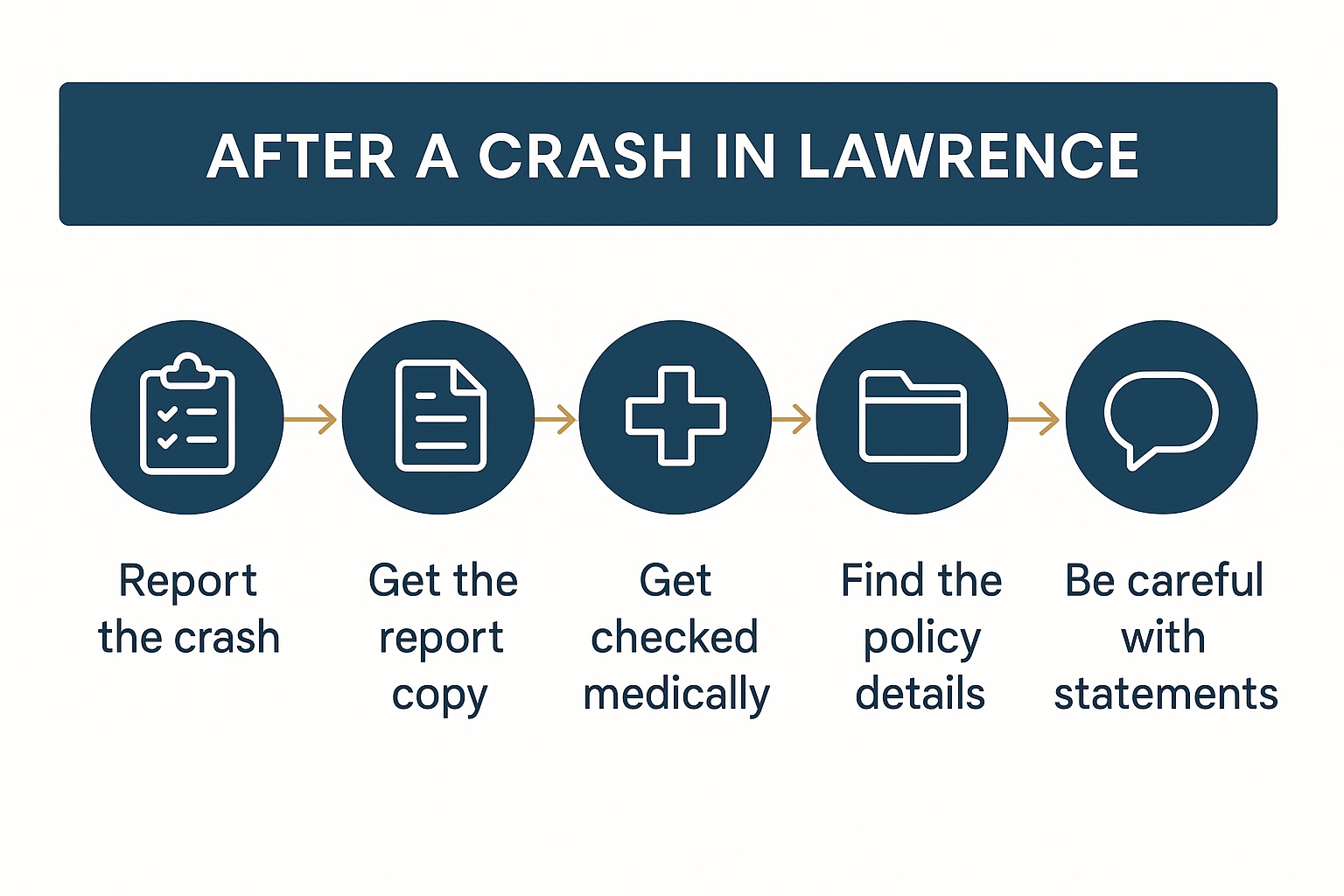
The general steps after any car accident are the same whether you are a student or not. This short video from our channel walks through them.
Watch: 5 Steps to Take After Being in a Car Accident. More client-education videos are on the Empower Injury Law YouTube channel.
A few things that specifically help students in Lawrence:
- Get the crash reported and get a copy of the report. If it happened on or near campus, note whether KU police, Lawrence police, or the Douglas County Sheriff responded.
- Get seen medically, even if you feel okay. PIP is there to pay for it, and early records matter.
- Find out whose policy covers the car you were in, and get your parents' policy details if you are on their plan.
- Be careful with recorded statements to any insurer before you understand which coverage applies and how fault might be argued.
For general Kansas consumer information on auto insurance, the Kansas Insurance Department is a neutral, non-firm resource.
Frequently asked questions
Am I covered by Kansas PIP if I was a passenger, not the driver?
Yes, generally. Kansas PIP follows the injured person, so it typically covers you whether you were the driver, a passenger, or a pedestrian struck by a car. You do not have to own the car or be the named policyholder to claim PIP benefits after a Lawrence crash.
My parents' car insurance is from another state. Does it work in Kansas?
Often, but it depends on the policy. Kansas law has a mechanism for applying Kansas PIP rules to vehicles driven and used in Kansas, and courts have extended PIP to some out-of-state situations. Whether your parents' out-of-state policy is treated as including Kansas PIP, and whether you count as covered while living in Lawrence, depends on the policy language and where the car is registered and kept. Have the policy reviewed rather than assuming either way.
Do I use my own PIP or the other driver's insurance first?
You generally use PIP first for your own medical bills and lost income, because Kansas is a no-fault state. PIP usually comes from the policy on the car you were in. The at-fault driver's liability insurance is a separate, later claim for damages PIP does not cover, such as pain and suffering and medical bills above your PIP limits.
The driver who hit me only had minimum insurance. What can I do?
If the at-fault driver's minimum liability limits are not enough to cover your losses, you may be able to use underinsured motorist (UIM) coverage on the policy that covers you, often a parent's policy. If the driver had no insurance at all, uninsured motorist (UM) coverage may apply. How much is available, and how it interacts with PIP, depends on the policies involved.
What happens if the accident was partly my fault?
Kansas uses modified comparative fault with a 50 percent bar. You can still recover if your share of the fault is less than the other side's, but your recovery is reduced by your percentage. If you are found 50 percent or more at fault, you recover nothing on a liability claim.
How long do I have to file a claim after a car accident in Kansas?
The Kansas personal injury statute of limitations is generally 2 years. That is the deadline to file a lawsuit for injuries from a car accident. Some situations, such as an injured minor, can change how the deadline runs, so confirm the deadline for your specific facts.
Talk to a Lawrence car accident lawyer
If you were hurt as a student in Lawrence or anywhere in Douglas County, including Eudora, you can talk through your options with us at no cost and with no pressure to hire. We can look at whose policy covers you, how PIP applies, and whether a claim against the at-fault driver makes sense. Call the Lawrence office at 785-367-6937 or email [email protected] to set up a free consultation. You can also read more about how we handle these cases on our Lawrence car accident page and our broader Lawrence personal injury page.
This page is general information about Kansas law and is not legal advice for your specific situation. Reading it does not create an attorney-client relationship. Outcomes depend on the facts, and nothing here is a promise about the result of any claim.