Diminished Value and Total-Loss Car Claims in Missouri: What Your Vehicle Is Really Worth
A diminished value claim in Missouri seeks the money you lose when your car is repaired after a crash but is worth less than it was before because it now has an accident on its record. That is a separate question from what happens when the insurer declares your vehicle a total loss, in which case there is no diminished value to recover and the payout is the vehicle's actual cash value.
If your car was damaged in a wreck in Clay County or the north Kansas City metro and the property-damage offer feels low, the first question is whether the insurer is repairing your car or totaling it. That answer decides what you can ask for, and the documents below are what move the number. Our Liberty office offers a free case review at 816-367-6937.
The one distinction that changes everything: repaired versus total loss
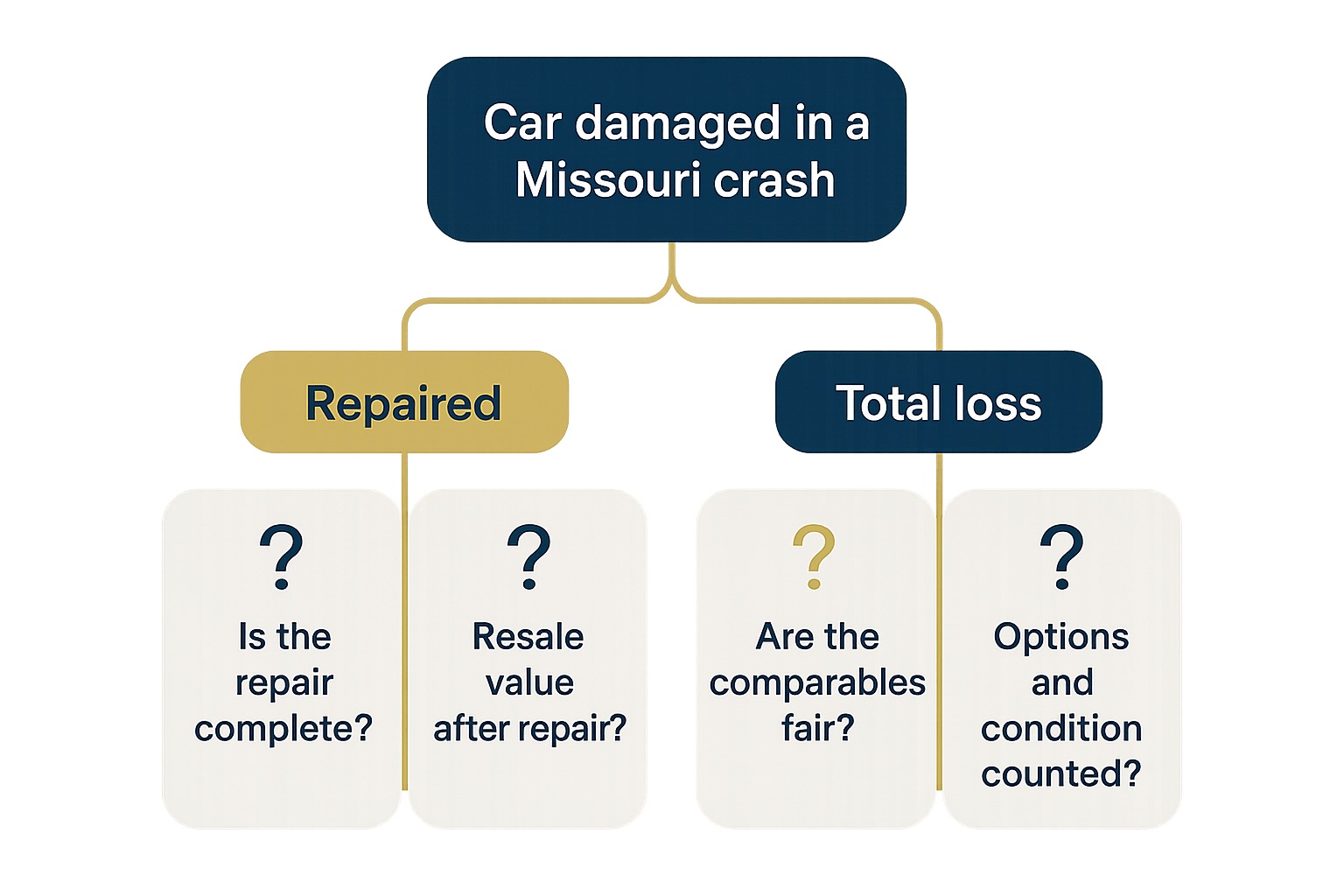
Almost all of the confusion around vehicle value comes from mixing up two very different outcomes.
Your vehicle was repaired
If the insurer pays to fix your car and you keep driving it, the property-damage side of your claim has two parts. The first is the cost of the repairs themselves. The second, which many drivers never think to raise, is diminished value: the market-value gap that remains after the repair is done.
A repaired vehicle with a documented accident history generally sells for less than an identical vehicle that was never wrecked, even when the repair is done well. Buyers pay less for a car with a crash on its history report, and that reduction is a real loss you suffered because of the collision.
Your vehicle was totaled
When the cost to repair a vehicle is high enough relative to its value, the insurer declares it a total loss rather than paying to fix it. Once that happens, diminished value is off the table. There is no repaired car to lose resale value, so the concept does not apply. Instead, the insurer owes you the vehicle's actual cash value, the fair market value of the car immediately before the crash.
If your car was repaired, you are looking at repair cost plus a possible diminished value claim. If it was totaled, you are looking at actual cash value.
What "total loss" actually means in Missouri
An insurer calls a vehicle a total loss when repairing it does not make economic sense. In practice that turns on comparing the repair estimate (sometimes combined with the salvage value) against the vehicle's pre-crash value.
Missouri, like other states, uses a threshold to help decide when a vehicle crosses from repairable into total-loss territory.
Related to the total-loss determination is the salvage-title question. When a vehicle is damaged badly enough, Missouri requires it to be retitled as salvage, which affects whether it can be legally driven and resold.
The practical takeaways do not depend on the exact number. If your car is close to the line, the insurer's choice between repairing and totaling it directly affects what you are owed, and the value it assigns to your vehicle drives that choice. That is why the pre-crash value the insurer uses deserves a hard look.
What "actual cash value" means when your car is totaled
Actual cash value (ACV) is the fair market value of your vehicle immediately before the crash. It is not what you paid for the car, not the loan balance you still owe, and not the cost of a brand-new replacement. It is what your specific car, with its year, mileage, trim, options, and condition, would have sold for the day before it was damaged.
Insurers usually generate an ACV figure from a valuation service that pulls comparable local sales and applies adjustments. That number is a starting point, not the final word. Common problems with a first ACV offer include:
- Comparable vehicles that are higher-mileage or lower-trim than yours
- No credit for recent maintenance, new tires, or major recent repairs
- Missed factory options or a trim level that carries a real market premium
- Condition adjustments that assume more wear than your car had
- Comparables pulled from a cheaper regional market rather than the Kansas City metro
You are entitled to push back on ACV with better evidence. Independent valuations, dealer quotes for comparable vehicles, and records of your car's actual condition can all move the number.
If you owe more on the vehicle than its actual cash value, the ACV payment may not cover your loan balance. That gap is what gap insurance is designed to cover, so check whether you carried it before you assume you are out of pocket.
How diminished value works on a repaired vehicle
When your vehicle is repaired rather than totaled, diminished value is the loss that survives the repair. Even a factory-quality repair does not erase the accident from the vehicle's history, and that history follows the car.
People generally describe three kinds of diminished value:
- Inherent diminished value: the loss in resale value that comes purely from the car having an accident on record, assuming the repair was done properly. This is the type most diminished value claims are about.
- Repair-related diminished value: additional loss when the repair itself was substandard, used non-original parts, or left visible or structural problems.
- Immediate diminished value: the difference between the car's value right before the crash and its value right after, before any repairs. This is more of an appraisal concept than a separate claim.
For most Missouri drivers with a well-repaired car, the claim that matters is inherent diminished value: the gap between what the car would have been worth without the accident and what it is worth now, repaired but with a crash on its record.
Whether a diminished value claim is worth pursuing depends on the vehicle. A newer car, a low-mileage car, or a vehicle that holds its value well tends to lose more in real dollars from an accident record than an older, high-mileage car. It also matters whether you are making the claim against the at-fault driver's liability insurer (a third-party claim) or your own insurer, because the coverage and the path differ.
Watch the property-damage settlement so it does not undercut your injury claim
Property damage and bodily injury are two separate parts of a car-crash claim, but they interact, and mishandling the property-damage piece can create problems for the injury side.
The most common trap is a release. An insurer may send a check for the vehicle along with paperwork to sign. If that paperwork releases all claims arising from the crash rather than the property-damage claim only, signing it can waive your injury claim for a fraction of its value. Read what you are signing, and confirm that a property-damage settlement is limited to property damage.
This is also why timing and documentation matter. The same crash that dented your car may have caused injuries that take days or weeks to fully show. Settling the property piece quickly is often fine and sometimes necessary so you can get back on the road, but it should be done in a way that leaves the injury claim intact.
For a plain-language walkthrough of getting the vehicle side handled fairly, our attorney video below covers how to approach a property-damage settlement.
Watch: How to Maximize Your Property Damage Settlement (5/5) on the Empower Injury Law YouTube channel. If your problem is that the payout will not cover repairing or replacing the car at all, the companion video How to Get Enough Money to Repair or Replace Your Vehicle (4/5) is a useful next watch.
Documentation checklist: build the strongest number
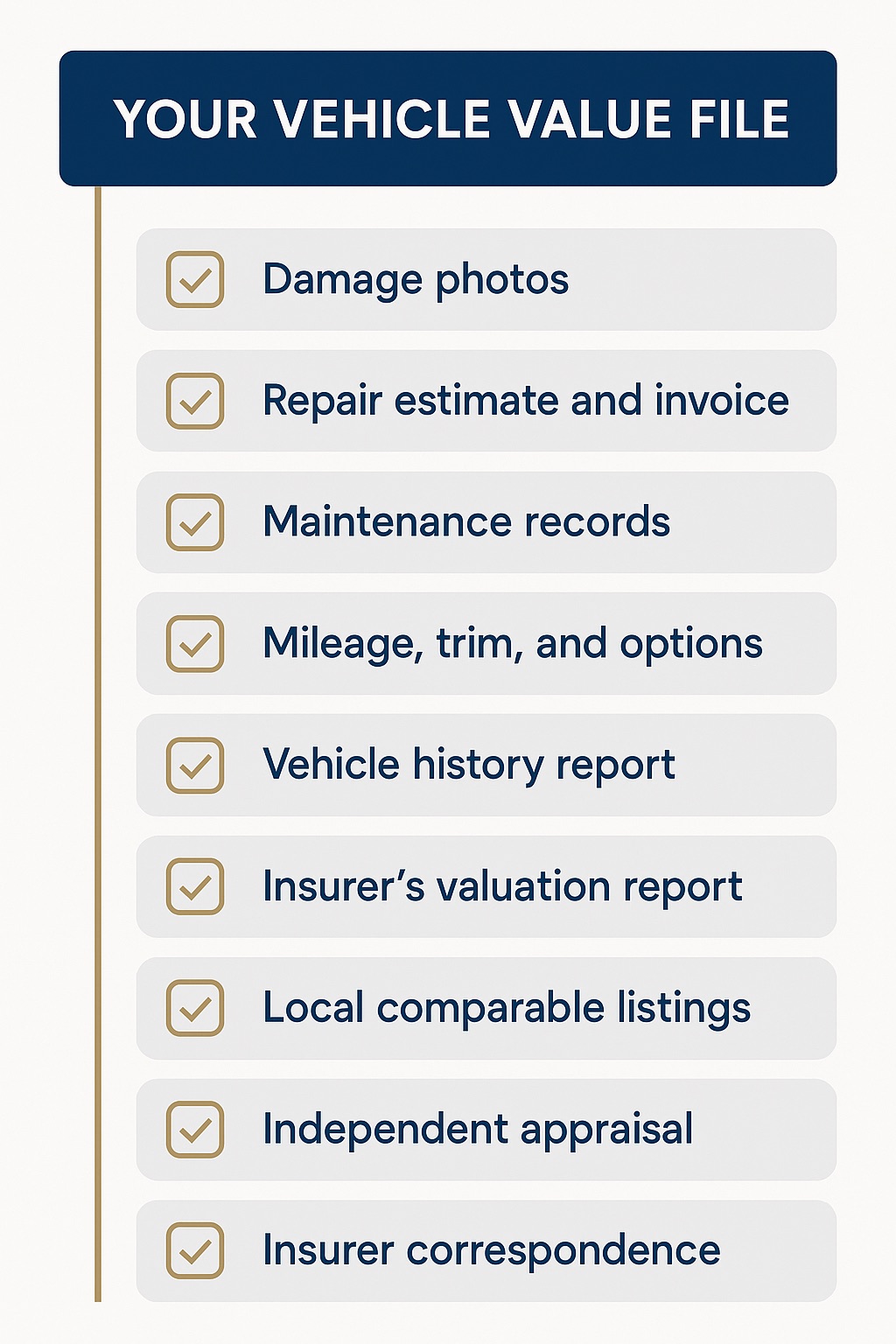
Whether you are challenging an actual cash value on a totaled car or making a diminished value claim on a repaired one, evidence moves the number more than argument does. Gather these:
- Photos of the vehicle before the crash if you have any, and detailed photos of the damage after
- The full repair estimate and the final repair invoice, itemized, showing parts and labor
- Records of recent maintenance, new tires, and any major recent repairs or upgrades
- Your vehicle's documented mileage and a list of factory options and trim level
- The vehicle history report showing the accident now on record (for diminished value)
- The insurer's valuation report and the list of comparable vehicles it relied on
- Independent comparables: local listings for the same year, trim, and mileage in the Kansas City metro market
- An independent appraisal or dealer valuation if the amounts justify one
- All written communication with the insurer, so the claim's handling is documented
- If your car was totaled, your loan payoff amount and any gap insurance policy
Keep everything in one place and in writing. If the insurer is going to argue your car was a lower-trim, higher-mileage, or rougher example than it was, this is what answers that argument.
When an insurer will not deal fairly on vehicle value
Most property-damage claims resolve without a fight. Sometimes they do not. If an insurer ignores clear evidence of value, leans on unreasonable comparables, or refuses to pay what the vehicle is plainly worth, that is a coverage dispute, and Missouri does not leave policyholders without options.
Missouri law addresses insurers that refuse to pay covered claims without a reasonable basis, and the state's Department of Commerce and Insurance oversees insurer conduct. For how Missouri handles an insurer that stonewalls a valid claim, including the vexatious-refusal remedy, see our overview of insurance bad faith and vexatious refusal in Missouri.
You can also file a complaint with the Missouri Department of Commerce and Insurance, the state regulator, and reach its Insurance Consumer Hotline at 800-726-7390. A regulatory complaint does not replace a legal claim and will not by itself force a payment, but it creates a record and sometimes prompts an insurer to take a stalled file seriously. The unfair-claim-settlement and vexatious-refusal provisions live in Chapter 375 of the Revised Statutes of Missouri, including the vexatious-refusal remedy at RSMo 375.420 and its companion RSMo 375.296.
How a lawyer fits a property-damage dispute
Not every property-damage disagreement needs a lawyer, and it would be wrong to suggest otherwise. A modest gap on a straightforward ACV is often something you can resolve yourself with good comparables and a firm, documented request.
Where a lawyer tends to matter is when the property-damage problem sits on top of an injury claim, when the numbers are large enough that a diminished value or ACV dispute is worth formal pushback, or when the insurer's conduct starts to look like more than an honest disagreement. Because we handle the injury claim, we can make sure the property-damage settlement is structured so it does not waive the bigger claim, and we can fold the vehicle issue into the overall resolution.
Talk to a Missouri attorney
If your vehicle was damaged in a crash in Clay County or the north Kansas City metro and the property-damage offer does not reflect what your car was really worth, our Liberty office is available for a free case review. We handle these cases on a contingency fee, which means no attorney fee unless we recover for you.
Call 816-367-6937 to talk with our Liberty office. If you were also injured, start with our overviews of a Liberty car accident, a Liberty motor vehicle accident, and Missouri personal injury claims.
This page is general information about Missouri law, not legal advice, and it does not create an attorney-client relationship. No result is guaranteed.
Frequently asked questions
What is a diminished value claim in Missouri?
It is a claim for the money you lose when your car is repaired after a crash but is worth less than before simply because it now has an accident on its record. The claim seeks the difference between the vehicle's value without the accident and its value repaired but with the crash on record. It applies to repaired vehicles, not to vehicles the insurer declares a total loss.
Can I claim diminished value if my car was totaled?
No. Once a vehicle is declared a total loss, there is no repaired car to lose resale value, so diminished value does not apply. For a totaled vehicle the insurer owes you the actual cash value, which is the fair market value of the car immediately before the crash.
What does actual cash value mean for a totaled car?
Actual cash value is what your specific vehicle, with its year, mileage, trim, options, and condition, would have sold for immediately before the crash. It is not what you paid, not your remaining loan balance, and not the price of a new replacement. The insurer's first offer is a starting point you can challenge with better comparables and condition evidence.
How do I prove my car is worth more than the insurer's offer?
With documentation. Gather the itemized repair estimate and invoice, records of recent maintenance and new parts, proof of mileage and trim, the insurer's own valuation report and comparables, independent local comparables from the Kansas City metro market, and, if the amounts justify it, an independent appraisal. Evidence moves the number more than argument.
Does a good repair remove the diminished value?
Not usually. Even a factory-quality repair does not erase the accident from the vehicle's history, and buyers pay less for a car with a crash on its record. That remaining gap, often called inherent diminished value, is the loss a diminished value claim addresses.
Will settling the property-damage claim hurt my injury claim?
It can, if you sign the wrong paperwork. Some releases waive all claims from the crash, not just the vehicle claim. Make sure any property-damage settlement is limited to property damage so it does not release your injury claim. When both exist, coordinate the vehicle piece with the injury claim.
What does it cost to have a lawyer review my claim?
Our Liberty office offers a free case review and handles these matters on a contingency fee, so there is no attorney fee unless we recover for you. Call 816-367-6937 to discuss a low or disputed vehicle-value offer.
Author Bio

Kevin A. Jones | Personal Injury Lawyer
Kevin A. Jones, founder and managing attorney of Empower Injury Law, has been practicing law since 2009. With over $25 million in jury verdicts and settlements in his first decade, Kevin has earned a reputation as a fierce advocate for his clients.
Kevin’s approach to law is rooted in his passion for helping people who have been mistreated by corporations, insurance companies, and other powerful entities.
Whether representing individuals wronged by negligent drivers or those injured on someone else’s property, Kevin is dedicated to achieving justice. His extensive experience in the courtroom ensures that clients receive strong, personalized representation that delivers results.
Practice Areas


