Pre-Existing Conditions and the Eggshell Rule in Missouri Car Accident Claims
Yes, you can still recover after a Missouri car accident even if you had a prior injury or health condition, and the insurer's "it was your old back, not our driver" line does not end your claim. Under Missouri's eggshell rule, a driver who causes a crash in Clay County or anywhere else in the state takes the person they hit as they find them. If the collision made an existing condition worse, the at-fault driver is responsible for that worsening. The catch is what you have to show, and that is where a Northland claim is won or lost: a clear picture of how you were before the crash, and how you were after.
If you have a prior injury and an adjuster is already leaning on it, this explains what Missouri law requires and what to document.
What the eggshell rule covers
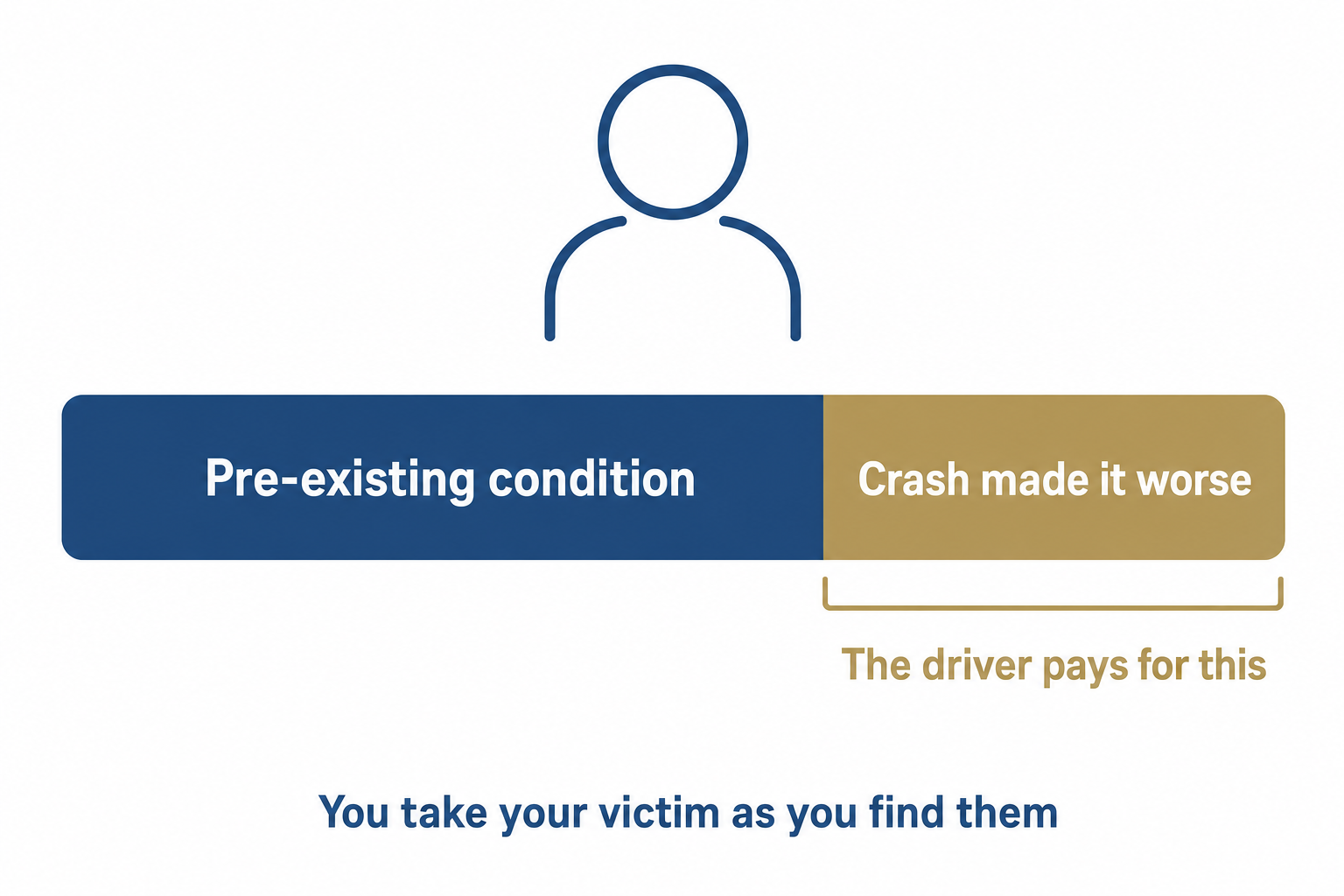
The eggshell rule, sometimes called the thin-skull rule, is a long-settled part of Missouri tort law. The person who caused the harm cannot complain that their victim was unusually fragile. If a careless driver would have given an average person a sore neck but gave you, with your prior cervical fusion, a serious reinjury, the driver answers for the serious reinjury.
There is an important limit, and it is the limit the insurer will push on. The at-fault driver is not responsible for your pre-existing condition itself. They are responsible for the aggravation, the amount by which the crash made that condition worse. If you lived with chronic low-back pain before the collision and the crash turned manageable pain into a herniation that needed surgery, the surgery and the added disability are on the at-fault driver. The baseline pain you already had is not.
So the real question in these cases is rarely "did you have a prior problem." Most adults over 30 have something on an old imaging report. The question is how much worse the crash made you, and whether you can prove that difference.
Why insurers lean on the "old injury" defense
Blaming a prior condition is one of the most common ways an auto insurer tries to pay less. It works best when your records are thin. If there is a years-old MRI showing degeneration and nothing documenting how you felt and functioned in the months before the crash, the adjuster can argue the degeneration, not the collision, explains your pain. The eggshell rule is on your side, but it does not fill an evidentiary gap on its own. Evidence does.
This defense shows up constantly in soft-tissue and whiplash claims, where imaging often shows pre-existing changes in a neck or back that were not causing real trouble until the crash. A prior degenerative finding is not a bar to recovery. It is a fact to put in context.
How to prove aggravation, not a new injury
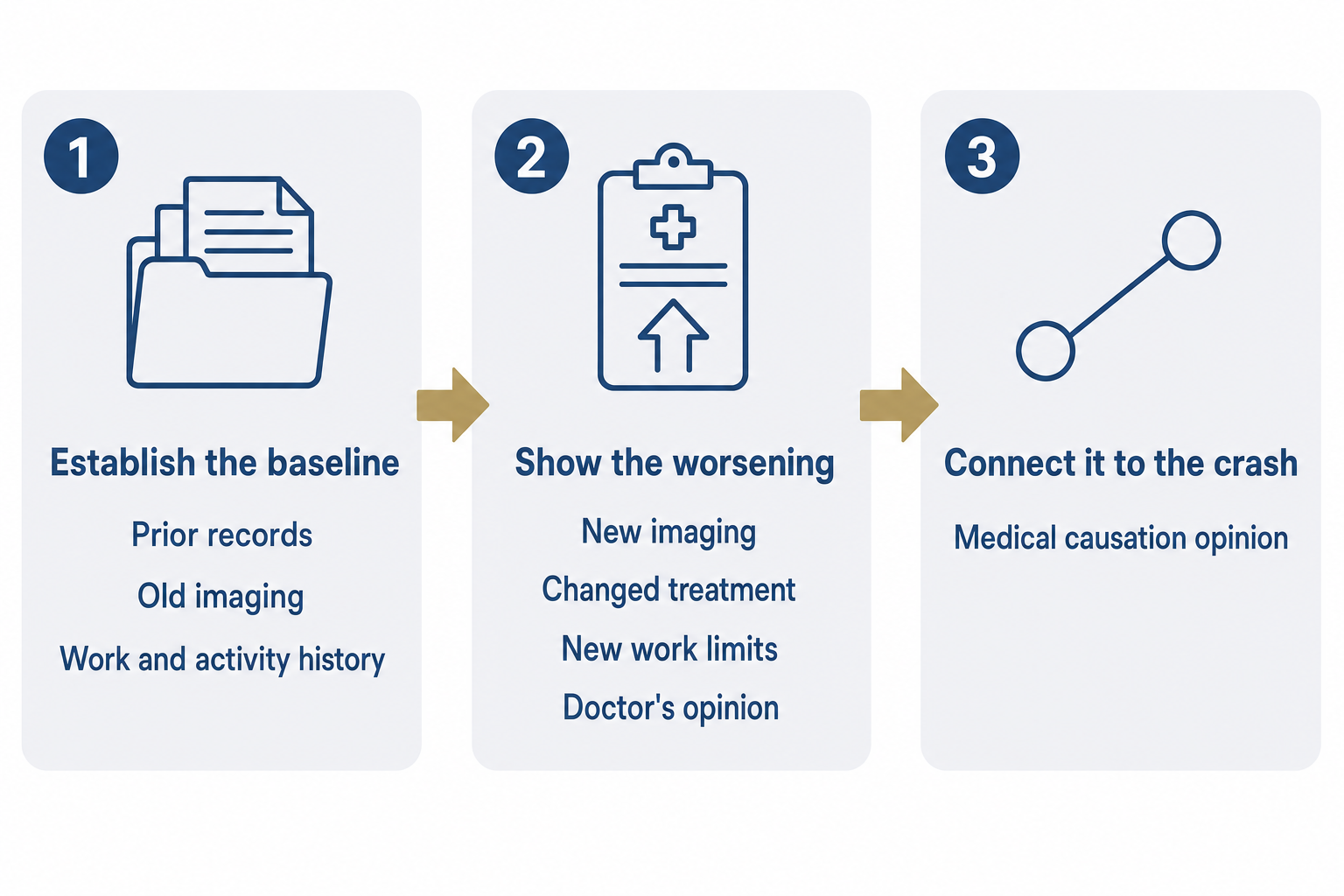
Three things, built in order, carry an aggravation claim.
Establish a pre-crash baseline
The strongest evidence is what your life looked like before the collision. Prior treatment records, imaging, and work and activity history show the condition you were living with. If you were working full time, lifting your kids, and only occasionally taking something for an old ache, that baseline matters as much as any scan. Gaps in treatment before the crash can cut both ways, so an honest, complete picture is better than a selective one.
Show the worsening after the crash
Get evaluated promptly and tell every provider about both the prior condition and the change the crash caused. "My back acted up a few times a year; since the wreck I cannot stand for 20 minutes" is the kind of specific, consistent account that holds up. New imaging compared against old imaging, a change in the treatment you need, new work restrictions, and a treating physician's opinion that the crash aggravated the condition are what move an adjuster or a jury.
Connect the worsening to the collision
The link between the crash and the worsening usually comes from your treating doctors, and in a disputed case from a retained medical expert who can compare the before and after and give an opinion to a reasonable degree of medical certainty. Causation is a medical question, and it is answered with medical evidence, not with the adjuster's hunch about your age.
Missouri also lets you put real numbers on the medical side of the loss. Under RSMo 490.715, the parties can introduce the actual cost of your care, meaning what was paid plus what remains owed after discounts and write-offs, which keeps the focus on the treatment the aggravation actually required.
How Missouri comparative fault fits in
A pre-existing condition is about the extent of your damages. It is separate from fault for the crash itself. Even if you were partly at fault for the collision, Missouri's pure comparative fault system still lets you recover. Your damages are reduced by your percentage of fault, but there is no cutoff that bars you, which is different from Kansas and several other states. Missouri adopted pure comparative fault in Gustafson v. Benda, 661 S.W.2d 11 (Mo. banc 1983). If you were found 20 percent at fault for a crash that aggravated your old shoulder injury, you recover 80 percent of the damages tied to that aggravation. Our Missouri comparative fault explainer walks through how that split works.
How long you have to bring a Missouri claim
In Missouri, the deadline to file a personal injury lawsuit is generally 5 years from the date of the crash, under RSMo 516.120. An aggravation claim follows the same clock. That is more time than many people expect, but it is not a reason to wait, because the baseline-and-worsening evidence these cases depend on is easiest to preserve while treatment is fresh. Waiting makes the "old injury" defense stronger, not weaker.
Frequently asked questions
Can I still sue if I had a prior injury to the same body part?
Yes. Missouri's eggshell rule means the at-fault driver takes you as you are. If the crash aggravated an existing injury, you can recover for that aggravation. You will need records showing your condition before the crash and how it worsened afterward.
Does a pre-existing condition reduce what my claim is worth?
It narrows what you can recover to the aggravation rather than the underlying condition, but it does not erase the claim. A well-documented worsening, a prior surgery turned into a second surgery, new work restrictions, can be worth a great deal. How these pieces add up is covered in our guide to what a Missouri car accident claim is worth.
What if I never had symptoms before the crash, but an old scan shows degeneration?
Imaging findings are common and are not the same as a disabling condition. If you were functioning normally and the crash set off real symptoms, the degeneration is context, not a defense. A treating physician can explain that a latent, asymptomatic condition became symptomatic because of the collision.
The adjuster says my records already show this problem. Should I just accept that?
No. An adjuster pointing to a prior entry is making an argument, not stating the law. The eggshell rule and your medical evidence are what decide the question. Before you accept a reduced offer based on an old injury, have a lawyer review the full medical record first.
How do I keep the insurer from blaming my old injury?
Tell your providers about both the prior condition and the change the crash caused, keep your treatment consistent, and make sure the pre-crash baseline is in the record. The clearer the before-and-after, the harder the defense is to run.
Talk to a Liberty car accident lawyer
We handle auto injury claims across Clay County and the Northland from our Liberty office, including the ones insurers try to discount by pointing at a prior injury. If an adjuster is blaming your old condition, we can review your records, line up the baseline-versus-aggravation evidence, and tell you honestly where your claim stands. Consultations are free and there is no pressure to hire us.
Call our Liberty car accident lawyer at 816-367-6937, or reach our Liberty personal injury team to talk through your options. You can also watch our video library for plain-language explanations of how Missouri claims work.
This article is general information about Missouri law, not legal advice, and it does not create an attorney-client relationship or promise any particular outcome. Every claim turns on its own facts and medical record.
Author Bio

Kevin A. Jones | Personal Injury Lawyer
Kevin A. Jones, founder and managing attorney of Empower Injury Law, has been practicing law since 2009. With over $25 million in jury verdicts and settlements in his first decade, Kevin has earned a reputation as a fierce advocate for his clients.
Kevin’s approach to law is rooted in his passion for helping people who have been mistreated by corporations, insurance companies, and other powerful entities.
Whether representing individuals wronged by negligent drivers or those injured on someone else’s property, Kevin is dedicated to achieving justice. His extensive experience in the courtroom ensures that clients receive strong, personalized representation that delivers results.
Practice Areas


