Who Pays My Medical Bills After a Kansas Car Accident (and What Happens When PIP Runs Out)
After a car accident in Kansas, your medical bills are paid first by personal injury protection (PIP) coverage on your own auto policy, no matter who caused the crash. Kansas is a no-fault state, so PIP is the starting point for everyone. The harder question is what happens when PIP runs out, because a serious injury can cost far more than PIP was designed to cover. In Kansas the bills are paid in this order: PIP first, then your own health insurance, then the liens and repayment rights that attach to any recovery, and finally the at-fault driver's bodily-injury liability coverage for what is left. Empower Injury Law helps injured drivers and passengers work through this sequence in Lawrence, Douglas County, and nearby communities like Eudora and Baldwin City.
This page is general information about Kansas law, not legal advice about your specific situation. What applies to your claim depends on your policy, your health plan, and your facts.
Who pays medical bills after a car accident in Kansas?
In Kansas, your medical bills are paid in a sequence, not all at once by a single source. Understanding the order is the key to not getting stuck with a bill that someone else is responsible for.
1. Your PIP coverage pays first, regardless of fault. 2. When PIP is exhausted, your own health insurance generally becomes the next payer, subject to that plan's rules. 3. Liens and subrogation rights (a health insurer, an ERISA plan, Medicare, or Kansas Medicaid/KanCare) may attach to any money you recover, meaning some of those payers can be repaid out of a settlement. 4. The at-fault driver's bodily-injury liability coverage is where you pursue the remaining balance, along with damages PIP does not cover, subject to Kansas comparative fault and the filing deadline.
For the basics of how PIP itself works, see our Kansas PIP and no-fault basics page.
Step 1: PIP pays your medical bills first
Kansas is a no-fault state under the Kansas Automobile Injury Reparations Act, K.S.A. 40-3101 and following. Every Kansas auto policy is required to include PIP, and PIP pays your accident-related medical expenses and certain other losses regardless of who was at fault. That is the whole point of no-fault: your own insurer starts paying your bills right away, without waiting to sort out blame.
PIP in Kansas covers several categories of loss set by statute (see K.S.A. 40-3103 and K.S.A. 40-3107):
- Medical expense, for reasonable treatment of your injuries.
- Rehabilitation expense.
- Work loss or wage loss, replacing part of the income you lose while you cannot work.
- Substitution or essential-services benefits, covering things you cannot do while injured (such as household tasks).
- Funeral and burial expense.
- Survivor benefits, paid to survivors after a death.
Each category has its own statutory minimum dollar amount, and those minimums are what a basic policy has to provide. Under K.S.A. 40-3103, the minimums are at least $4,500 for medical expenses, at least $4,500 for rehabilitation, at least $900 a month for up to 1 year of disability or lost income, up to $25 a day for up to 365 days of substitution or essential services, up to $2,000 for funeral and burial, and at least $900 a month for up to 1 year of survivors' benefits. Because these are minimums, the practical takeaway is that PIP is meant to get you through the early phase of treatment and wage loss, not to fund the full cost of a serious injury.
What happens when PIP runs out in Kansas?
PIP is capped. Once your medical bills pass the PIP medical limit, PIP stops paying for treatment, and you are into the next stage even though your treatment may be far from over. This is the moment that surprises most people. Your own health insurance generally becomes the next payer for your ongoing medical care, and the groundwork for a claim against the at-fault driver becomes more important, because that is ultimately where the larger costs of a serious injury get addressed.
Step 2: Your health insurance becomes the secondary payer
Once PIP is used up, your own health insurance (an employer plan, a marketplace plan, Medicare, or Kansas Medicaid/KanCare) generally steps in as the next payer for your continued treatment, subject to that plan's own rules on networks, copays, deductibles, and coordination of benefits.
A few practical points at this stage:
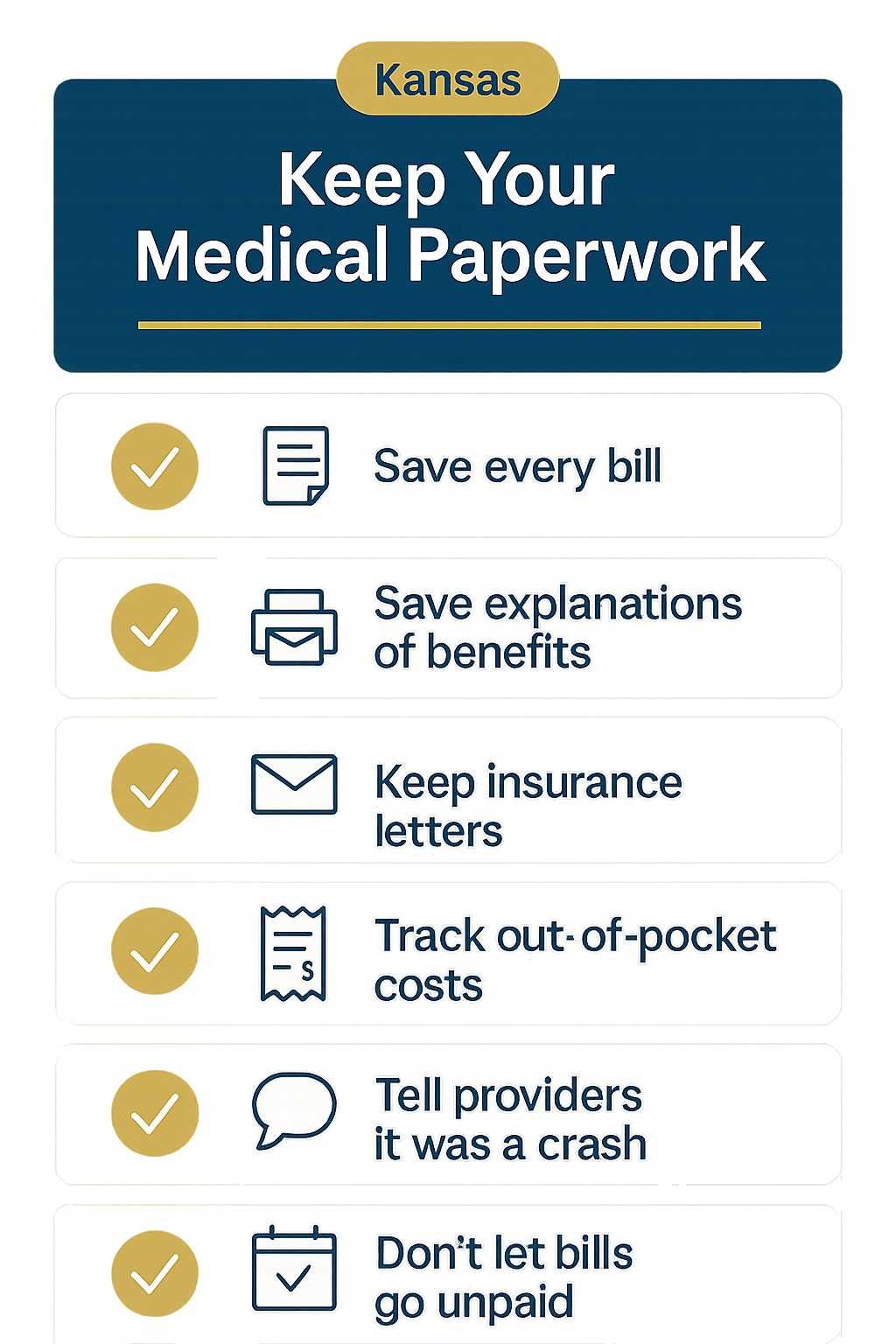
- Keep using your health insurance rather than letting bills go unpaid. An unpaid medical bill can go to collections and damage your credit while your injury claim is still pending, which helps no one.
- Tell your providers and your health plan that the treatment relates to a car accident. That matters because of the repayment rights in Step 3.
- Save every explanation of benefits and bill. The amounts your health insurer pays, not the sticker price, are usually what matters when the claim is resolved.
Step 3: Liens and subrogation, or who gets repaid from a recovery
This is the step people rarely see coming. When your health insurer, an ERISA employer plan, Medicare, or Kansas Medicaid/KanCare pays for treatment related to a crash that someone else caused, that payer often has a right to be repaid out of any money you later recover from the at-fault driver. Those rights go by different names (subrogation, reimbursement, or a lien), but the effect is similar: part of a settlement may have to go back to the payer that covered your care.
Why this matters to you in plain terms:
- A settlement figure is not the same as what you keep. Liens and repayment rights are usually resolved out of the recovery before you receive your share.
- These rights can often be negotiated down. Getting the reduction right is a large part of the practical value of handling an injury claim carefully, because it directly affects your net result.
- Different payers follow different rules. Medicare and ERISA plans in particular have their own federal requirements, and mishandling them can create problems later.
For most people, this is the stage where working with a lawyer changes the outcome, not because the law is dramatic, but because coordinating PIP, health insurance, and these repayment rights is detailed work that decides how much of a recovery you keep.
Step 4: The at-fault driver's bodily-injury liability coverage
After PIP and health insurance, the remaining medical bills and the losses that PIP does not fully cover are pursued against the at-fault driver's bodily-injury liability coverage. This is the part of the process most people picture when they think of an injury claim, and in Kansas it sits at the end of the sequence, not the beginning.
Because Kansas is a no-fault state, there is a statutory threshold you must meet before you can step outside no-fault and recover non-economic damages (pain and suffering) from the at-fault driver. That threshold is set by K.S.A. 40-3117. A threshold exists. Whether your injury clears it depends on your facts.
Kansas uses modified comparative fault with a 50% bar under K.S.A. 60-258a. Your recovery from the at-fault driver is reduced by your own percentage of fault, and it is eliminated entirely if you are found 50% or more at fault. In a clear-liability crash this may not be a live issue, but it becomes important whenever the insurer disputes how the crash happened.
There is also a deadline. Most Kansas personal injury claims must be filed within 2 years under K.S.A. 60-513. Miss it, and the claim against the at-fault driver is generally lost no matter how strong it was, so this stage is time-sensitive. Our guide to the Kansas statute of limitations covers the deadline in detail.
A quick note on how the pieces fit together
These sources are coordinated, not added together, and the repayment rights in Step 3 decide how much of a recovery reaches you. For the broader process of a Kansas crash claim, see our Lawrence, KS car accident lawyer page.
Video: getting your medical bills paid after a crash
The video below covers medical bills after a crash in general terms. The Kansas rules are the ones on this page, and how they apply depends on your facts.
Watch: How to Get Medical Bills Paid After a Car Accident
More plain-language client videos are on our YouTube channel.
Talk it through with the Lawrence office
If you were hurt in a crash in Lawrence, Douglas County, or a nearby community like Eudora or Baldwin City, and you are trying to figure out who pays your medical bills or what to do now that PIP has run out, you can talk it through with us at no cost. We review your PIP benefits, coordinate your health insurance, handle the lien and subrogation claims so more of any recovery stays with you, and pursue the at-fault driver's coverage for what is left, while watching the filing deadline. We work on a contingency fee, so there is no fee unless there is a recovery.
Call the Lawrence office at 785-367-6937, or request a free case review through the form on this page. For injuries generally, see our Lawrence personal injury lawyer page.
This page is general information about Kansas law, not legal advice, and it does not create an attorney-client relationship. Your medical-bill and coverage questions turn on your policy, your health plan, and the facts of your claim. If you have questions about yours, call our Lawrence office at 785-367-6937.
Frequently asked questions
Who pays my medical bills first after a car accident in Kansas?
Your own personal injury protection (PIP) coverage pays first, regardless of who caused the crash. Kansas is a no-fault state under the Kansas Automobile Injury Reparations Act, so every Kansas auto policy includes PIP, and it starts covering your accident-related medical bills and some wage loss right away without waiting to determine fault.
What happens when my PIP runs out in Kansas?
When PIP is exhausted, your own health insurance generally becomes the next payer for your ongoing treatment, subject to your plan's rules. Some of those payers may later have a right to be repaid out of any recovery you get from the at-fault driver, and the remaining balance and your other losses are pursued against the at-fault driver's bodily-injury liability coverage.
Does my health insurance have to pay after a car accident in Kansas?
Once PIP is exhausted, your own health insurance generally steps in as the secondary payer for continued treatment, subject to its own rules on networks, deductibles, and coordination of benefits. Keep using it rather than letting bills go to collections, and confirm how your specific plan handles accident-related care.
Can my health insurer or Medicare take money out of my settlement in Kansas?
Often, yes. When a health insurer, an ERISA employer plan, Medicare, or Kansas Medicaid/KanCare pays for treatment from a crash someone else caused, it may have a right (through subrogation, reimbursement, or a lien) to be repaid out of any recovery you obtain from the at-fault driver. These rights can often be negotiated down, and how they are handled affects how much of a settlement you keep.
Can I recover pain and suffering from the at-fault driver in Kansas?
Because Kansas is a no-fault state, there is a statutory threshold under K.S.A. 40-3117 that your injury must meet before you can recover non-economic damages such as pain and suffering from the at-fault driver. Whether your injury meets that threshold depends on your facts.
How long do I have to file a car accident injury claim in Kansas?
Most Kansas personal injury claims must be filed within 2 years under K.S.A. 60-513. Because missing the deadline generally ends the claim regardless of its strength, treat the matter as time-sensitive and confirm your specific deadline with us.
Author Bio

Kevin A. Jones | Personal Injury Lawyer
Kevin A. Jones, founder and managing attorney of Empower Injury Law, has been practicing law since 2009. With over $25 million in jury verdicts and settlements in his first decade, Kevin has earned a reputation as a fierce advocate for his clients.
Kevin’s approach to law is rooted in his passion for helping people who have been mistreated by corporations, insurance companies, and other powerful entities.
Whether representing individuals wronged by negligent drivers or those injured on someone else’s property, Kevin is dedicated to achieving justice. His extensive experience in the courtroom ensures that clients receive strong, personalized representation that delivers results.
Practice Areas


