Who Pays My Medical Bills After a Missouri Car Accident?
If you were hurt in a car accident in Clay County or the north Kansas City area, the bills arrive long before any settlement. In Missouri, your medical bills usually get paid in two stages. First, while you are still treating, your own coverage pays as the bills arrive: your health insurance, and your MedPay (medical payments) coverage if you carry it. Then, at the very end, the at-fault driver's liability insurer typically pays once, in a lump sum at settlement or after a verdict, and some of the money that paid your early bills has to be repaid out of that recovery. Missouri is a fault state, so the at-fault driver is ultimately responsible, but that payment comes later, not bill by bill.
This is general information about Missouri law, not legal advice about your specific claim.
Missouri has no PIP, so nothing pays your bills automatically
This surprises a lot of people. Missouri is not a no-fault state and has no personal injury protection (PIP). There is no automatic first-party benefit that pays your accident-related medical bills as they come in. (Kansas has PIP; Missouri does not. If someone told you "your car insurance pays your medical bills no matter what," they were describing a system Missouri does not use.)
Because there is no PIP, the at-fault driver's insurance company does not pay your doctors directly while you treat. That carrier generally pays one time, at the end, as part of a single settlement or judgment that covers your medical expenses, lost wages, and other damages together. That is why almost everyone needs a way to cover bills in the meantime.
Who pays medical bills after a car accident in Missouri
Four sources pay accident bills in Missouri, roughly in this order.
Your own health insurance
For most people, health insurance is the main source that pays bills as they arrive. You give the provider your health-insurance card, and the plan pays its share, subject to your deductible, copays, and coinsurance. Using your health insurance does not mean you are letting the at-fault driver off the hook. It means the bills get paid on time and your account does not go to collections while your injury claim is pending. Your health plan will usually assert a right to be repaid later out of any settlement, which we cover below under subrogation.
MedPay (medical payments coverage)
MedPay is optional first-party coverage on your own auto policy in Missouri. If you bought it, it pays reasonable medical expenses from the crash up to its limit (commonly $1,000 to $10,000), regardless of who was at fault, and regardless of whether you also have health insurance. It applies to you and often to your passengers. MedPay is useful for the bills health insurance does not fully cover, like deductibles and copays, and for getting treatment started quickly.
Check your declarations page to see whether you have MedPay and how much. If you are not sure, we can look at your policy with you.
Whether your MedPay insurer can be repaid out of your later recovery depends on your policy and Missouri law, and it is one of the points we confirm early in a case so there are no surprises at settlement.
The at-fault driver's liability insurance
This is the coverage most people think of first, but it is usually last in time. The at-fault driver's bodily injury liability insurer is responsible for the harm their insured caused, and it pays in the single payment at the end described above. Missouri's minimum liability limits are low ($25,000 per person), so if your injuries are serious, the at-fault policy may not be enough to cover everything.
Your own uninsured or underinsured motorist coverage
If the at-fault driver had no insurance, or not enough, your own uninsured/underinsured motorist (UM/UIM) coverage can step in to pay for injury damages, including medical expenses. UM coverage is mandatory in Missouri; UIM is optional coverage many drivers carry. This is a separate topic with its own rules, and we cover it in detail on our Missouri uninsured and underinsured motorist page.
The order bills get paid, then repaid
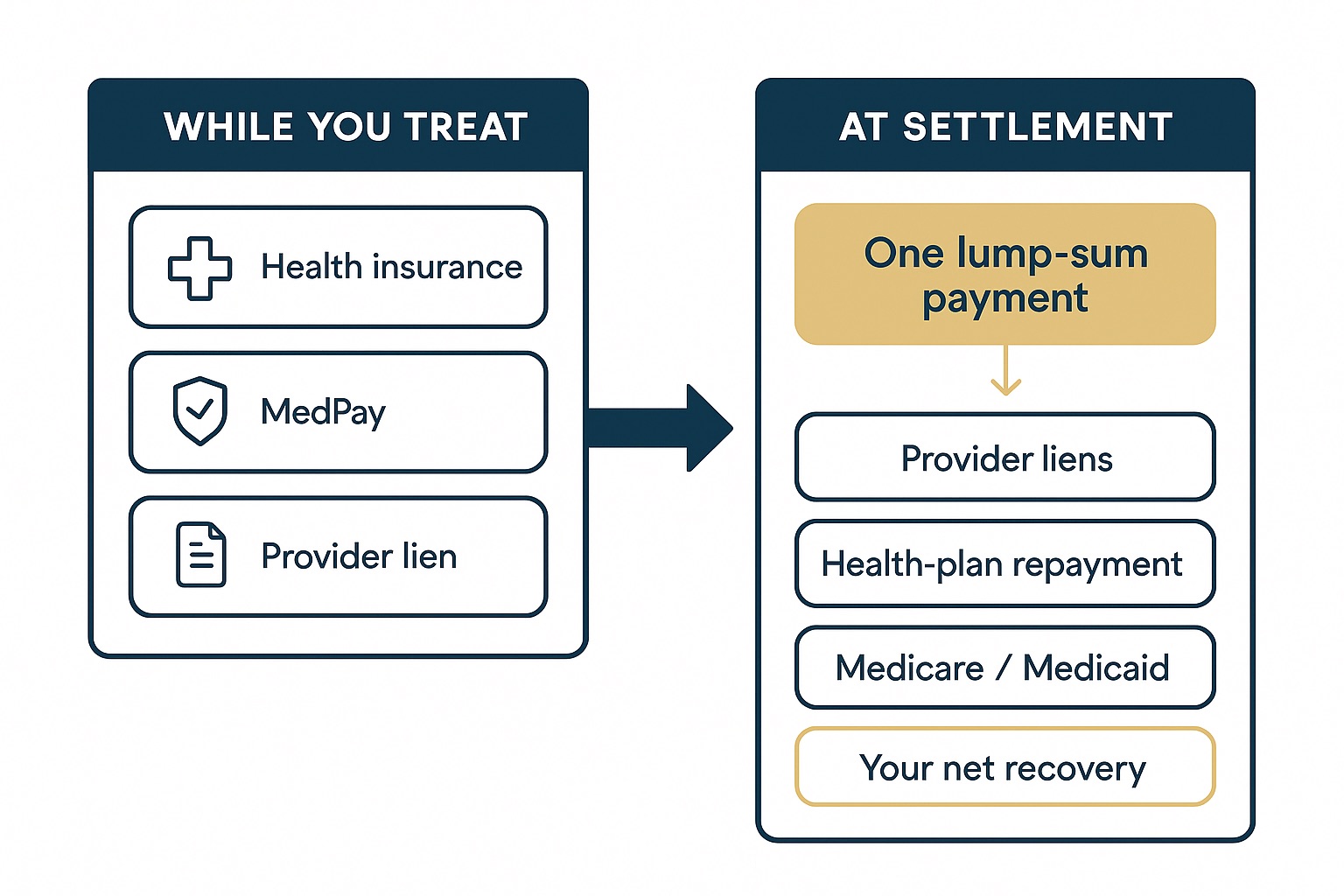
Stage 1, while you are treating. Bills arrive from the ambulance, the ER, imaging, follow-up visits, and physical therapy. These get paid, or held, by:
- Your health insurance, which pays its share as bills come in.
- Your MedPay, which can cover deductibles, copays, and bills health insurance does not.
- In some cases, the provider itself, which treats you and places a lien against your future recovery instead of being paid up front (see the hospital lien section below).
Stage 2, at settlement or judgment. The at-fault liability insurer (or your UM/UIM coverage) pays a single amount for all of your damages. Out of that recovery, several parties may be entitled to be repaid before you keep the rest:
- Perfected hospital and provider liens.
- Your health plan's subrogation or reimbursement claim.
- Government payers like MO HealthNet (Medicaid) or Medicare, if they paid accident-related care.
Sorting out that repayment, and reducing it where the law allows, is a large part of what turns a gross settlement number into money that reaches you.
Missouri hospital and provider liens
Missouri lets hospitals and certain other providers place a lien on your injury recovery when they treat you and are not paid up front. The main statute is RSMo 430.225 and the related sections in that chapter.
In general terms, the statute identifies which providers can assert a lien, sets out how the lien is perfected, limits how much of your net recovery all provider liens can take as a group, and sets priority among competing claims.
A properly perfected provider lien has to be dealt with out of your settlement, and there are legal limits on how large a bite those liens can take. We review every asserted lien to confirm it is valid, correctly perfected, and not overstated.
Health-plan subrogation and the Missouri made-whole doctrine
When your health insurer pays accident-related bills, it usually claims a right to be reimbursed out of your later recovery. That right is called subrogation or reimbursement. It is common and, up to a point, legitimate. The insurer paid your bills, and it wants that money back when the at-fault side pays.
Missouri recognizes a made-whole doctrine, which, generally stated, means an insurer should not recover its subrogation claim ahead of the injured person until that person has been fully compensated for the loss. That doctrine can reduce or defeat a subrogation claim when your recovery is not enough to make you whole, which happens often when the at-fault driver carries only minimum limits.
There is an important exception. Many employer health plans are governed by a federal law called ERISA, and a self-funded ERISA plan can write its plan language to override state protections like the made-whole doctrine. Whether your plan can do that depends on how the plan is funded and exactly what its language says, which is why we ask for your plan documents early.
Disputes over subrogation and reimbursement are, at bottom, disputes with insurers over what they are owed. When an insurer refuses to pay or behaves unreasonably about a claim, Missouri also has remedies against insurer misconduct, which we cover on our Missouri bad-faith and vexatious-refusal page.
Medicaid (MO HealthNet) and Medicare
Government health programs have their own recovery rules, and they are stronger than a private plan's.
If MO HealthNet (Missouri Medicaid) paid for your accident-related care, it can assert a lien and a right of recovery against your settlement under RSMo 208.215.
The statute sets out how MO HealthNet's lien attaches and how the recoverable amount is determined.
If Medicare paid for accident-related care, federal law treats Medicare as a secondary payer. That means Medicare's payments are treated as "conditional" and it is entitled to be reimbursed out of a related settlement. This is a federal framework administered by the Centers for Medicare & Medicaid Services, and you can read the agency's own explanation of coordination of benefits and recovery on Medicare's site.
Getting Medicare and Medicaid repayment right matters. These claims cannot be ignored, but they can often be reduced, and resolving them properly protects both your recovery and your future benefits.
Why using your own coverage does not "let the other driver off the hook"
People worry that if their health insurance or MedPay pays the bills, the at-fault driver avoids responsibility. That is not how it works in Missouri. The medical expenses you incurred remain part of your damages claim against the at-fault driver, even if a health plan or MedPay advanced the money first. The repayment process at settlement is how those advances get squared up. Using your coverage keeps you out of collections and keeps your treatment on track; it does not reduce what the at-fault side owes.
Missouri also uses pure comparative fault, meaning your recovery can be reduced by your percentage of fault but is not barred even if you were partly at fault. This principle comes from Missouri case law, Gustafson v. Benda, not from a single statute. It affects the size of the recovery the bills are eventually repaid from.
How long you have to bring a Missouri injury claim
In Missouri, the deadline to file most personal-injury lawsuits is 5 years from the date of the accident, under RSMo 516.120. That is longer than in many states, but it is not a reason to wait. Evidence goes stale, memories fade, and lien and subrogation issues are easier to manage when they are addressed early. Some claims have shorter or different deadlines, so check the deadline for your claim early.
Video: handling medical debt and liens at settlement
The medical bills and liens described above have to be sorted out before you receive settlement money. This short video from our channel explains how outstanding medical debt and liens are handled and negotiated at the end of a case, so you can see how the repayment stage plays out.
More client-education videos are on our YouTube channel.
Frequently asked questions
Does the at-fault driver's insurance pay my medical bills as I go?
No. In Missouri, the at-fault driver's liability insurer generally does not pay your providers as bills arrive. It typically pays one lump sum at settlement or after a verdict that covers your medical expenses, lost wages, and other damages together. That is why most people use their own health insurance and MedPay while they treat.
Do I have to use my own health insurance after a car accident in Missouri?
You are not required to, but it is usually the smartest move. Because Missouri has no PIP and the at-fault insurer pays only at the end, using your health insurance keeps bills current and keeps your account out of collections. Your health plan will typically seek reimbursement from your settlement later, and the medical expenses remain part of your claim against the at-fault driver.
What is MedPay and do I have it?
MedPay is optional medical payments coverage on your own auto policy in Missouri. If you bought it, it pays reasonable accident-related medical bills up to its limit regardless of fault, and it covers you and often your passengers. Check your policy declarations page to see whether you have it and how much.
Can a hospital put a lien on my car accident settlement in Missouri?
Yes. Under Missouri's hospital and provider lien statute, RSMo 430.225, hospitals and certain providers can place a lien on your recovery when they treat you and are not paid up front. The statute limits how much of your net recovery all provider liens can take and sets priority among competing claims. Perfected liens have to be resolved out of your settlement.
Does my health insurer get paid back out of my settlement?
Often, yes, through subrogation or reimbursement. Missouri's made-whole doctrine can reduce or defeat that claim when your recovery does not fully compensate you, but a self-funded ERISA plan may be able to override the made-whole doctrine through its plan language. Whether that applies depends on your specific plan documents.
What happens if Medicare or Medicaid paid my bills?
If MO HealthNet (Medicaid) or Medicare paid for accident-related care, each has a right to be repaid out of your settlement, MO HealthNet under RSMo 208.215 and Medicare under the federal secondary-payer rules administered by CMS. These claims cannot be ignored, but they can often be reduced.
Talk to a Liberty, Missouri injury attorney
If you were injured in a crash in Clay County or the north Kansas City area and the medical bills are stacking up, you do not have to figure out the order of payment and repayment on your own. Empower Injury Law can review your coverage, manage the liens and subrogation claims, and work to keep as much of any recovery in your hands as the law allows. Our Liberty office offers a free consultation. Call 816-367-6937 to talk through your situation. There is no obligation, and no pressure.
To understand the broader claim these bills are part of, see our Liberty car accident page.
*This article provides general information about Missouri law and does not create an attorney-client relationship or constitute legal advice. Outcomes depend on the facts of each case.*
Author Bio

Kevin A. Jones | Personal Injury Lawyer
Kevin A. Jones, founder and managing attorney of Empower Injury Law, has been practicing law since 2009. With over $25 million in jury verdicts and settlements in his first decade, Kevin has earned a reputation as a fierce advocate for his clients.
Kevin’s approach to law is rooted in his passion for helping people who have been mistreated by corporations, insurance companies, and other powerful entities.
Whether representing individuals wronged by negligent drivers or those injured on someone else’s property, Kevin is dedicated to achieving justice. His extensive experience in the courtroom ensures that clients receive strong, personalized representation that delivers results.
Practice Areas


