PIP Survivor and Funeral Benefits After a Fatal Kansas Crash
If your spouse or a family member died in a car crash in Lawrence or anywhere in Kansas, their own auto insurance may owe your family money right now, before anyone sorts out who caused the crash. Kansas is a no-fault state, so every Kansas auto policy carries personal injury protection, known as PIP. When the insured person dies, PIP pays a funeral or burial benefit of up to $2,000 and a survivors' benefit of at least $900 a month for up to a year. You claim these from the deceased's own insurer, regardless of who was at fault. This is separate from, and comes before, any wrongful-death claim against the driver who caused the crash.
We handle these claims out of our Lawrence office, serving Douglas County and the surrounding communities including Eudora, Baldwin City, and Tonganoxie. Below is what PIP survivor and funeral benefits cover in Kansas, how to claim them, and how they fit alongside a wrongful-death case.
What PIP pays a Kansas family after a death
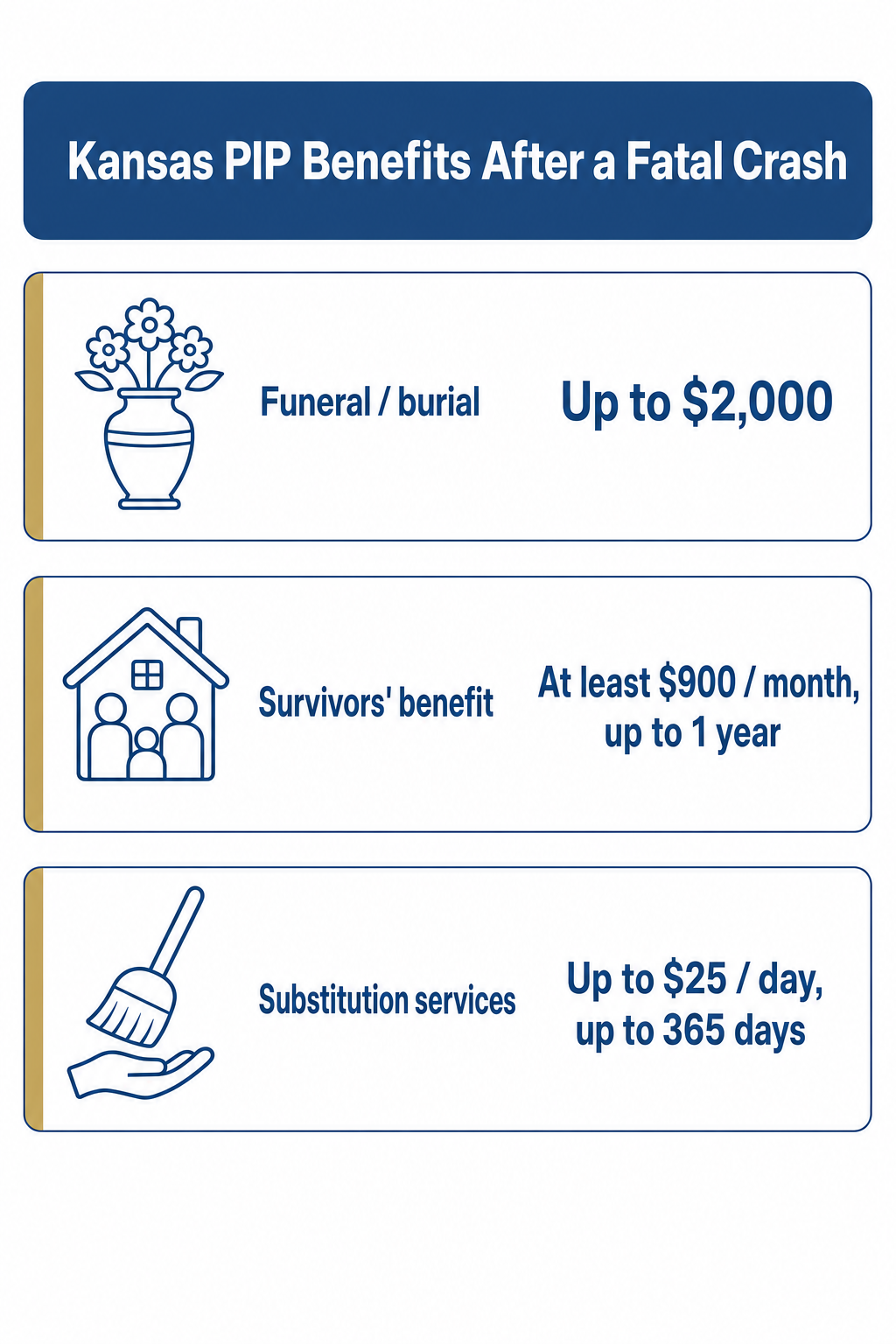
PIP is first-party coverage. That means it is paid by the injured or deceased person's own auto insurer, not the at-fault driver's insurer, and it is paid without regard to fault. Kansas law sets the minimum benefits every PIP policy must include under K.S.A. 40-3103. After a death, two of those benefits matter most to a surviving family.
The funeral and burial benefit pays the reasonable costs of a funeral, burial, or cremation, up to $2,000 per person. The survivors' benefit replaces the income and household contributions the family lost, paid at a minimum of $900 a month for up to one year after the death. Many policies carry higher limits than these minimums, so the actual figures depend on the policy the deceased bought.
PIP also includes a substitution benefit, up to $25 a day for up to 365 days, for the everyday tasks the deceased would have handled, such as childcare or home upkeep. These benefits can run at the same time, and a family dealing with a sudden loss often needs more than one of them.
Who can claim the survivors' benefit
The survivors' benefit goes to the family members who depended on the person who died. A surviving spouse and dependent children are the usual claimants. It is paid monthly rather than as a lump sum because it stands in for ongoing support, the earnings and the daily work the family counted on, not a one-time expense.
How to claim PIP after a fatal crash
Start by finding the deceased person's auto insurance policy and notifying that insurer of the death. The funeral and survivors' benefits come from that policy, so the first step is identifying the right insurer and opening the claim. Keep the funeral home invoice and any burial or cremation receipts, because the funeral benefit reimburses documented costs up to the limit.
If the person who died did not own a policy, PIP may still be available through another policy in the household, such as a resident relative's auto coverage. Which policy responds depends on the household's coverage and the facts of the crash, so bring every auto policy in the home when you sit down with us.
Kansas law backs up the timeliness of these payments. Under K.S.A. 40-3111, if a PIP insurer unreasonably delays or refuses benefits it owes, a court can award interest on the overdue amount and the attorney fees spent recovering it. That provision exists so a grieving family is not left waiting on money the policy clearly owes.
PIP survivor benefits vs. a Kansas wrongful-death claim
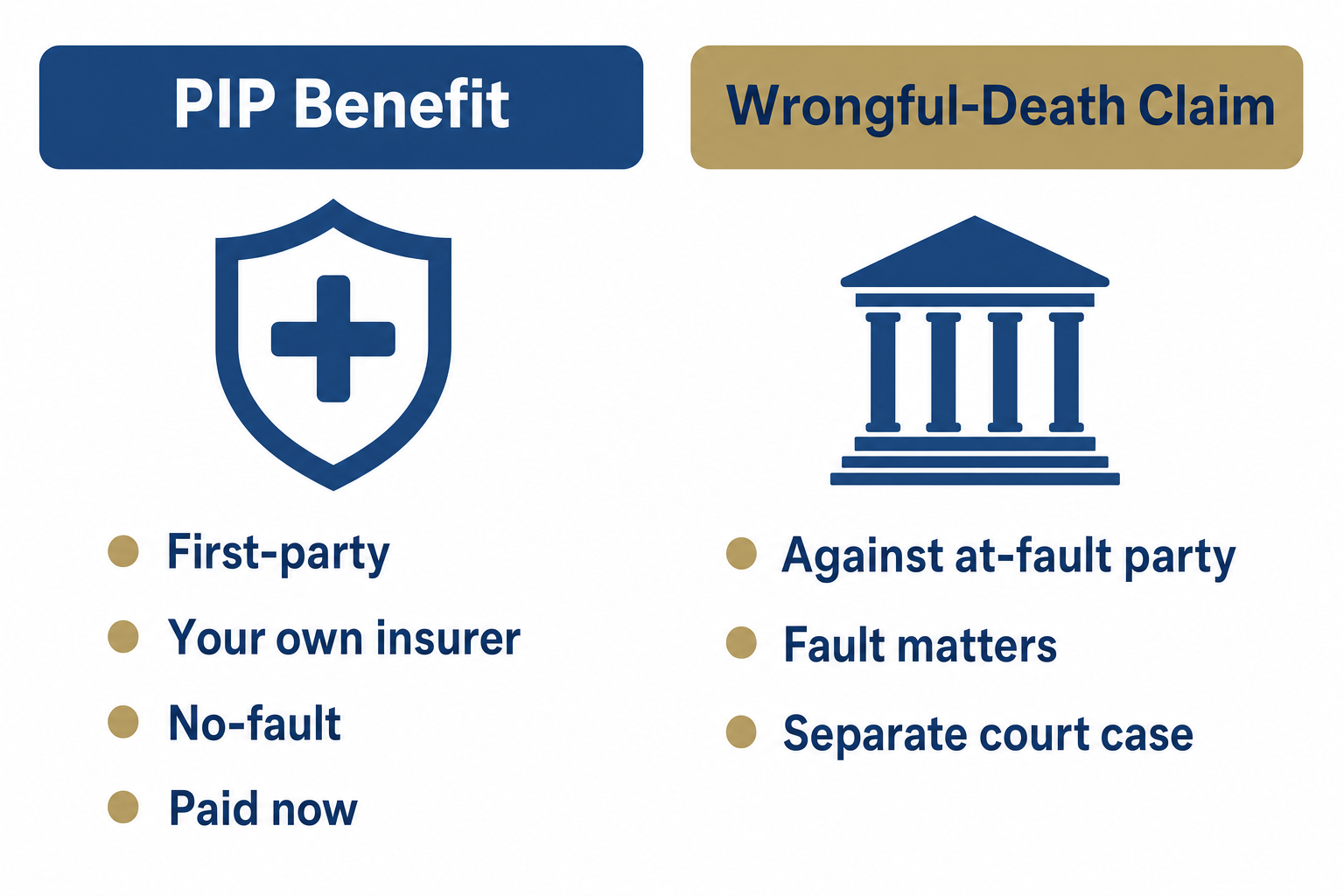
PIP survivor and funeral benefits are not a wrongful-death claim, and the two should not be confused. PIP is first-party and immediate: it comes from the deceased's own insurer, it pays without proving anyone was at fault, and you can pursue it right away. A wrongful-death claim is different. It is brought against the driver or party who caused the crash, fault is central to it, and it is a separate court action with its own damages and its own deadline.
Because they are separate, you are not choosing one or the other. A family can collect PIP survivor and funeral benefits from the deceased's insurer and still pursue a wrongful-death claim against the at-fault driver.
The wrongful-death claim also reaches losses PIP does not. Kansas caps nonpecuniary wrongful-death damages, things like the loss of a family member's companionship and the survivors' mental anguish, at $250,000 in the aggregate under K.S.A. 60-1903. Pecuniary losses, such as lost financial support, are not capped. Funeral and medical care expenses fall outside that cap entirely under K.S.A. 60-1904. Our Kansas wrongful-death page covers who can bring that claim and how the damages work.
Fault also matters to the wrongful-death side in a way it never does to PIP. Kansas follows a modified comparative-fault rule: a claim is barred if the person who died was 50 percent or more at fault for the crash, and any recovery is reduced by their share below that line. We explain that in detail on our Kansas comparative-fault page. PIP is unaffected by any of this, because it is no-fault.
Will collecting PIP reduce a later recovery
Kansas does not let a family collect twice for the same loss. PIP pays first. If you later recover from the at-fault driver for a loss PIP already covered, the PIP insurer has an anti-duplication right in that recovery for the benefits that overlap, under K.S.A. 40-3113a. In practice this means the PIP benefits are not lost, and they are not double-counted either. Collecting PIP now does not reduce what your family is owed overall, and it gets needed money to you far sooner than a wrongful-death case resolves.
If the at-fault driver had no insurance or too little, your family may also have a claim under the deceased's uninsured or underinsured motorist coverage. See our Kansas UM and UIM coverage page for how that coverage works alongside PIP.
Deadlines
PIP benefits are claimed from the insurer, so the policy's own terms and notice requirements govern how quickly you must act, and prompt notice to the insurer is always the safer course. A wrongful-death claim has a firm legal deadline: in Kansas it generally must be filed within two years of the date of death. Our Kansas statute-of-limitations page lays out that deadline and the narrow exceptions to it. Missing the wrongful-death deadline does not affect your right to PIP, but the two are easy to lose track of at once, which is reason enough to talk with someone early.
Talk with our Lawrence office
Losing a family member in a crash is hard enough without decoding an insurance policy. If you are a surviving spouse or dependent in Lawrence, Douglas County, or the surrounding area, we can review the deceased's policy, identify the PIP benefits owed, and open the claim while handling any wrongful-death case alongside it. Call our Lawrence office at 785-367-6937 for a free, no-pressure consultation, or contact us here.
For short explainers on Kansas auto-insurance questions, you can also visit our video library.
This article is general information about Kansas law, not legal advice, and reading it does not create an attorney-client relationship. Every claim turns on its own facts and the specific policy involved.
Frequently asked questions
What is the PIP funeral benefit in Kansas?
Kansas PIP pays the reasonable cost of a funeral, burial, or cremation up to $2,000 per person, under K.S.A. 40-3103. It comes from the deceased person's own auto insurer and is paid regardless of who caused the crash. Keep the funeral home invoice, because the benefit reimburses documented costs up to the limit.
How much is the Kansas PIP survivors' benefit?
The survivors' benefit is at least $900 a month for up to one year after the death. It replaces the income and household contributions the family lost. Some policies carry higher limits than this minimum, so the exact amount depends on the policy the deceased bought.
Who gets PIP survivor benefits in Kansas?
The survivors' benefit goes to the family members who depended on the person who died, typically a surviving spouse and dependent children. Because it stands in for what that person contributed to the household, it is paid monthly rather than as a lump sum.
Is PIP the same as a wrongful-death claim in Kansas?
No. PIP survivor and funeral benefits are first-party benefits from the deceased's own insurer, paid without proving fault and available right away. A wrongful-death claim is a separate action against the at-fault driver where fault matters. A family can pursue both.
Does collecting PIP reduce a wrongful-death recovery?
Kansas does not allow a double recovery for the same loss. PIP pays first, and if you later recover from the at-fault driver for a loss PIP already covered, the PIP insurer has an anti-duplication right in that recovery under K.S.A. 40-3113a. The benefits are not lost and not counted twice.
How long do I have to act after a fatal crash in Kansas?
PIP is claimed from the insurer under the policy's notice terms, so notify the insurer promptly. A Kansas wrongful-death claim generally must be filed within two years of the date of death. The two run separately, so it helps to track both early.
Author Bio

Kevin A. Jones | Personal Injury Lawyer
Kevin A. Jones, founder and managing attorney of Empower Injury Law, has been practicing law since 2009. With over $25 million in jury verdicts and settlements in his first decade, Kevin has earned a reputation as a fierce advocate for his clients.
Kevin’s approach to law is rooted in his passion for helping people who have been mistreated by corporations, insurance companies, and other powerful entities.
Whether representing individuals wronged by negligent drivers or those injured on someone else’s property, Kevin is dedicated to achieving justice. His extensive experience in the courtroom ensures that clients receive strong, personalized representation that delivers results.
Practice Areas


