Who Is at Fault in a Winter or Ice-Road Car Crash in Lawrence, KS?
Ice on the road does not decide who is at fault. If another driver slid into you on a slick stretch of K-10 or at 23rd and Iowa, the weather alone does not clear them, and it does not leave you without a claim. Under Kansas law, every driver has a duty to drive reasonably for the conditions in front of them. When someone ignores that duty and causes a crash, the ice is part of the story, not the answer to it.
Does ice automatically excuse the other driver?
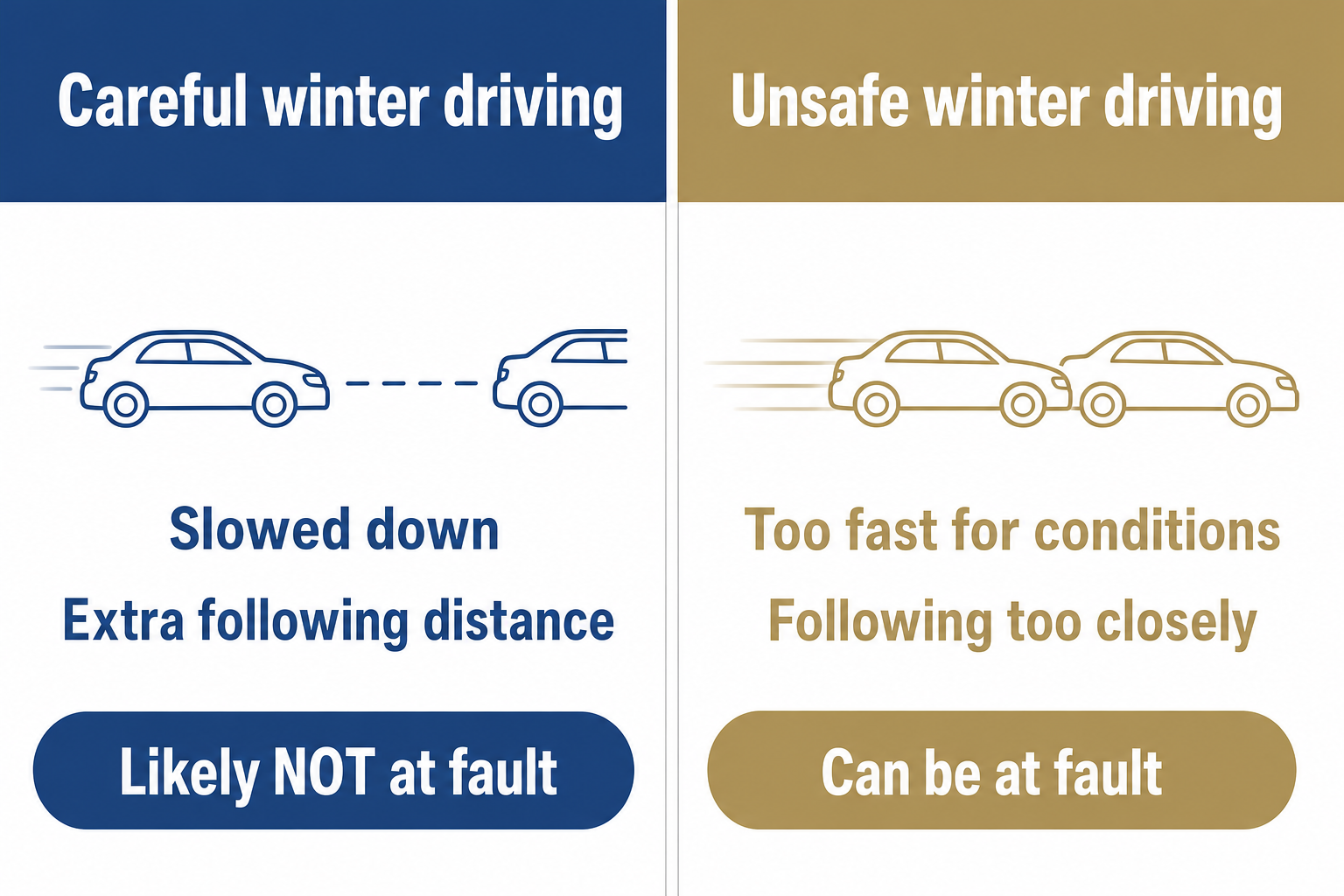
No. A common worry after a winter crash is that "the roads were bad, so it was nobody's fault." Kansas does not work that way.
Kansas drivers have a duty to use reasonable care for the conditions they are actually driving in. When the road is icy, reasonable care means slowing down, leaving more room behind the car ahead, and adjusting to what any careful driver would see. Kansas even puts the speed rule in plain terms: no one may drive faster than is reasonable and prudent under the conditions and the hazards then existing (K.S.A. 8-1557). That is why a driver can be at fault for driving too fast for conditions, or following too closely, even when they were at or under the posted speed limit. The posted limit is a ceiling for good conditions, not a safe speed on ice.
No one has a duty to control the weather. A driver who was genuinely careful and still lost traction on a patch of black ice may not be negligent at all. The question is always what a reasonable driver would have done in those conditions, not whether ice was present.
Common ways a driver is at fault on ice
- Driving too fast for a snow-packed or icy road, even under the posted limit
- Following too closely to stop safely on a slick surface
- Braking or turning abruptly in conditions that called for caution
- Failing to clear ice or snow from windows before driving
- Driving on bald or badly worn tires in winter weather
Bridges and overpasses matter here. The deck of a bridge ices before the roadway around it, which is a known winter hazard on the South Lawrence Trafficway and on the river and creek crossings out toward Eudora, Baldwin City, and Tonganoxie. A driver who takes a bridge at highway speed in freezing conditions, then cannot stop, is not excused by the ice. That hazard is the exact thing reasonable care is supposed to account for.
How Kansas comparative fault affects your recovery
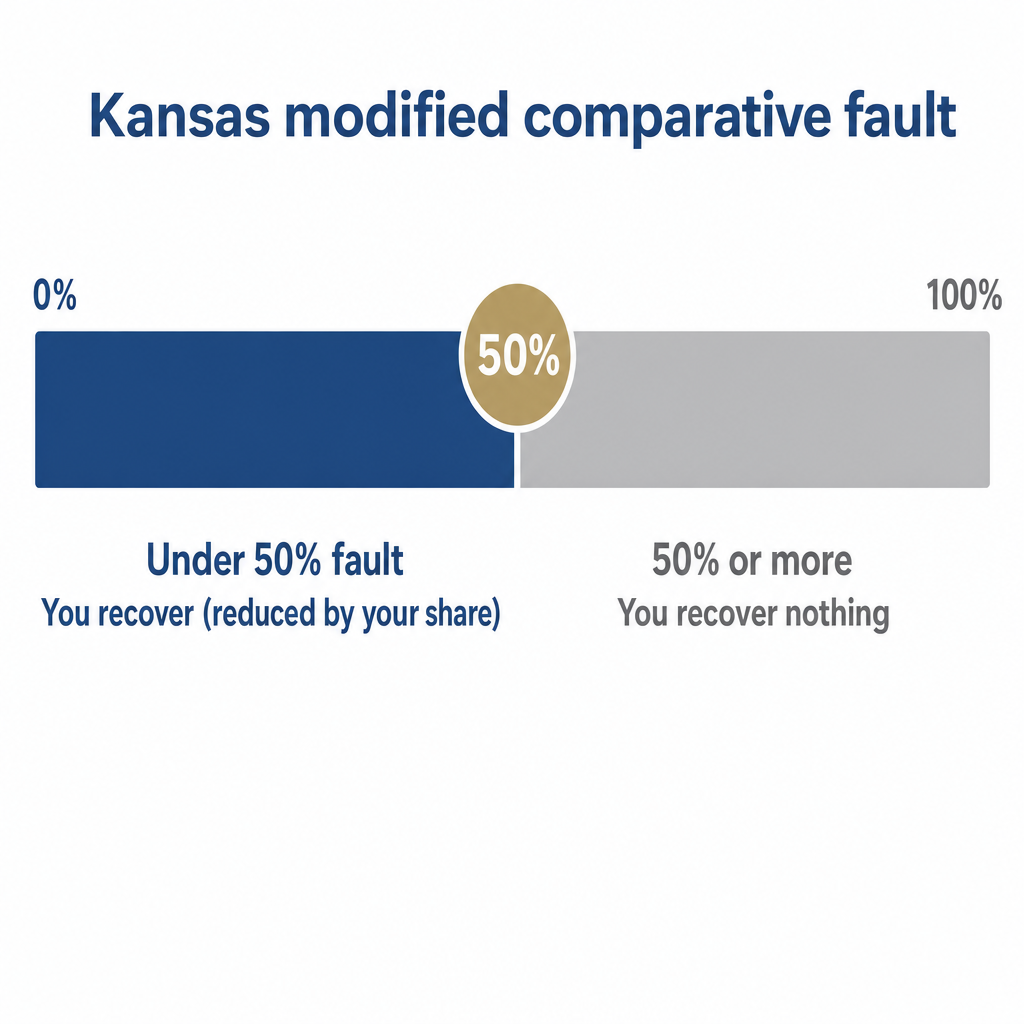
Winter crashes often involve shared blame. The other driver may have been going too fast, and the insurer may argue you could have done something differently. Kansas handles that with modified comparative fault.
Under K.S.A. 60-258a, you can recover only if your share of the fault is less than 50 percent. At 50 percent or more you recover nothing, and an exact 50/50 split is barred. If you are under 50 percent, your recovery is reduced by your own percentage. Someone found 20 percent at fault, for example, collects 80 percent of their damages.
Your share is measured against the total combined fault on the whole claim, not against each driver one at a time. In a crash with more than one other driver, which is common in winter pileups, the fault is divided across everyone involved. If you come in under 50 percent of that total, each defendant is responsible only for its own percentage share. Kansas does not make one defendant pay another's share. We walk through how this works in a multi-vehicle winter wreck on our page about chain-reaction and pileup fault in Kansas, and the 50 percent bar in more detail on our page about the Kansas 50 percent fault rule.
Because fault percentages drive what you recover, the evidence about how the crash happened is worth protecting early.
Who pays your medical bills first: Kansas PIP
Kansas is a no-fault state for the first layer of benefits. Your own personal injury protection coverage, or PIP, pays your medical bills and certain other losses regardless of who caused the crash (K.S.A. 40-3103). You do not have to prove the other driver was at fault before your PIP benefits apply, which matters when you are hurt and the bills start arriving. We explain the benefit amounts and how PIP works on our Kansas PIP and no-fault page.
PIP is the starting point, not the ceiling. When your injuries are serious, a claim against the at-fault driver (and in some cases your own underinsured motorist coverage) can reach losses PIP does not fully cover. Recovering pain-and-suffering damages in Kansas depends on crossing an injury threshold set by statute (K.S.A. 40-3117). Fault still matters at that stage, which is why the evidence from the scene carries weight well beyond the first set of bills.
Proving fault after a winter crash: documenting the scene
Icy-road evidence disappears fast. The ice melts, the snow is plowed, and the road looks ordinary within a day. What you gather at the scene, or shortly after, often decides the fault question later.
If you are able to do so safely:
- Photograph the road surface, the ice or snow, and both vehicles before anything is moved or cleared
- Note the time, the temperature, and whether the road had been treated or plowed
- Get names and numbers for any witnesses, including other drivers who slowed down safely in the same spot
- Keep the crash report from the Lawrence Police Department or the Kansas Highway Patrol, and note the responding agency
- Save your own vehicle data if your car records speed or braking
A short video from our office covers the first steps to take at any crash scene, and it applies here: 5 Steps to Take After Being in a Car Accident. You can find more client-education videos on our YouTube channel.
Weather records for the day can also support your account of the conditions. The National Weather Service maintains public records, and a crash report usually lists the conditions the officer observed.
The Kansas deadline to act
In Kansas, you generally have 2 years from the date of the crash to file a personal injury lawsuit (K.S.A. 60-513). Two years can feel like plenty of time, but the proof in a winter case is the part that does not wait. Road conditions, vehicle data, and witnesses' memories all fade long before the deadline does. Acting while that evidence still exists usually puts a claim on far stronger footing than waiting does.
Talk with our Lawrence office
If you were hurt in a winter or icy-road crash in Lawrence or anywhere in Douglas County, you can call our Lawrence office at 785-367-6937 for a free, no-pressure consultation. We will look at how the crash happened, how Kansas comparative fault is likely to apply, and what your options are. You can also read more about handling a local crash on our Lawrence car accident page, or about crashes on the busy corridor east of town on our K-10 accident page.
This page is general information about Kansas law, not legal advice about your specific situation, and it does not promise any particular result.
Frequently asked questions
If the other driver slid on ice, can I still make a claim?
Yes, in many cases. Ice does not automatically excuse a driver. Kansas requires drivers to use reasonable care for the conditions, which includes slowing down and leaving extra following distance on slick roads. If the other driver was going too fast for the conditions or following too closely, they can be at fault even though ice was involved.
Can a driver be at fault even if they were under the speed limit?
Yes. The posted limit is the maximum for good conditions. Kansas law requires a speed that is reasonable and prudent for the actual conditions, so a driver can be at fault for going too fast for an icy road even while under the posted limit.
What if the crash was partly my fault?
Kansas uses modified comparative fault. You can still recover if your share of the fault is less than 50 percent, and your recovery is reduced by your own percentage. At 50 percent or more, including an exact 50/50 split, you cannot recover.
Who pays my medical bills while fault is being sorted out?
Your own Kansas PIP coverage pays medical and certain other benefits first, regardless of who was at fault. A claim against the at-fault driver can address losses beyond what PIP covers.
How long do I have to file after a winter crash in Lawrence?
Generally 2 years from the date of the crash under Kansas law. Because road and weather evidence disappears quickly, it is better not to wait near the deadline to start looking into a claim.
Author Bio

Kevin A. Jones | Personal Injury Lawyer
Kevin A. Jones, founder and managing attorney of Empower Injury Law, has been practicing law since 2009. With over $25 million in jury verdicts and settlements in his first decade, Kevin has earned a reputation as a fierce advocate for his clients.
Kevin’s approach to law is rooted in his passion for helping people who have been mistreated by corporations, insurance companies, and other powerful entities.
Whether representing individuals wronged by negligent drivers or those injured on someone else’s property, Kevin is dedicated to achieving justice. His extensive experience in the courtroom ensures that clients receive strong, personalized representation that delivers results.
Practice Areas


