Multi-Vehicle Pileups and Chain-Reaction Crashes in Kansas: How Fault Is Divided
A chain-reaction crash on I-70 near the Lawrence tolls, or a fog-and-brake-lights pileup where K-10 narrows toward the South Lawrence Trafficway, leaves a predictable question once the tow trucks clear: who is responsible, and can you still recover if more than one driver played a part? In Kansas, the answer runs through the state's modified comparative fault rule. A jury assigns each driver, and sometimes you, a percentage of the fault, and those percentages decide both whether you recover and from whom. Your own injury benefits, meanwhile, start paying right away, no matter whose fault the crash turns out to be.
This is where multi-vehicle crashes differ from a simple two-car rear-end. Fault is rarely a clean line. The car that hit you may have been shoved into you by the car behind it, which was following too close, which was itself boxed in by a driver who stopped short three lanes over. Kansas law has a specific method for sorting that out.
How Kansas divides fault in a multi-car pileup
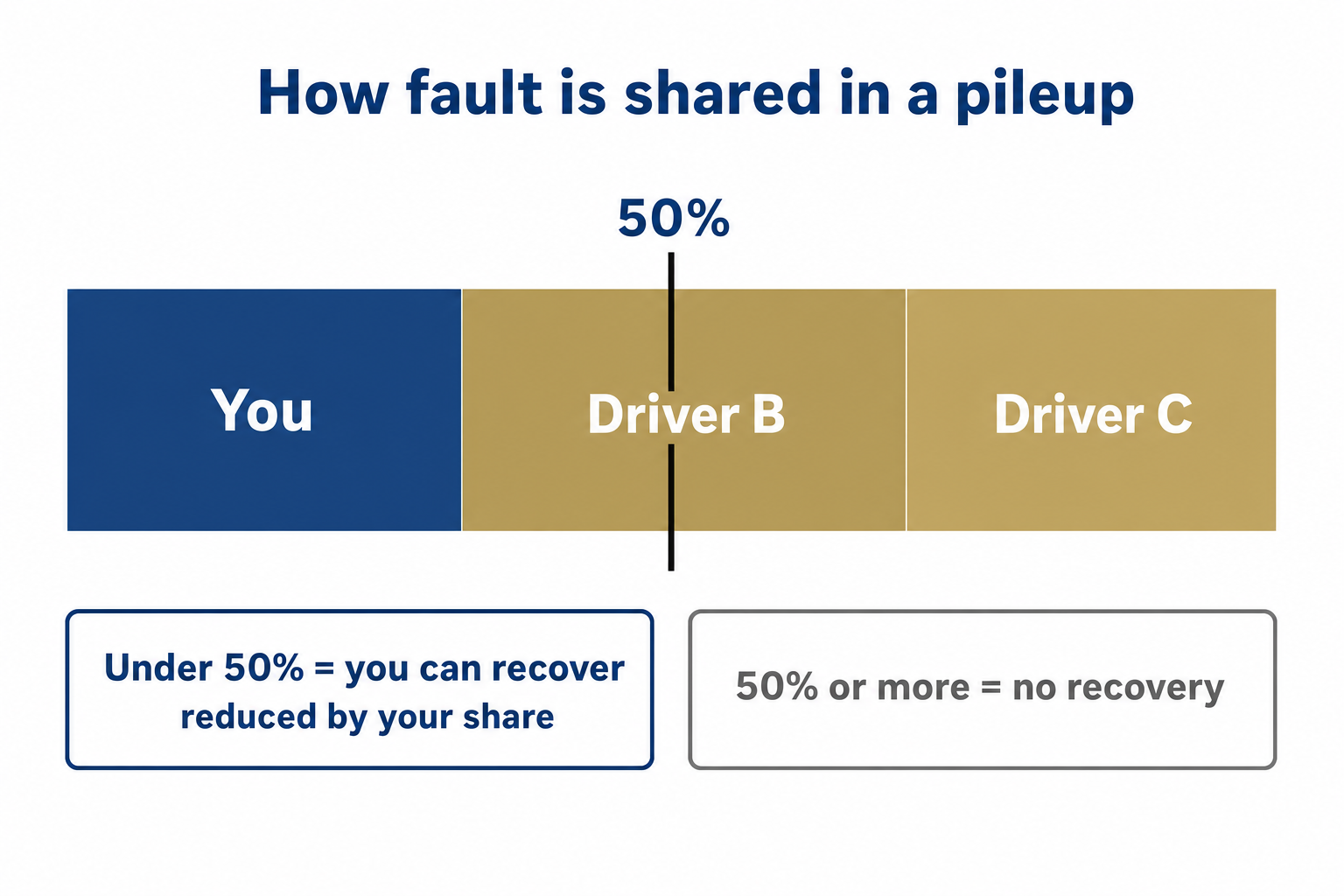
Kansas uses modified comparative fault with a 50 percent bar, set out in K.S.A. 60-258a. In a pileup, the jury looks at everyone whose conduct is in question, each driver and, if it applies, you, and assigns a percentage of the total fault to each one. Those percentages add up to 100.
Your right to recover turns on how your own share compares to the combined fault of everyone else on the claim. The comparison is against the total, not against any single driver one at a time. If your share of that combined total is 50 percent or more, you recover nothing. If your share is under 50 percent, you recover, and your award is reduced by your percentage. A driver found 20 percent at fault who is awarded $100,000 in damages collects $80,000.
The combined-total point matters most when several drivers share the blame. Suppose a jury puts you at 30 percent, one driver at 45 percent, and a third driver at 25 percent. You are under 50 percent against the combined 70 percent assigned to the two of them, so you recover, reduced by your 30 percent. The question is never whether you were more at fault than one particular driver standing alone. It is whether your slice of the whole pie reaches half.
Kansas is deliberately not the same as Missouri here. Missouri uses pure comparative fault, where a plaintiff can recover a reduced amount even at 90 percent fault. Kansas does not. Cross the 50 percent line in Kansas and recovery ends. That difference is the reason an accurate fault picture is worth getting right in a pileup, and the deeper mechanics are covered in our explainer on the Kansas 50 percent bar.
Each at-fault driver pays only its own share
Kansas does not use joint and several liability in a comparative-fault case. When you are under 50 percent and recover, each defendant is liable only for its own proportionate share of your damages, matching the percentage of fault the jury assigned to that driver. This is several liability. The driver found 45 percent at fault owes 45 percent of the damages; the driver found 25 percent at fault owes 25 percent, and no more.
The practical consequence in a pileup is that you are not collecting one lump sum from the "most at-fault" driver who then chases everyone else for contribution. You look to each at-fault driver, and each driver's own liability insurance, for that driver's share. When one of the at-fault drivers is uninsured or carries too little coverage for their share of a serious injury, that gap does not automatically shift onto the other drivers. It is instead where your own coverage can come into play, which we return to below.
Your PIP pays while fault is still being sorted out
Fault in a multi-car crash can take months to pin down. Kansas is a no-fault state for first-party benefits, so you do not have to wait. Under K.S.A. 40-3103, every Kansas auto policy includes personal injury protection (PIP), and your own PIP pays your medical and economic benefits regardless of who caused the crash.
Kansas sets minimum PIP benefits that every policy must provide:
- Medical expenses: at least $4,500 per person.
- Rehabilitation expenses: at least $4,500 per person.
- Disability and loss of income: at least $900 per month for up to one year.
- Substitution and essential services: up to $25 per day for up to 365 days.
- Funeral and burial expenses: up to $2,000.
- Survivors' benefits: at least $900 per month for up to one year.
In a pileup, each injured person's own PIP responds to that person's losses. You do not have to establish which of several drivers was negligent before your medical bills start getting paid, and you do not have to sue first. This is often the difference between getting treatment promptly and waiting out a fault dispute among four or five drivers and their insurers. How the sequence works once PIP is exhausted is laid out in our guide on who pays your medical bills after a Kansas car accident, and the broader mechanics are in our Kansas PIP and no-fault overview.
PIP does not reduce what you recover from the at-fault drivers
A common worry is that taking PIP will cut into a later recovery against the drivers who caused the crash. It does not. Under K.S.A. 40-3113a, PIP does not offset or reduce what you can recover from an at-fault driver. The one limit is that you cannot collect twice for the same loss. If your PIP carrier paid your medical bills and you later recover for those same bills from an at-fault driver, the PIP carrier is reimbursed out of that recovery for the benefits it duplicated.
So PIP gives you a first-party source that pays early, and the anti-duplication rule simply prevents a double payday for the same dollar, it does not shrink your claim against the drivers who were at fault.
Recovering pain and suffering: the tort threshold
PIP covers medical and economic losses. To recover non-economic damages (pain and suffering) from an at-fault driver, Kansas requires the injury to meet a no-fault tort threshold under K.S.A. 40-3117. We walk through how that threshold works, and what kinds of injuries typically meet it, on our Kansas PIP and no-fault page.
What happens after the crash
While fault is being sorted out, the record you create in the first days matters. A quick overview of the practical steps, from the scene through the first calls, is in this short firm video.
More videos are on our YouTube channel.
In a multi-vehicle crash specifically, two things are worth doing if you are able. Identify every vehicle involved, not just the one that struck you, because in a pileup the driver who hit you may not be the driver most at fault. And get the names and insurers of as many drivers as you can, since you may have a claim against more than one of them for their own share.
When an at-fault driver has no insurance, or too little
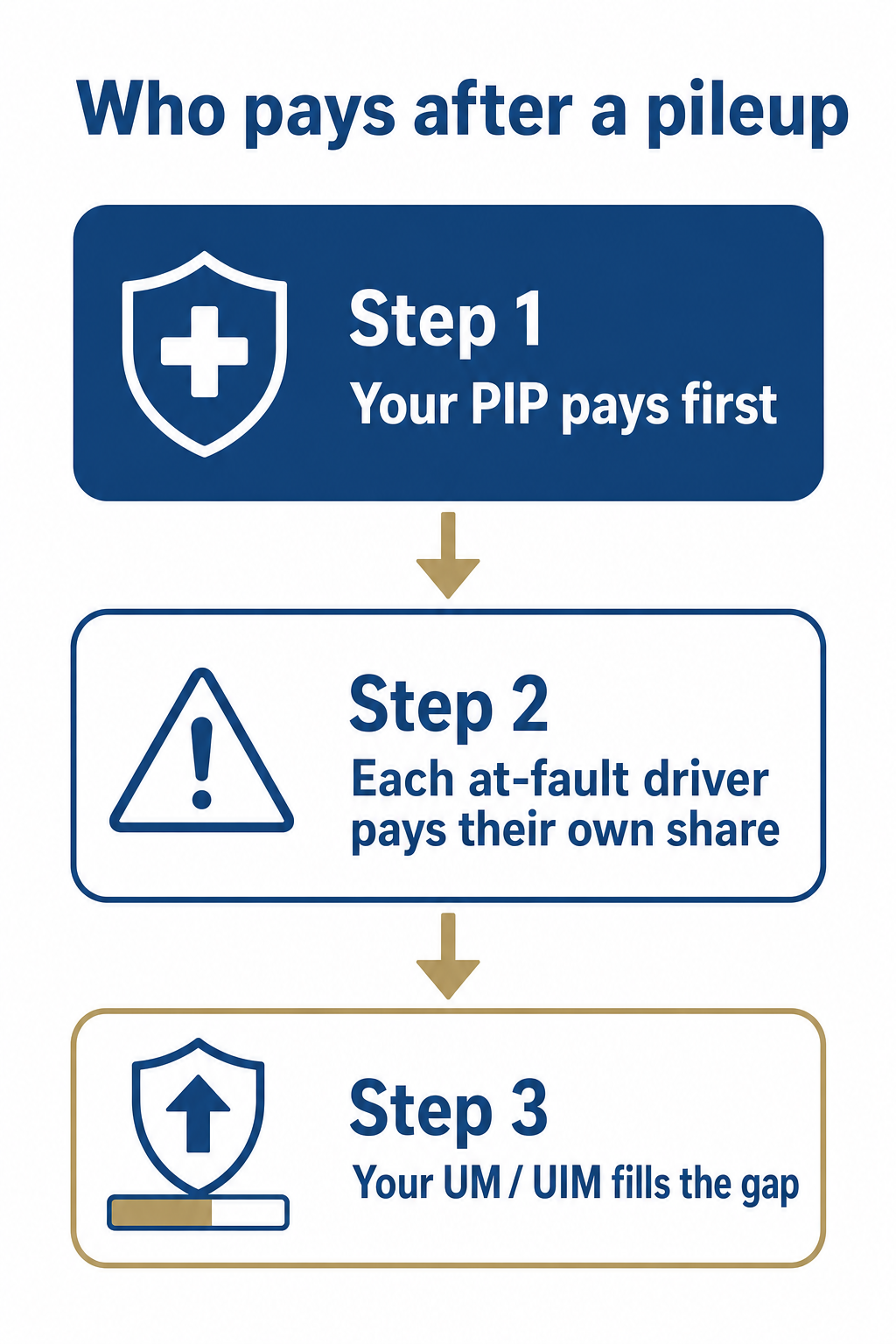
Pileups frequently include at least one driver who is uninsured or whose policy is too small to cover their share of a serious injury. Because Kansas uses several liability, that driver's shortfall does not simply transfer to the other drivers. Kansas law addresses the gap through your own coverage instead.
Uninsured and underinsured motorist coverage (UM/UIM) is mandatory in Kansas under K.S.A. 40-284. If one of the drivers who caused your crash had no insurance, or did not carry enough to cover their portion of your damages, your own UM/UIM coverage can fill that gap. How this works, and how to claim it, is covered on our Kansas UM/UIM coverage page and, for the uninsured-driver scenario specifically, on our page about being hit by an uninsured driver in Kansas.
How long you have to file
The deadline to file a personal injury lawsuit in Kansas is 2 years, under K.S.A. 60-513. That clock runs whether one driver caused your crash or six did. A multi-car case can take longer to investigate because there are more drivers, more insurers, and more competing accounts of who did what, so the sooner the facts are preserved the better. The deadline and its exceptions are explained in more depth on our Kansas statute of limitations page.
Frequently asked questions
Can I still recover if I was partly at fault in a Kansas pileup?
Yes, as long as your share of the fault is under 50 percent. Kansas compares your percentage to the combined fault of everyone else on the claim. If your share of that total is under 50 percent, you recover, reduced by your percentage. If it reaches 50 percent or more, you recover nothing. Being partly at fault, even alongside several other drivers, does not by itself end your claim.
Who pays my medical bills while fault is being sorted out?
Your own PIP coverage pays first, regardless of who caused the crash. Every Kansas auto policy includes PIP, with at least $4,500 for medical expenses and at least $4,500 for rehabilitation, among other benefits. That means your treatment does not have to wait for the drivers and insurers to agree on fault. When PIP is exhausted, other sources follow, which we cover on our Kansas medical bills page.
What if one of the drivers who hit me had no insurance?
Because Kansas uses several liability, an uninsured driver's share does not shift onto the other at-fault drivers. Instead, your own uninsured/underinsured motorist coverage, which is mandatory in Kansas, can cover that driver's portion of your damages. See our page on being hit by an uninsured driver in Kansas.
How long do I have to file after a chain-reaction crash in Kansas?
Two years from the date of the crash, under K.S.A. 60-513. The number of drivers involved does not change the deadline, but it does make early investigation more important, since a pileup involves more accounts and more insurers to untangle.
Talk to a Lawrence car accident attorney
If you were hurt in a multi-vehicle or chain-reaction crash in Douglas County or along the I-70, K-10, or US-59 corridors, we can review how Kansas fault rules apply to your situation and what your options are. The consultation is free. Call our Lawrence office at 785-367-6937, or read more on our Lawrence car accident page and our K-10 corridor page.
This page is general information about Kansas law, not legal advice about your specific case, and it does not promise any particular outcome.
Author Bio

Kevin A. Jones | Personal Injury Lawyer
Kevin A. Jones, founder and managing attorney of Empower Injury Law, has been practicing law since 2009. With over $25 million in jury verdicts and settlements in his first decade, Kevin has earned a reputation as a fierce advocate for his clients.
Kevin’s approach to law is rooted in his passion for helping people who have been mistreated by corporations, insurance companies, and other powerful entities.
Whether representing individuals wronged by negligent drivers or those injured on someone else’s property, Kevin is dedicated to achieving justice. His extensive experience in the courtroom ensures that clients receive strong, personalized representation that delivers results.
Practice Areas


